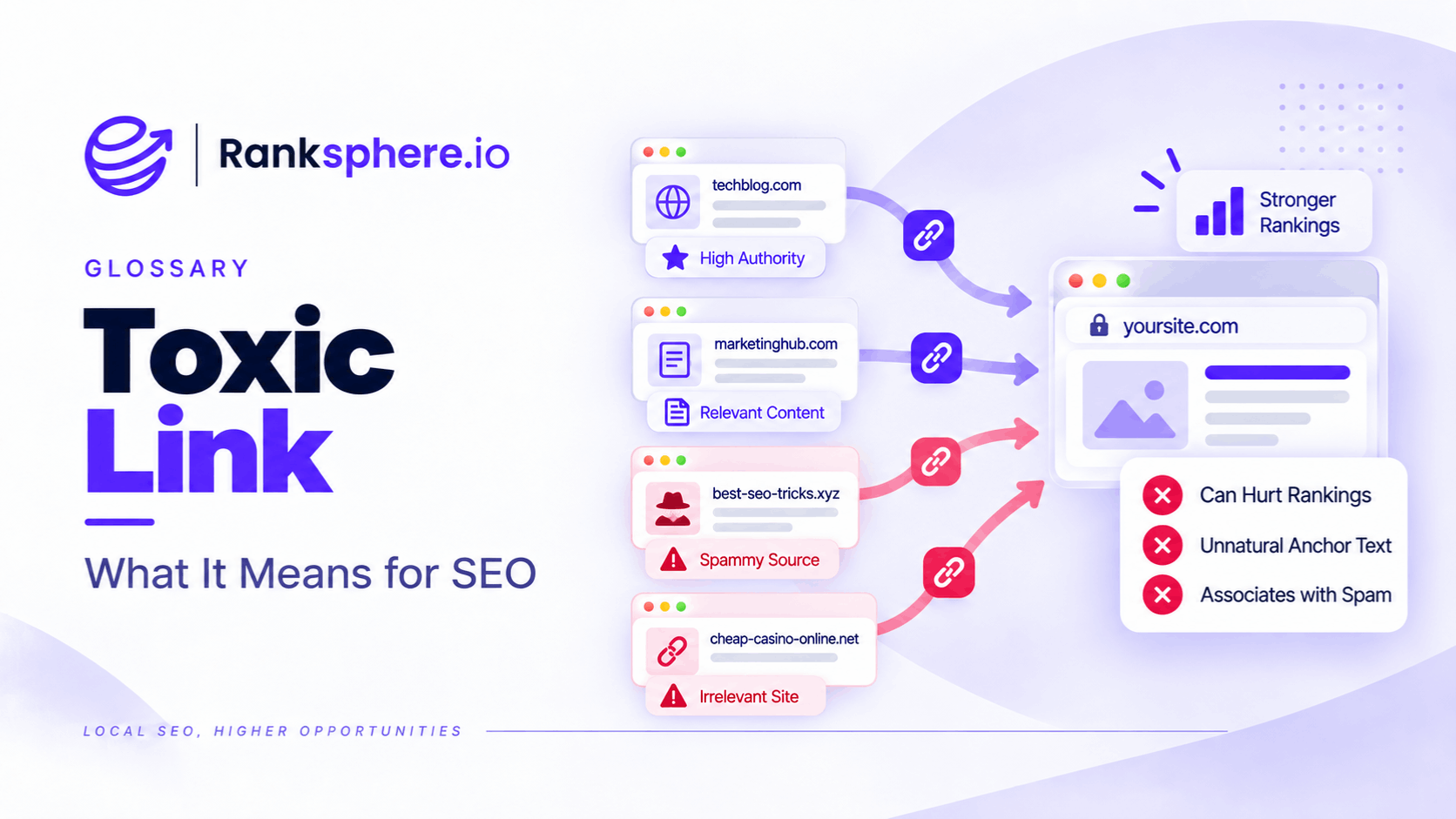
A toxic link is a backlink that a third-party SEO tool has classified as potentially risky or harmful.
The important distinction is that “toxic link” is not a Google metric or official Google link category.
Different SEO platforms use their own models to assess backlinks and may assign labels such as:
- Toxic
- Potentially toxic
- Spammy
- High risk
- Suspicious
Those labels can be useful for prioritising a backlink review.
They should not be treated as proof that Google considers the link harmful.
Google's own guidance uses different language. It refers to links that are:
- Spammy
- Artificial
- Low quality
- Manipulative
and focuses particularly on links created to influence rankings.
Google also says that, in most cases, it can determine which links to trust without site-owner intervention, which is why most websites do not need to use the Disavow Links tool.
What does “toxic link” mean?
In SEO tools, a toxic-link label normally means:
this backlink has characteristics the tool associates with risky or manipulative link building.
Those characteristics may include things such as:
- Suspicious anchor text
- Large-scale directory links
- Link-network patterns
- Unrelated websites
- Very low-quality sites
- Sitewide links
- Automated pages
- Unusual domain characteristics
Each platform has its own methodology.
A link that one tool marks as highly toxic may receive:
- A lower score
- A different warning
- No warning at all
in another platform.
That is because there is no shared industry toxicity standard.
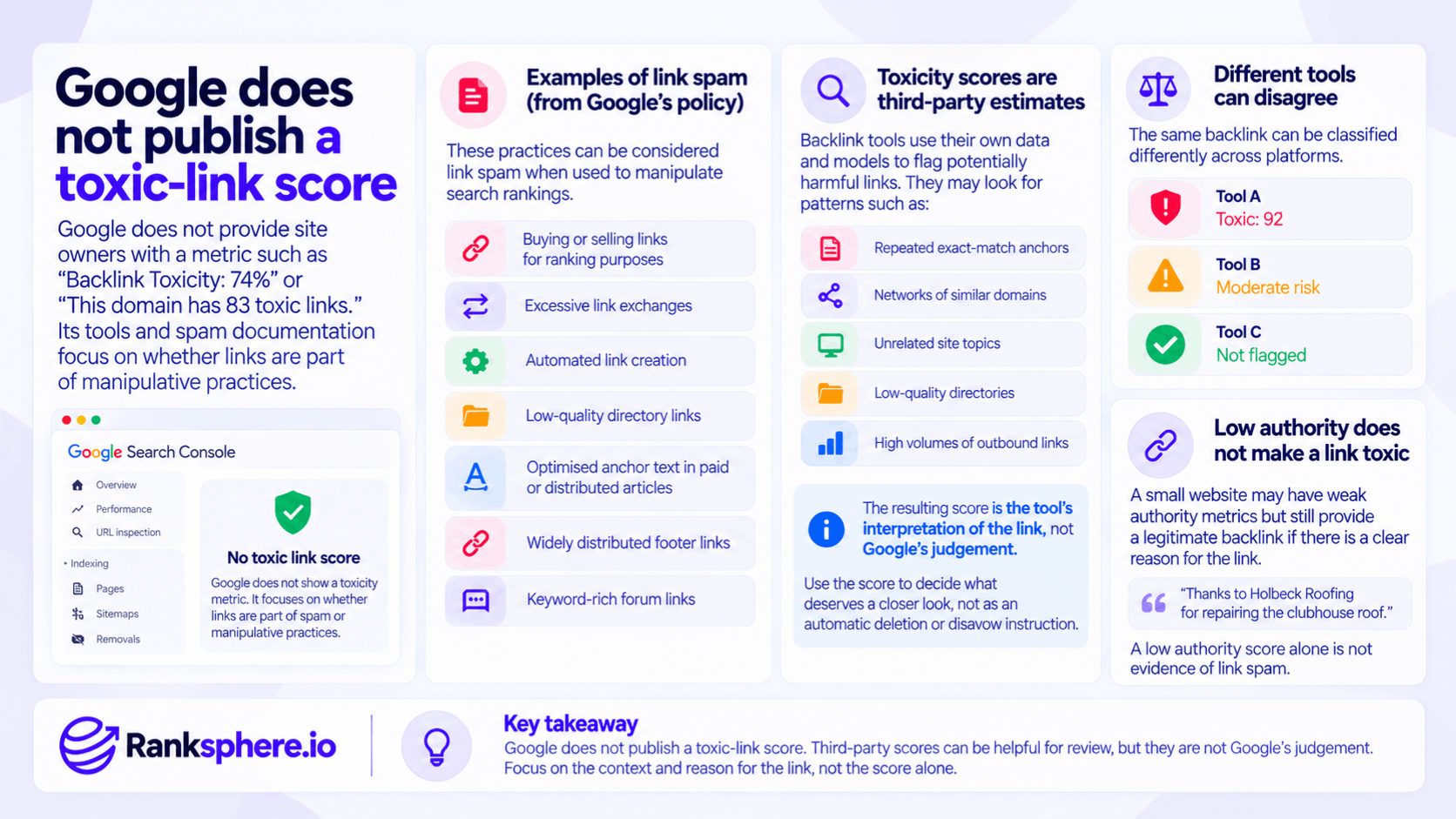
Google does not publish a toxic-link score
Google does not provide site owners with a metric saying:
Backlink Toxicity: 74%
or:
This domain has 83 toxic links.
Its Search Console tools and spam documentation focus instead on whether links are part of manipulative practices.
For example, Google's link-spam policy identifies practices such as:
- Buying or selling links for ranking purposes
- Excessive link exchanges
- Automated link creation
- Low-quality directory links
- Optimised anchor text in paid or distributed articles
- Widely distributed footer links
- Keyword-rich forum links
as examples of link spam when their purpose is to manipulate search rankings.
That is much more useful than asking:
What toxicity score does this link have?
The better question is:
Why does this link exist?
Toxicity scores are third-party estimates
Backlink-analysis platforms need a way to help users review potentially thousands or millions of links.
A scoring system is therefore understandable.
A tool might look for patterns such as:
- Repeated exact-match anchors
- Networks of similar domains
- Unrelated site topics
- Low-quality directories
- High volumes of outbound links
and use those signals to flag a backlink for inspection.
That can be helpful.
But the resulting score is still:
the tool's interpretation of the link
rather than:
Google's judgement of the link.
Use the score to decide what deserves a closer look.
Do not use it as an automatic deletion or disavow instruction.
Different backlink tools can disagree
Suppose a backlink is scored:
Toxic: 92
in one platform.
Another might classify the same site as:
Moderate risk
and a third may not flag it at all.
That does not mean one tool has access to secret Google data.
Each provider has:
- Its own crawler
- Its own backlink database
- Its own metrics
- Its own risk model
That is why toxicity scores should not be compared as though they were standardised measurements.
Low authority does not make a link toxic
A small website may have weak third-party authority metrics and still provide a perfectly legitimate backlink.
For example:
A local charity writes:
Thanks to Holbeck Roofing for repairing the clubhouse roof.
The charity's site may have:
- Few backlinks
- Low Domain Authority
- Little organic traffic
The link still has an obvious reason to exist.
It represents a real relationship.
A low authority score alone is not evidence of link spam.
Strange-looking websites are not automatically harmful
Likewise, a link from an unfamiliar website is not automatically dangerous.
Established websites naturally attract links from places they never contacted.
That can include:
- Scrapers
- Content aggregators
- Foreign-language sites
- Automated directories
- Archive websites
The web is messy.
A backlink audit should distinguish between:
links the business deliberately created
and:
links that appeared without the business doing anything.
That distinction often matters much more than the design quality of the referring site.
What Google actually says about suspicious backlinks
Google's current Disavow Links documentation says that, in most cases, its systems can assess which links to trust without additional guidance from the website owner.
That is why Google says:
most sites will not need to use the Disavow Links tool.
This should be the starting point for any toxic-link discussion.
Not:
an SEO tool found 300 suspicious domains, so we need to disavow 300 domains.
Spam backlinks can be normal
A mature website may accumulate:
- Scraper links
- Strange directories
- Broken sites
- Copied content
- Automated backlinks
without asking for any of them.
Seeing those links in a backlink tool does not automatically mean the site is under attack or at risk of a Google penalty.
The presence of spam is often simply part of being visible on the web.
Do not promise that spam links can never matter
The opposite extreme is also too absolute.
Avoid saying:
“Unsolicited links can never harm you.”
Google's own Disavow documentation is more nuanced.
It says Google works to prevent third-party actions from negatively affecting websites, but also acknowledges that incoming links can affect how it evaluates a page or site in some circumstances.
The practical interpretation is:
random spam normally does not justify intervention, but backlink history still matters when there is evidence of deliberate manipulation.
The real concern is manipulative link building
The more important risk usually comes from links that were intentionally created to influence rankings.
For example:
A business or previous SEO may have:
- Bought backlinks
- Used private blog networks
- Paid for followed guest posts
- Run excessive exchanges
- Submitted to low-quality directory networks
- Built keyword-rich links at scale
Those practices fall much closer to what Google actually defines as link spam.
Paid links
Paying for exposure is not inherently prohibited.
Businesses legitimately pay for:
- Advertising
- Sponsorship
- Partnerships
Google's concern is links that pass ranking credit as part of a paid arrangement.
Google says paid and sponsored links should be appropriately qualified, typically using:
- rel="sponsored"
- or rel="nofollow"
rather than being presented as ordinary editorial links.
A paid sponsorship link marked appropriately is a different situation from secretly buying followed links to manipulate rankings.
Excessive link exchanges
A normal partnership may involve two businesses linking to each other.
That is not automatically link spam.
The concern is an exchange programme built primarily for SEO.
For example:
“We'll link to 100 sites if all 100 link back to us.”
Google explicitly lists excessive link exchanges among examples of link spam.
Again, context matters.
Private blog networks
A private blog network, or PBN, generally involves websites created or controlled primarily to place backlinks and influence rankings.
That creates a very different risk profile from:
a random low-quality website linking to you without your knowledge.
The PBN links exist because someone deliberately built or purchased them for ranking purposes.
That historical intent is important when reviewing a backlink profile.
Paid guest posts
Guest articles are not automatically problematic.
A genuine expert can contribute useful material to another website.
The issue arises when the arrangement primarily exists to buy ranking links.
Google specifically identifies paid advertorials and distributed articles containing links that pass ranking credit, particularly those using optimised anchor text, as examples of link spam.
Keyword-rich anchor text
Anchor text can provide useful context.
But large-scale manipulative campaigns often reveal themselves through repeated commercial anchors.
For example:
emergency plumber London
appearing across dozens of unrelated paid guest posts is more concerning than one publisher naturally using those words once.
Do not create a rule such as:
“More than 10% exact-match anchor text is toxic.”
Google publishes no such percentage.
Use anchor patterns as evidence to investigate how links were acquired.
Anchor distribution is not a toxicity score
A backlink profile might contain:
- Brand anchors
- URL anchors
- Descriptive anchors
- Commercial anchors
There is no ideal distribution.
The objective is not to manipulate the percentages until the profile looks natural.
Look for patterns that can be explained by actual link-building history.
Links from unrelated websites
Topic mismatch can be a useful warning sign.
For example:
A Manchester dentist receiving links from hundreds of:
- Casino blogs
- Cryptocurrency sites
- Generic overseas blogs
may deserve investigation.
But unrelated topics are not proof of manipulation.
A dentist could legitimately appear in:
- Local news
- Charity coverage
- Business associations
even though none is a dentistry website.
Ask why the link exists.
Sitewide links
One link placed in a site template can generate thousands of backlinks.
For example:
A footer link might appear on:
2,000 pages
from one domain.
That can make the total backlink count look dramatic.
Google specifically identifies widely distributed footer or template links as potential link spam when they are used to manipulate rankings.
But a sitewide link is not automatically toxic.
Again, context and purpose matter.
Toxic links vs link spam
These terms should not be treated as synonyms.
Toxic link
A third-party SEO-tool label.
Link spam
Google's term for links or linking practices that violate its spam policies because they manipulate ranking signals.
A tool can label a link toxic even where Google has taken no action.
Likewise, a genuinely manipulative link does not need a third-party toxicity score before it becomes a problem.
Toxic link vs bad backlink
“Bad backlink” is another informal SEO phrase.
It can mean:
- Low-quality link
- Irrelevant link
- Spam link
- Paid link
- Link the SEO simply does not like
That vagueness creates confusion.
When reviewing a backlink, describe the actual concern.
For example:
Paid followed link from an unrelated guest-post network
is much more useful than:
Bad backlink: Toxicity 87.
Toxic links and negative SEO
Negative SEO generally refers to attempts by another party to damage a site's search performance.
One alleged tactic involves creating large numbers of spam backlinks to a competitor.
Site owners understandably worry when thousands of strange links suddenly appear.
But Google explicitly says most sites do not need to tell it which backlinks to distrust because its systems can assess links without additional guidance in most cases.
That does not justify ignoring every backlink problem.
It does mean:
sudden spam alone is not a reason to panic.
Investigate before calling something a negative SEO attack
Suppose a website suddenly receives:
5,000 strange backlinks.
First determine:
- Where they came from
- Whether they are repeated sitewide links
- Whether an old agency created them
- Whether content was scraped
- Whether a redirect introduced them
Do not immediately conclude:
a competitor is attacking us.
Evidence first.
When should you worry about backlinks?
Concern becomes more justified when there is evidence that:
- The business bought links
- A previous agency built manipulative links
- The site participated in link schemes
- Search Console shows an unnatural-links manual action
- A substantial manipulative backlink history exists and a manual action appears likely
That is much closer to Google's own guidance on when disavow may be appropriate.
Check Search Console first
Before acting on a toxicity score, check Search Console.
Go to:
Security & Manual Actions → Manual Actions
If Google has manually determined that unnatural backlinks violate its policies, Search Console can show:
Unnatural links to your site
Google says this manual action means it has detected a pattern of:
- Unnatural
- Artificial
- Deceptive
- Manipulative
links pointing to the site.
That is very different from a commercial tool colouring a backlink red.
No manual action does not automatically mean everything is fine
This needs nuance.
A clean Manual Actions report is useful evidence.
But it does not prove:
every historic link-building practice is acceptable.
Google also says disavow may be relevant where a considerable number of artificial links make a manual action likely, even if one has not yet appeared.
So check:
- Search Console
- Historic SEO work
- Paid-link campaigns
- Anchor patterns
- Known link schemes
together.
Ask what the business or previous agency actually built
One of the most useful backlink-audit questions is:
Have we ever paid somebody specifically to build links?
Then ask:
- Which agency?
- Which years?
- What methods?
- Which anchor text?
- Which websites?
A 2018 link campaign can explain suspicious patterns far better than a 2026 toxicity score.
Historical context matters.
Manual actions for unnatural links
If Google applies an unnatural-links manual action, it provides a documented remediation process.
Google recommends:
- Identify links that violate its spam policies.
- Try to have those links removed or appropriately qualified.
- Disavow links that cannot be removed where necessary.
- Submit a reconsideration request with information about the cleanup.
That is more involved than:
upload everything marked toxic.
What is the Disavow Links tool?
The disavow tool allows site owners to tell Google that specified backlinks should not be taken into account in the normal way.
It is an advanced tool.
Google explicitly warns that using it incorrectly can harm a site's Search performance.
That warning should be taken seriously.
When Google says to consider disavow
Google's current documentation says backlinks should normally be disavowed only when both of the following apply:
- The site has a considerable number of spammy, artificial or low-quality backlinks.
- Those links have caused a manual action or are likely to cause one.
That is much narrower than:
“Disavow everything with a toxicity score over 60.”
Do not use disavow as routine maintenance
A monthly process such as:
export toxic backlinks → add to disavow file
is not Google's recommended workflow.
Most websites do not need the tool at all.
That means routine disavow work should require a clear reason.
Not merely:
the backlink tool found more red domains this month.
Removal should normally come first in a manual-action cleanup
Where a genuine unnatural-links problem exists, Google recommends attempting to remove violating backlinks or have them changed so they no longer pass ranking credit.
The Disavow Links tool is then used for problematic links that cannot reasonably be removed.
So:
manual action → immediately disavow everything
is not the complete process.
Do not blindly disavow legitimate links
Google specifically tells site owners dealing with unnatural-link manual actions:
do not disavow organic links to the site.
That is another reason automated toxicity exports are risky.
A small legitimate website may look suspicious to a scoring model while still providing a useful real-world link.
Review the context.
Search Console backlink data is not complete
Search Console can help investigate backlink patterns.
But remember that backlink tools — including Search Console — do not necessarily show the same complete set of links.
Do not assume:
I cannot see the link in Search Console, therefore Google doesn't know about it.
Use backlink exports to understand patterns rather than trying to reconstruct Google's entire link graph perfectly.
What should you do with unsolicited spam links?
For most sites:
nothing immediately.
If you did not:
- Request them
- Pay for them
- Build them
- Participate in creating them
and there is no broader unnatural-link problem, a few or even many strange backlinks are not automatically a project.
Google says most sites can rely on its systems to assess which links deserve trust.
Keep monitoring, but do not panic
Monitoring is still useful.
If strange links appear, record:
- Source domains
- Anchor text
- Timing
- Destination pages
If a clear pattern develops that connects to manipulative activity, investigate further.
Monitoring and disavowing are not the same thing.
Should you contact spam websites asking for removal?
Usually there is little value in chasing every scraper.
If a genuine manual-action cleanup is underway, removal attempts are part of Google's recommended process.
Outside that scenario, spending hours emailing hundreds of automated spam sites may produce little benefit.
Prioritise based on actual risk.
Toxicity scores can still be useful
The term does not need to be discarded completely.
A toxicity score can help when you have:
50,000 backlinks
and need somewhere to start.
For example, it might highlight groups containing:
- Repeated exact-match anchors
- Suspicious networks
- Unusual directories
You can inspect those first.
That is a reasonable use.
Use toxicity as triage, not verdict
A useful workflow is:
Tool flags link → human reviews context → decision based on evidence
Not:
Tool flags link → automatically disavow
The difference is important.
The score tells you:
look here.
It should not automatically tell you:
remove this.
Review the surrounding page
When inspecting a suspicious backlink, open the source page.
Ask:
- Is there real editorial content?
- Why is my business mentioned?
- Is the link paid?
- Is the anchor unnaturally optimised?
- Is the page one of thousands of obviously templated placements?
The actual page often tells you more than the score.
Review the linking domain
Also inspect the wider site.
A legitimate site may have:
- Low metrics
- An old design
- Few backlinks
while still being a genuine:
- Charity
- Supplier
- Community organisation
Conversely, a polished website may exist solely to sell backlinks.
Visual quality is not enough.
Check anchor text
Repeated commercial anchors can help reveal historic link campaigns.
For example:
- best accountant Manchester
- accountant Manchester
- cheap accountant Manchester
across large numbers of unrelated guest posts may warrant investigation.
See link profile for the broader analysis.
But remember:
anchor concentration is evidence, not a standalone penalty threshold.
Check how the links were obtained
This is often the deciding factor.
A link can look suspicious while having an innocent explanation.
Another can look professionally placed while having been directly purchased for ranking purposes.
Ask:
What relationship produced this link?
That question gets closer to Google's policy framework than:
What is its toxicity percentage?
Domain authority does not determine toxicity
Do not combine third-party metrics into a formula such as:
DA under 10 + foreign TLD = toxic.
See domain authority.
A new local organisation may have very low authority metrics.
That says little about whether the link is manipulative.
Country-code domains
A foreign domain does not automatically represent spam.
An English business may receive a link from:
- International supplier
- Overseas manufacturer
- Global association
The relevant question is whether the source and relationship make sense.
Do not disavow solely because the TLD looks unfamiliar.
Scraper links
Scrapers copy content from other websites and may recreate the original links.
This can produce backlinks the business never requested.
If an article is copied to dozens of domains, you might suddenly see dozens of new backlinks.
That does not necessarily mean someone ran a link-building campaign.
Look at the source pattern.
Directory links
Directories need context.
A legitimate professional directory can be useful.
A network of thousands of low-quality directories created primarily to sell ranking links is different.
Google specifically lists low-quality directory and bookmark-site links as an example of link spam.
Do not conclude:
directory = toxic
or:
directory = good citation
without reviewing the site.
Footer links
Footer links also require context.
A normal footer link might identify:
- Parent company
- Website provider
- Legal organisation
A campaign placing keyword-rich links across hundreds of client footers is different.
Google's spam policy specifically mentions widely distributed footer or template links when used for manipulation.
Guest posts
A guest article written for a legitimate audience can be perfectly reasonable.
The problem appears when guest posting becomes:
buy article → insert followed keyword link → repeat across hundreds of unrelated sites.
Google explicitly calls out paid advertorial or guest-post links that pass ranking credit as link spam.
Again, scale and intent matter.
Link networks
Groups of websites built or controlled primarily for backlink placement deserve particular scrutiny.
Common characteristics can include:
- Similar designs
- Similar article templates
- Repeated commercial anchors
- Little genuine audience
- Unrelated topics on the same site
A third-party toxicity score may help surface the network.
But the human evidence is what makes the case.
What about competitors sending bad backlinks?
If somebody deliberately creates spam backlinks pointing at a competitor, the target website has limited control over that.
Google's own guidance acknowledges this problem indirectly by saying it works to ensure actions taken on third-party sites do not negatively affect website owners and that most sites can rely on Google to evaluate links without additional guidance.
Do not let an alarming backlink graph trigger a disavow project automatically.
Check ranking changes carefully
If rankings fall at the same time suspicious backlinks appear, that does not prove causation.
Rankings can change because of:
- Algorithm updates
- Competitors
- Technical problems
- Content changes
- Search demand
Backlink timing is one piece of evidence.
Not proof.
Do not sell fear
A backlink report showing:
427 toxic links
can sound alarming to a client.
Before recommending work, explain:
- Whose score it is
- What the score actually means
- Whether Google has issued a manual action
- Whether historic manipulative link building occurred
That creates a much more responsible conversation.
“Toxic backlinks found” is not an outcome
Likewise, reporting:
We removed 92 toxic backlinks this month
does not tell the client whether the work mattered.
Better questions include:
- Was there a manual action?
- Were known manipulative links cleaned up?
- Did we stop an ongoing paid-link programme?
- Are we now following Google's spam policies?
Those are meaningful changes.
Do not manufacture a perfect backlink profile
A real link profile can contain:
- Great links
- Weak links
- No-follow links
- Weird scraper links
The objective is not:
zero suspicious domains.
The objective is:
avoid manipulating links for ranking purposes and address genuine historical problems when they exist.
What to do instead of obsessing over toxicity
If there is no evidence of a genuine unnatural-link problem, time is usually better spent improving things you can control.
That might include:
- Useful content
- Digital PR
- Genuine partnerships
- Local link building
- Internal linking
- Technical SEO
Backlink hygiene still matters.
But it should not become permanent busywork driven by colour-coded reports.
Earn links rather than manufacture them
Useful backlinks often come from:
- Local news
- Professional associations
- Suppliers
- Community organisations
- Original research
- Useful resources
Those links exist because something worth referencing happened.
They do not need to be engineered to fit a toxicity model.
Toxic links and local businesses
Small local businesses are especially vulnerable to backlink-cleanup overdiagnosis.
A site may naturally have links from:
- Local directories
- Old community sites
- Newspapers
- Suppliers
Many will have modest third-party metrics.
That does not make them toxic.
For local SEO, real-world relevance is often much more informative than whether a backlink tool likes the design of the referring website.
Ranksphere and suspicious backlinks
Backlink analysis should help businesses understand their wider profile without turning every unusual domain into an emergency.
A useful workflow would surface:
- Suspicious patterns
- Historic manipulative anchors
- New referring domains
while leaving the final decision to proper analysis.
The objective should be:
identify genuine risk
rather than:
maximise the number of links labelled clean.
Common toxic-link mistakes
- Treating a third-party toxicity score as Google data.
- Assuming every link labelled toxic is actively harming rankings.
- Automatically disavowing every red or high-risk domain.
- Comparing toxicity scores across tools as though they use one standard.
- Calling every low-authority backlink harmful.
- Disavowing links simply because they come from an unfamiliar country or TLD.
- Treating scraper links as proof of a negative SEO attack.
- Assuming no manual action means manipulative historic links can never matter.
- Using disavow as routine monthly maintenance.
- Skipping removal attempts when dealing with an actual unnatural-links manual action.
- Ignoring paid or manipulative links the business or a previous agency deliberately built.
- Believing Google always neutralises every manipulative link automatically.
- Selling backlink cleanup solely from a tool's toxicity count.
Toxic-link best practices
- Treat toxicity scores as investigation hints, not Google verdicts.
- Check Search Console for manual actions before recommending drastic action.
- Review historic link-building activity, including work carried out by previous agencies.
- Inspect suspicious links manually before making decisions.
- Focus on why a link exists rather than one third-party metric.
- Leave ordinary unsolicited spam alone unless there is evidence of a broader problem.
- If an unnatural-links manual action exists, follow Google's documented removal, qualification, disavow and reconsideration process.
- Use the Disavow Links tool only when the situation meets Google's guidance.
- Do not disavow legitimate organic links simply because a commercial tool dislikes them.
- Stop manipulative link-building practices rather than continually cleaning up after them.
- Put ongoing effort into earning relevant links instead of chasing a perfect toxicity score.
Example
“A local accountancy firm receives a sales email from an SEO agency.
The subject line reads:
URGENT: 380 toxic backlinks detected.
The agency offers a £1,200 backlink-cleanup project.
The firm's first step is not to approve the work.
It checks Search Console.
There is no unnatural-links manual action.
Next, it reviews its history.
The firm has never purchased a backlink package or deliberately participated in a link scheme.
Its known legitimate links include:
- A professional register
- The local chamber of commerce
- A client case study
- A regional business article
The team then samples the backlinks labelled toxic.
Most turn out to be:
- Scraped copies of old articles
- Automated directories
- Aggregator pages
- Unfamiliar sites that linked without being asked
A handful look genuinely poor.
But there is no evidence that the firm created them or that they form part of a manipulative campaign.
That matches Google's current guidance: most sites do not need the Disavow Links tool because Google can usually determine which links to trust without additional instructions.
So the company does not upload a blanket disavow file purely because a tool assigned high toxicity scores.
Instead, it records the unusual domains and continues monitoring the profile.
Had the audit uncovered:
- A historic paid-link campaign
- Hundreds of artificial guest posts
- A Search Console manual action
the response would have been different.
The business would then review Google's link-spam policies, attempt to remove or appropriately qualify problematic links, disavow links that could not be resolved where necessary, and follow the documented reconsideration process.
That is the distinction that matters.
A toxic link is a third-party warning label, not a Google penalty. Use the score to decide what deserves inspection, then make decisions from the actual link history, Google's policies and the evidence — not from the colour of a dashboard.”
See also
- Disavow — when Google's advanced backlink-removal tool is appropriate
- Link profile — evaluating backlinks as a wider pattern
- Backlink — the individual external link
- Link building — where manipulative backlink risk usually originates
- Domain authority — another third-party metric that should not be confused with Google data
- Google Search Console — where unnatural-links manual actions are reported