Keyword gap analysis is the process of finding search queries that relevant competitors appear for and your site does not, then deciding which of those gaps are actually worth addressing.
The important part is the second half.
A competitor ranking for a keyword does not automatically mean:
you need a page for it.
The query might be:
- Irrelevant to your services
- Outside your market
- Informational when you need commercial demand
- Better served by an existing page
- Driven by a competitor advantage you cannot reproduce
For local businesses, keyword gap analysis also needs to go beyond website keywords.
Useful competitive gaps can exist across:
- Google Business Profile categories
- Services
- Attributes
- Reviews
- Local visibility
- Website pages
That makes local keyword gap analysis closer to a competitive visibility analysis than a simple spreadsheet of missing search terms.
What is keyword gap analysis?
A standard keyword gap analysis compares your site's search visibility with that of one or more competitors.
It asks questions such as:
- Which queries do competitors rank for that we do not?
- Which queries do we both rank for, but they perform much better?
- Which commercially relevant topics are missing from our site?
- Are we using the right page for a search intent?
- Is the apparent gap actually something we can address?
The output should be a prioritised set of opportunities.
Not a list of every keyword somebody else ranks for.
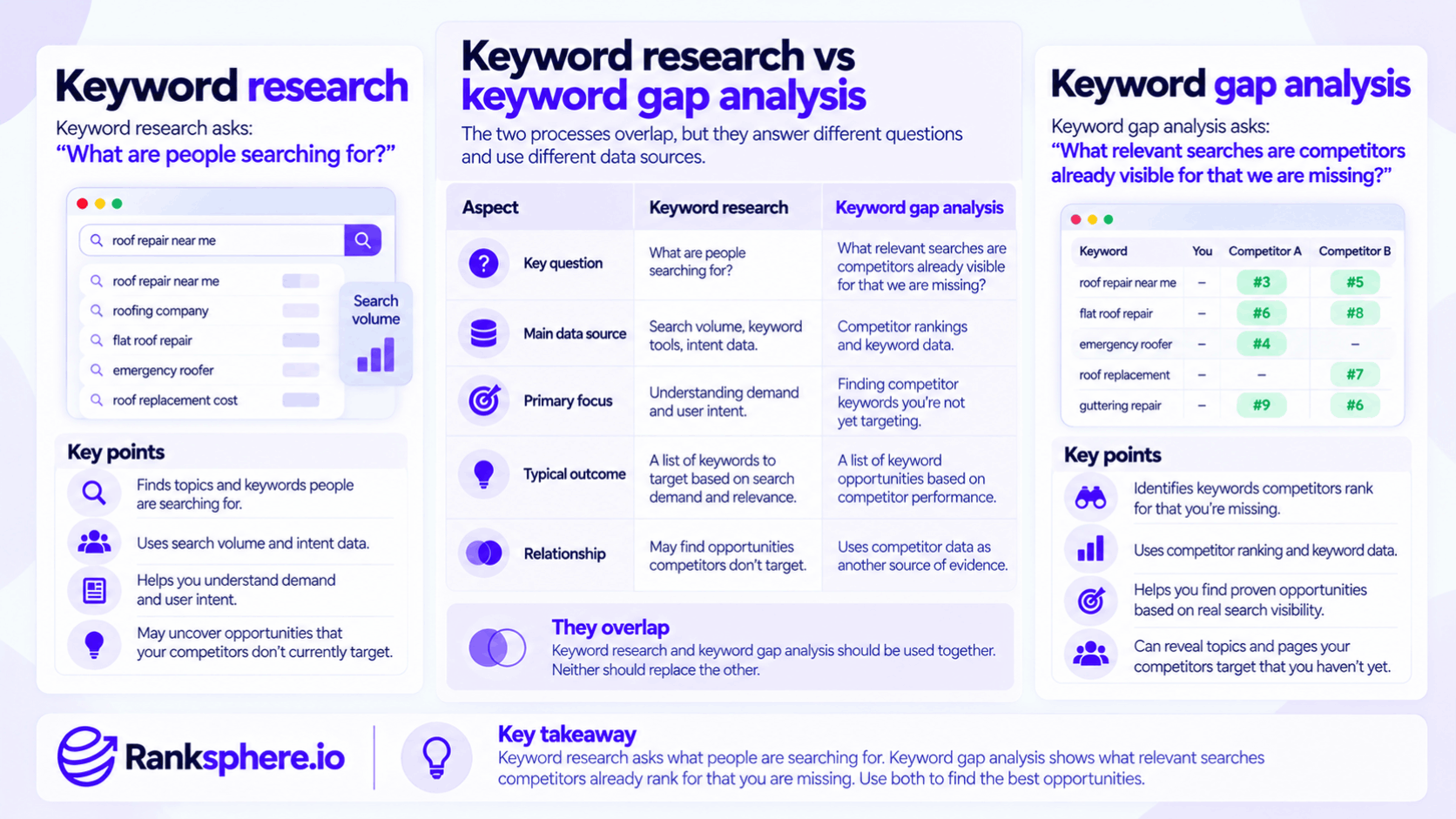
Keyword gap analysis vs keyword research
Keyword research asks:
What are people searching for?
Keyword gap analysis asks:
What relevant searches are competitors already visible for that we are missing?
The two overlap.
Keyword research may uncover demand none of your competitors currently target.
Gap analysis uses competitor performance as another source of evidence.
Neither should replace the other.
Keyword gap analysis vs content gap analysis
These terms are often used interchangeably, but there is a useful distinction.
Keyword gap
A query or group of queries where competitors have visibility and you do not.
Content gap
A user need, topic or search intent that your existing content does not adequately address.
A keyword gap can reveal a content gap.
But not every keyword gap requires new content.
Sometimes the solution is:
- Improve an existing page
- Correct a Business Profile category
- Add an accurate service
- Strengthen internal linking
- Do nothing
That is why the analysis has to happen before content production.
Start with the right competitors
The first step is not exporting keywords.
It is identifying who you actually compete with in search.
See competitor analysis for the wider process.
A business owner's commercial competitors and its search competitors are not always the same.
For example, a local vet may think its main competitor is another practice three streets away.
But the actual search results might also include:
- A larger veterinary group
- A specialist clinic
- A directory
- An informational publisher
Different queries can also produce different competitors.
There may be no single competitor set for the entire site.
Commercial competitors vs search competitors
Commercial competitor
Competes with you for customers.
Search competitor
Competes with you for visibility on a particular search result.
A national pet-care publisher may be a search competitor for:
why is my dog scratching?
but not for:
emergency vet near me.
That distinction changes the gap analysis.
You would not copy the national publisher's entire content strategy simply because it appears for informational searches.
Local-pack competitors vary by location
For local search, competitors can change depending on where the searcher is standing.
A practice visible from one side of town may disappear from the local results several miles away.
Google says local rankings are mainly based on:
- Relevance
- Distance
- Prominence
and distance is calculated in relation to the searcher's location.
That makes a single manual search a poor representation of the entire local market.
Use geo-grid data for local competition
Geo-grid tracking can show:
- Where you appear
- Where competitors appear
- Where visibility changes geographically
Ranksphere's rank tracker tracks competitors alongside you across the grid, helping turn a vague:
“Competitor X outranks us.”
into a more useful:
“Competitor X appears more consistently in this part of the service area for this query.”
That is a better starting point for diagnosis.
The standard keyword gap analysis
Once the competitor set is sensible, compare organic keyword visibility.
Look for three broad types of gap.
Missing keywords
Competitors rank.
You do not appear meaningfully.
For example:
Competitor:
EV charger installation
Your site:
No relevant visibility.
That may represent a genuine gap if you actually offer the service.
Weak keywords
You rank, but competitors have substantially stronger visibility.
For example:
Your page:
Position 35.
Several relevant competitors:
Consistently on the first page.
That does not automatically mean you need new content.
The existing page might instead need:
- Better intent alignment
- Stronger content
- Better internal linking
- Technical improvements
Untapped topic groups
A competitor may rank for a whole family of related queries you have barely covered.
For example:
- EICR cost
- landlord EICR
- EICR frequency
- EICR certificate
The opportunity may be broader than one missing keyword.
This is where keyword mapping becomes useful after the gap analysis.
Filter the raw report hard
Keyword tools can generate hundreds or thousands of gaps.
Most should not automatically become SEO tasks.
For every candidate, ask:
Do we actually want visibility for this?
A gap may be irrelevant because:
- You do not offer the service
- It attracts the wrong customer
- It is outside your location
- It belongs to another industry
- It has little commercial value
- Another existing page already satisfies the intent
The value is in the filtering.
Not the size of the export.
A 1,000-keyword gap report is not a 1,000-page content plan
Suppose an electrical contractor's competitors rank for:
how electricity works
history of the fuse
best electrical engineering universities
Those are technically keyword gaps.
They may have no commercial value to the contractor.
Creating pages simply because competitors rank for them would expand the site without improving its usefulness.
A smaller set of genuinely relevant opportunities is better than a giant spreadsheet of noise.
Check search intent before acting
Two keywords can look similar while requiring different content.
See search intent.
For example:
EICR cost
might favour:
- Guides
- Price explanations
- Service pages
while:
book EICR inspection
may strongly favour service providers.
Before creating a page, look at what currently satisfies the search.
Ask:
- What type of pages rank?
- What is the user trying to accomplish?
- Do we already have a page that could satisfy this need?
A keyword gap does not automatically equal a page gap.
Compare the current SERP
Competitor tools tell you who ranks.
The search results help explain why.
Check whether the SERP contains:
- Service pages
- Location pages
- Guides
- Directories
- Videos
- Local results
If competitors rank using service pages and you are trying to compete with a short blog article, the issue may be page type.
If Google overwhelmingly shows informational guides, building another sales page may not close the gap.
The SERP gives context to the data.
Keyword gaps can be caused by weak existing pages
Before creating a URL, check whether the site already has an appropriate page.
For example:
The competitor ranks for:
emergency electrician Bristol
You already have:
/emergency-electrician/
but it performs poorly.
The answer may be:
improve the current page
rather than:
create /24-hour-emergency-electrician-bristol/.
This prevents gap analysis from creating unnecessary duplication and keyword cannibalisation.
Keyword gaps can reveal service gaps
Sometimes the competitor ranks for a service you genuinely offer but barely mention online.
For example:
A veterinary practice provides:
senior cat consultations
but the service appears nowhere on:
- Website
- Google Business Profile
- Service pages
That is a genuine visibility gap.
The right response may involve several parts of the business's online presence rather than one new article.
Keyword gaps can reveal business gaps too
Sometimes the correct answer is:
we do not offer this.
A competitor ranking for:
24-hour emergency vet
is not an SEO opportunity if your clinic closes at 6pm.
Do not create pages implying:
- Services
- Availability
- Locations
that the business cannot genuinely provide.
Good gap analysis protects the website from that mistake.
Local keyword gap analysis
For a local business, organic keywords are only one layer.
Also compare:
- Business Profile categories
- Services
- Attributes
- Reviews
- Local-pack coverage
- Website coverage
But each needs to be interpreted differently.
Google Business Profile category gaps
Categories are one of the clearest profile elements to review.
Google explicitly says that the categories selected affect local ranking, and advises businesses to choose the primary category that best describes what the business actually is. Additional categories can describe other legitimate parts of the business, but Google advises against selecting a category for every individual service.
So a competitor-category analysis can be useful.
The wrong conclusion is:
“They use this category, so we should add it.”
The better question is:
“Does this category accurately describe our business too?”
Primary category gap
The primary category should be the most accurate description of the business as a whole.
If a competitor uses a category that better describes what your own business genuinely is, that may reveal a configuration issue worth investigating.
But do not change categories merely because the competitor ranks higher.
Google's own guidance says to choose the most specific category that accurately describes the business.
Additional category gaps
Additional categories may be appropriate where the business genuinely operates in several relevant areas.
But Google specifically warns against adding categories for every:
- Product
- Service
- Amenity
it offers.
A category gap analysis should therefore produce:
accurate missing categories
not:
every category a competitor has.
Category changes can trigger reverification
Category changes should not be treated as a casual five-minute SEO tweak.
Google currently warns that adding or editing categories may require the business to verify again.
That does not mean category changes should be avoided.
It means they should be:
- Accurate
- Deliberate
- Operationally planned
rather than copied from a competitor during an audit.
Google Business Profile service gaps
Google Business Profile allows businesses to list the services they offer.
Google supports:
- Existing suggested services
- Additional services
- Custom services
- Prices
- Descriptions
depending on the profile.
That makes service comparison useful.
For example, a competitor may list:
Rabbit consultations
while your practice offers the same service but has not added it.
Adding the service can improve the completeness and usefulness of the profile for customers.
What you should not claim is:
“Adding this service will improve rankings.”
Google does not publish a fixed ranking weight for Business Profile service entries.
A service gap must be real
Do not add competitor services simply because they appear useful for keywords.
Only list services you genuinely provide.
The test is:
Could a customer actually contact us and buy this?
If not, it does not belong on the profile.
Google Business Profile attribute gaps
Attributes describe business characteristics such as available amenities or accessibility information.
Google says that some attributes can help businesses appear when people search for places with those characteristics. Availability varies by:
- Category
- Country
- Location
and some attributes can be informed by customer contributions rather than directly controlled by the owner.
That makes attributes worth auditing where relevant.
Do not add attributes just because competitors have them
Attributes are factual.
If a competitor says:
Wheelchair-accessible entrance: Yes
that does not make it an SEO field for you to copy.
Your profile should describe your actual business.
Gap analysis here means:
Are we failing to communicate a genuine characteristic customers might care about?
not:
Which switches can we turn on?
Review gaps
Reviews are another useful competitive dimension.
Google says that:
- More reviews
- Positive ratings
can help a business's local ranking, while reviews also help the business stand out to customers.
So comparing review profiles makes sense.
Useful dimensions can include:
- Number of reviews
- Average rating
- Recent review activity
- Recurring themes
- Business responses
But do not turn these observations into a proprietary ranking formula.
Review velocity is not an official Google metric
Review velocity is an SEO industry concept describing the rate at which reviews arrive.
It can be useful for understanding:
- Competitor momentum
- Customer acquisition patterns
- Whether your own review generation has stalled
But Google does not publish:
“review velocity”
as a named ranking factor or give businesses a target number of reviews per week.
Use it as an analytical concept.
Not a known algorithm score.
Review count needs context
Suppose a competitor has:
400 reviews
and you have:
90.
That is a meaningful difference worth noting.
But the action is not:
“get 310 reviews.”
Instead, inspect:
- Customer volume
- Business age
- Review-request process
- Recent activity
- Rating
- Topics customers discuss
Then build an ethical process for asking genuine customers for feedback.
Google allows businesses to ask customers for reviews but prohibits offering incentives in exchange for them.
Local visibility gaps
Geo-grid tracking can reveal where a competitor appears and you do not.
That can be useful.
But a grid gap is not automatically an optimisation problem.
Google explicitly includes distance among the main local ranking factors.
That means a competitor located closer to a search point may have a legitimate proximity advantage.
Some coverage gaps cannot be “fixed”
Suppose your office is on the western side of town.
A competitor sits five miles east.
They may consistently outperform you around their own location.
That does not automatically mean your:
- Content
- Category
- Reviews
- Website
are wrong.
Part of the difference may simply be geography.
Do not sell an optimisation project promising to remove every red point from a geo-grid.
Website page gaps
Competitors may also have useful pages you lack.
For example:
Competitor:
/rabbit-care/
Your site:
No corresponding service information.
If you genuinely offer rabbit care, that deserves investigation.
But competitor page existence alone does not justify copying it.
Ask:
- Is there demand?
- Do we offer it?
- Is the intent distinct?
- Can an existing page cover it?
Use keyword mapping to decide where the opportunity belongs.
Location-page gaps
A competitor might have pages for several locations where you have none.
That can look like an obvious gap.
But location pages should reflect:
- Genuine service coverage
- Useful local information
- Real customer need
Do not respond by creating dozens of near-identical pages with only the town name swapped.
A page does not create physical proximity in local results.
Content gaps
Competitors may have guides answering questions your customers frequently ask.
For example:
A veterinary practice might discover strong competitor coverage for:
when should a puppy have its first vaccination?
If the practice has genuine expertise and customers ask the question regularly, that may be a useful content opportunity.
But not every informational gap needs closing.
A local clinic does not need to become a national pet-information publisher simply because a large competitor has thousands of articles.
Analyse why the competitor ranks
This is one of the most important steps.
A gap tells you:
something is different.
It does not tell you why.
Possible reasons include:
- Better intent match
- More useful content
- Better category
- More relevant links
- More reviews
- Stronger brand prominence
- Better proximity
- Longer business history
The remedy depends on the cause.
Do not copy the visible surface
Suppose a competitor outranks you and has:
- More words on its page
- More categories
- More services
- More reviews
That does not prove all four caused the ranking.
Competitive analysis is observational.
It does not provide controlled experiments.
Use competitor differences as hypotheses to investigate.
Prioritising gaps
Once you have filtered the opportunities, prioritise them.
A practical framework is:
Relevance
Does the gap matter to what the business actually sells?
Demand
Are customers genuinely looking for it?
Intent
Can the business create the right type of result?
Existing coverage
Could a current page or profile field solve it?
Feasibility
Can the gap realistically be addressed?
Business value
Would visibility here matter commercially?
This is much more useful than sorting a spreadsheet only by search volume.
Effort matters, but avoid fake precision
It is sensible to compare effort and likely impact.
But avoid statements such as:
“Category changes take 20 minutes while content clusters take two quarters.”
The first may trigger reverification.
The second could take days or months depending on the project.
Use broad categories such as:
- Low effort
- Medium effort
- High effort
based on the actual business.
High impact does not mean guaranteed ranking gain
A category correction may be very important when the existing category is inaccurate.
That does not mean:
“category changes always produce the biggest local SEO improvement.”
The site's biggest bottleneck could instead be:
- Proximity
- Reviews
- Weak content
- Technical problems
- Poor prominence
Prioritise based on evidence from that specific business.
Use gap analysis to decide what not to do
A good analysis should eliminate work as well as create it.
For example:
Gap: Competitor ranks for “24-hour vet”.
Finding: You are not open 24 hours.
Action: None.
Another:
Gap: Competitor ranks for an informational phrase.
Finding: Your existing guide already serves the intent but performs weakly.
Action: Improve the guide rather than create another URL.
That is good gap analysis.
Do not chase every competitor advantage
Some differences belong to the competitor.
For example:
- They have a different location
- They have been operating for 30 years
- They provide a service you do not
- They have a national brand
SEO cannot make every business identical.
The purpose of competitive analysis is to identify addressable gaps, not erase every difference.
Gap analysis and keyword mapping
Once a real keyword opportunity survives the filtering process, feed it into keyword mapping.
The map should determine:
- Whether an existing URL serves it
- Whether an existing page should be improved
- Whether a new page is justified
- Which supporting terms belong with it
This prevents the gap report from turning directly into a pile of new pages.
Gap analysis and local SEO audits
Keyword gaps should also sit within a broader local SEO audit.
That audit can compare:
- Organic visibility
- Business Profile
- Reviews
- Local rankings
- Website pages
A keyword gap is only one symptom.
The underlying issue might live somewhere else.
How often should keyword gap analysis be repeated?
There is no universal quarterly requirement.
A fast-moving competitive market may justify reviewing important gaps every few months.
A stable small-business market may need it much less often.
Useful triggers include:
- New competitors entering the market
- New services
- Major website changes
- Significant ranking changes
- Expansion into new areas
Treat it as a living analysis rather than an annual ritual or rigid calendar task.
Common keyword gap analysis mistakes
- Using only the competitors the business owner names.
- Treating every competitor keyword as an opportunity.
- Turning a raw keyword export into a content calendar.
- Ignoring search intent.
- Assuming every gap needs a new page.
- Copying competitors' Business Profile categories without checking whether they accurately describe your business.
- Adding a category for every service even though Google advises against this.
- Treating Google Business Profile services as a proven ranking-weight checklist.
- Treating review velocity as an official Google ranking factor.
- Assuming every geo-grid difference can be fixed through optimisation.
- Ignoring distance when analysing local pack coverage.
- Creating location pages merely because a competitor has them.
- Assuming competitor differences prove causation.
- Prioritising search volume instead of commercial relevance.
- Running the analysis once and never revisiting it.
Keyword gap analysis best practices
- Identify genuine search competitors before comparing keywords.
- For local SEO, identify competitors by query and location rather than relying on one competitor list.
- Filter aggressively for services and topics the business can genuinely provide.
- Check search intent and the current SERP before creating content.
- Investigate existing pages before creating new URLs.
- Compare accurate Business Profile categories, but never copy a competitor category simply for ranking purposes.
- Use Google Business Profile services to represent services the business genuinely offers rather than treating them as ranking fields.
- Review attributes only where they factually apply.
- Compare reviews as part of prominence and customer trust without inventing fixed velocity targets.
- Use geo-grid tracking to identify geographic visibility differences.
- Separate fixable relevance and prominence issues from distance-related differences.
- Feed genuine content opportunities into keyword mapping.
- Prioritise opportunities according to relevance, feasibility and business value rather than raw keyword count.
- Revisit the analysis when the market or business changes rather than following an arbitrary schedule.
Example
“Consider a hypothetical veterinary practice called Kelsall Veterinary.
The team begins with a conventional keyword gap report.
The tool returns hundreds of queries competitors rank for that Kelsall does not.
Many relate to broad topics such as:
- Dog breeds
- General pet care
- Animal behaviour
- National informational searches
Those are technically gaps.
They are not automatically useful opportunities for a local veterinary practice.
So the team filters them out.
It then reviews local competitors using:
- Organic results
- Local pack visibility
- Business Profiles
- Geo-grid tracking
More useful differences begin to appear.
One competitor uses a more specific primary Business Profile category.
Kelsall does not copy it immediately.
The team checks Google's category guidance and asks:
Does that category accurately describe Kelsall's business too?
If it does, the category deserves consideration.
If it does not, it is not a gap.
The review also finds services the practice genuinely offers but has never added to its Business Profile.
Those are added because they make the profile more complete and help customers understand what the practice provides — not because the team promises that each service entry will improve rankings.
The competitor also has a substantially larger review profile.
Instead of setting a target to:
“match their review count”
Kelsall examines its own process for asking genuine customers for feedback and builds a consistent, policy-compliant review routine.
Finally, the geo-grid shows that the competitor is much stronger in some parts of the area.
Some of the difference may be addressable through:
- Better relevance
- More complete information
- Stronger prominence
but some may simply reflect distance, one of Google's main local ranking factors.
The keyword report still contributes.
It identifies a small number of commercially relevant searches for services Kelsall genuinely offers but does not explain clearly online.
Those go into the keyword map.
The broad informational queries are left alone.
The output is not:
“Create 340 pages.”
It is a short list of evidence-based actions across:
- Website content
- Business Profile
- Reviews
- Local visibility
That is the real value of keyword gap analysis.
The goal is not to copy everything competitors have. It is to identify relevant opportunities they expose, understand why the difference exists and act only where the gap is real, useful and genuinely addressable.”
See also
- Competitor analysis — identifying who genuinely competes with you in search
- Keyword mapping — deciding which page should address a validated gap
- Google Business Profile categories — reviewing whether your categories accurately describe the business
- Geo-grid rank tracking — comparing local visibility geographically
- Local SEO audit — the broader diagnostic process
- Keyword research — finding demand beyond what competitors already rank for