Helpful content is content created primarily to inform, assist, or provide value to people rather than simply attract visitors from search engines.
Google uses the term people-first content to describe pages that serve a genuine audience, answer relevant questions, and offer a useful experience.
For example, a roofing company might publish a guide explaining when a damaged roof needs repairing and when replacement is the better option. If the guide draws on the company's experience, explains the costs involved, and helps homeowners make an informed decision, it serves a clear purpose.
That is different from publishing dozens of generic roofing articles simply because keyword research tools show search demand.
Google introduced its Helpful Content Update in August 2022. The associated helpful content system operated separately until March 2024, when Google incorporated its approach to identifying helpful content into its broader core ranking systems.
There is no longer a separate Helpful Content Update that website owners need to wait for.
However, Google's focus on useful, reliable, people-first content remains central to its search guidance.
What Happened to Google's Helpful Content Update?
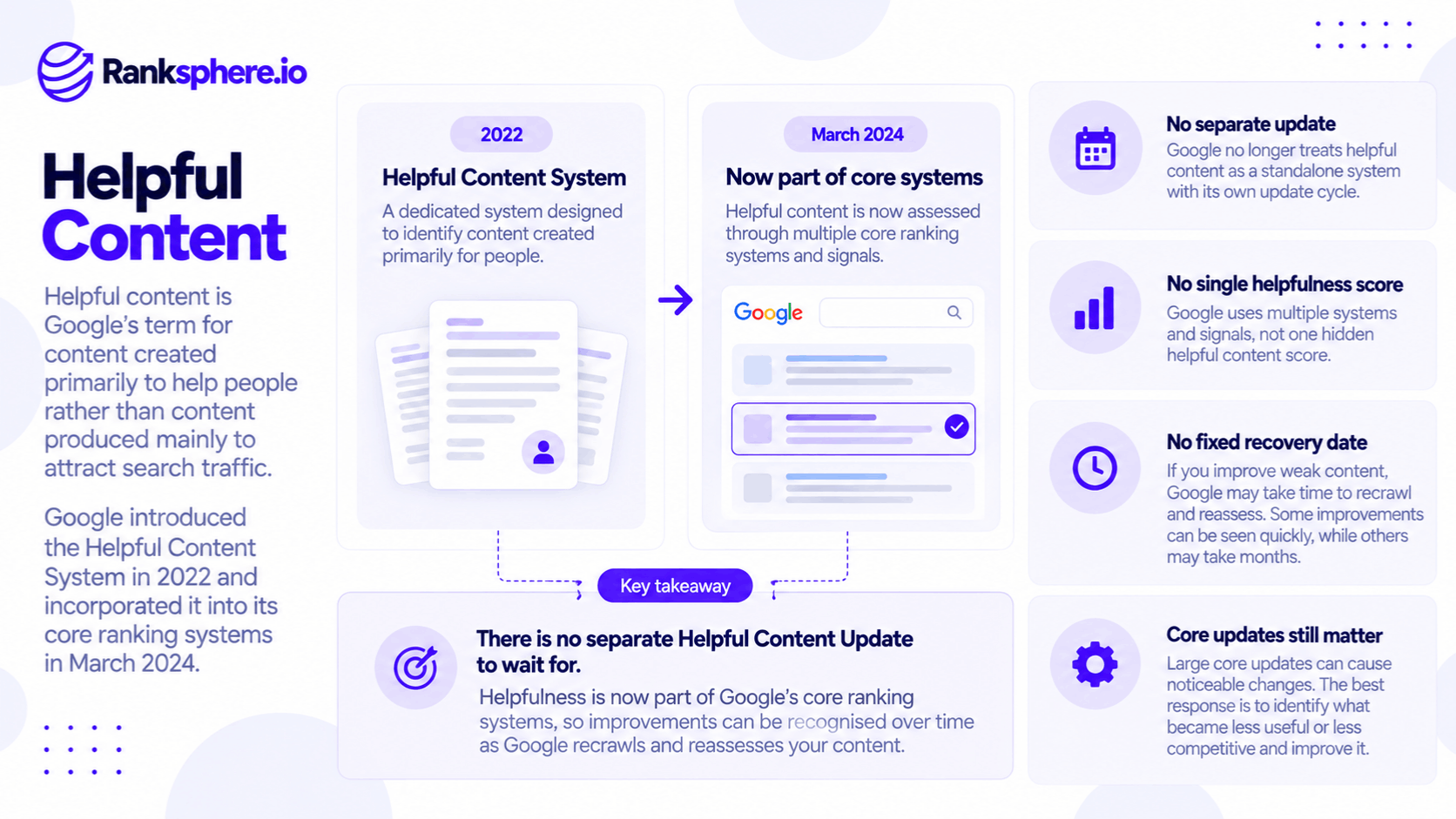
Google's approach to evaluating helpful content changed significantly in March 2024.
Understanding that change matters because older SEO advice still refers to the Helpful Content Update as though it were a separate ranking system.
Before March 2024
Google introduced the helpful content system in 2022 to better identify content created primarily for people rather than search engine rankings.
The system was updated periodically, and Google announced several helpful content updates.
Some websites experienced substantial ranking and traffic changes during those updates.
The system also included site-wide signals, meaning its assessment could extend beyond individual pages.
As a result, SEO discussions often focused on whether a website had been affected by the Helpful Content Update and when it might recover.
After March 2024
In March 2024, Google changed how its ranking systems evaluated helpfulness.
Instead of relying on one separately identified helpful content system, Google incorporated multiple signals and approaches into its core ranking systems.
The standalone helpful content system was subsequently listed among Google's retired ranking systems.
This means:
- Google no longer announces a separate Helpful Content Update.
- Helpfulness is evaluated through Google's broader ranking systems.
- Core updates may affect how helpful and reliable content is ranked.
- Websites don't need to wait for a specifically named helpful content update.
- Content improvements may take time to influence search performance.
However, this doesn't mean every ranking signal is refreshed continuously or that every content improvement will be reflected immediately.
Google's systems operate in different ways, and significant ranking changes can still occur during broad core updates.
What Does Google Consider Helpful Content?
Google publishes guidance to help website owners evaluate whether their content is genuinely useful.
The guidance focuses on the reader's experience rather than a particular keyword count, article length, or publishing frequency.
For local businesses, several questions are especially important.
Does the Content Serve a Real Audience?
A useful page should address questions or needs relevant to the business's customers.
For example, a dental practice might publish an explanation of dental implant treatment because patients frequently ask about the procedure, healing time, and costs.
That article serves an identifiable audience.
By contrast, the same practice might publish unrelated articles about trending subjects purely to attract search traffic.
The second approach may bring little value to existing or potential patients.
Does It Demonstrate Genuine Experience or Expertise?
Google encourages content that demonstrates relevant knowledge or first-hand experience.
For example, a roofing contractor can explain a repair using photographs from a completed project.
The article might describe:
- What caused the damage
- How the contractor identified the problem
- Which repairs were necessary
- What affected the cost
- What homeowners should look out for
These details may be more useful than generic advice copied from information already widely available.
However, not every helpful article requires first-hand experience.
Some subjects benefit more from specialist expertise, authoritative research, or clear explanations of established information.
Does It Answer the Reader's Question?
A page should help visitors accomplish the purpose of their search.
For example, someone searching for "how much does roof replacement cost?" expects pricing information.
An article that discusses roofing materials for several thousand words but never explains costs may leave the reader dissatisfied.
A more useful page would provide realistic pricing information where available, explain what affects the final quote, and clarify when an individual assessment is necessary.
Does It Add Something Useful?
Google encourages original information, research, analysis, and meaningful explanations.
For example, a local plumbing company might publish a guide based on common problems encountered during real service visits.
That gives the article a reason to exist beyond repeating competing webpages.
However, originality doesn't always require new research.
A clear, accurate explanation can still be helpful when it genuinely meets the reader's needs.
Can Readers Trust the Information?
People should be able to understand who is responsible for the content and why the information is credible.
For example, a legal services article may benefit from identifying the qualified professional who wrote or reviewed it.
The page should also distinguish general information from advice that depends on individual circumstances.
Trust is especially important for topics involving health, legal rights, financial decisions, or safety.
How Does Helpful Content Relate to E-E-A-T?
Google discusses helpful content alongside E-E-A-T, which stands for:
- Experience
- Expertise
- Authoritativeness
- Trustworthiness
These concepts help explain qualities associated with reliable information.
However, E-E-A-T isn't a single numerical Google ranking factor.
Google uses a range of signals and systems to identify content that demonstrates these qualities.
For local businesses, first-hand experience can be particularly valuable.
For example, a landscaping company may have photographs, project details, and practical knowledge from completed garden installations.
That information can make its content more useful than a generic article describing landscaping services.
However, relevant experience should be demonstrated honestly.
Businesses shouldn't invent completed projects, customer results, qualifications, or case studies simply to make content appear more trustworthy.
What Does Unhelpful Content Look Like?
Unhelpful content doesn't have one fixed format.
A short article isn't automatically unhelpful, and a long article isn't automatically helpful.
The problem is whether the page provides meaningful value to its intended audience.
Common warning signs include:
Content Written Only Around Keywords
A business may publish an article solely because a keyword tool reports substantial search volume.
However, the topic may have little relevance to the business or its audience.
Keyword research is useful, but it should help identify genuine customer needs rather than become the only reason for creating content.
Rewriting Competitors Without Adding Value
Some content strategies involve finding an article that already ranks and producing a longer version.
This is often associated with the skyscraper technique.
Researching competing content can be useful.
However, simply combining what competitors have already published doesn't guarantee a better article.
The new page should offer a meaningful improvement for readers.
Publishing Large Amounts Without Quality Control
Businesses may use AI tools, freelancers, or automated workflows to increase publishing volume.
The use of AI doesn't automatically make content unhelpful.
However, producing large quantities of low-value pages primarily to manipulate search rankings can violate Google's scaled content abuse policy.
This applies regardless of whether the pages were created by humans or automation.
For more information, see AI-generated content.
Adding Unnecessary Length
Some websites expand articles simply to reach an assumed ideal word count.
For example, a straightforward definition might be stretched into a 3,000-word article containing repetitive explanations.
If a question can be answered clearly in a few paragraphs, additional length may not help.
Include as much detail as the subject requires.
Publishing Thin or Repetitive Pages
Thin content may provide little original information or fail to satisfy the user's needs.
For example, a local business might publish twenty nearly identical location pages with only the town names changed.
If the pages offer no useful location-specific information, they may add little value.
However, low word count or limited traffic alone doesn't prove that a page is thin.
How to Improve Helpful Content on a Website
Improving content should begin with understanding what the reader needs.
For local businesses, this often means reviewing existing pages rather than continually publishing new ones.
Review the Main Search Intent
Start by identifying what visitors expect from the page.
For example, someone searching for "emergency plumber near me" may want contact details and availability.
Someone searching for "why does my boiler lose pressure?" may want an explanation of the possible causes.
These searches require different information.
A useful page should match the purpose of the query.
Add First-Hand Information
Where relevant, include details based on actual business experience.
Examples include:
- Completed project photographs
- Common customer questions
- Realistic service pricing
- Practical explanations from qualified staff
- Genuine case studies
- Important limitations or risks
These details can help distinguish a business's content from generic explanations.
Answer Important Questions Directly
Avoid burying useful information beneath long introductions.
For example, if a service page discusses consultation costs, explain the available pricing information clearly.
Then provide the details customers need to understand what is included.
Remove Unnecessary Repetition
Review whether each section adds useful information.
If several paragraphs repeat the same point, combine them.
If multiple pages address substantially the same search intent, consider whether they should be improved or consolidated.
Keep Information Accurate
Review information that changes over time.
This may include:
- Service prices
- Product specifications
- Regulations
- Opening hours
- Treatment information
- Availability
Not every article needs regular rewriting, but important facts should remain correct.
How to Recover From a Helpful Content Traffic Drop
If a website experiences a substantial decline in organic search traffic, don't immediately assume Google has identified its content as unhelpful.
A traffic decline can have several causes.
The first step is diagnosing the problem.
1. Check Whether the Drop Coincides With a Core Update
Review Google's official Search Status Dashboard and compare the timing with your traffic data.
If the decline occurred during a core update, wait until the rollout is complete before drawing conclusions.
Google recommends allowing at least a full week after the update finishes before making a detailed comparison in Search Console.
However, timing alone doesn't prove that the update caused the decline.
2. Identify Which Pages Lost Visibility
Use Google Search Console to review affected pages and queries.
Ask:
- Did the entire website lose traffic?
- Were only blog articles affected?
- Did important service pages lose rankings?
- Did impressions decline, or only clicks?
- Did the average position change?
- Did competitors gain visibility?
This helps distinguish a broad site problem from changes affecting specific content types.
3. Check for Changes in Search Results
A decline doesn't always mean the content has become worse.
Google may change which results appear, and user behaviour can also change.
For example, some informational queries may display AI-generated answers or other search features.
These changes may affect clicks without producing an equivalent decline in impressions or rankings.
Investigate the search results before attributing the problem entirely to content quality.
4. Review Affected Content
Apply Google's people-first content questions to the pages that lost visibility.
Consider whether the content:
- Addresses a genuine audience need
- Answers the main question
- Contains accurate information
- Demonstrates appropriate experience or expertise
- Provides value beyond existing resources
- Remains current
- Has a clear purpose
It's also useful to ask someone who isn't involved in writing the content to review it.
An independent perspective can identify problems that internal teams overlook.
5. Improve, Consolidate, or Remove Content
Not every low-performing page needs to be deleted.
Some articles may need clearer explanations, updated information, or more useful examples.
Others may overlap with existing pages and benefit from consolidation.
A page that no longer serves a useful purpose may be a candidate for removal.
This is part of content pruning.
However, removing content indiscriminately after a ranking decline can create additional problems.
Make decisions based on each page's value, relevance, and purpose.
Ranksphere's Website Audit Tool helps identify website issues, including thin and near-duplicate content, that may warrant further review.
An audit can identify potential problems, but determining whether content is genuinely helpful still requires editorial judgment.
6. Allow Time for Changes to Be Reflected
Google's systems need time to process changes.
Some improvements may be reflected within days, while broader reassessment can take several months.
In some cases, meaningful improvements may not be reflected until a subsequent core update.
However, there is no guaranteed recovery date.
A website shouldn't delay improvements simply because it is waiting for a particular update.
Common Helpful Content SEO Mistakes
- Treating the Helpful Content Update as a standalone system. It became part of Google's core ranking systems in March 2024.
- Waiting for a separate recovery update. Google no longer announces standalone helpful content updates.
- Assuming every traffic drop is a content-quality problem. Search result changes, competition, and technical issues may also contribute.
- Deleting low-traffic pages without reviewing them. Some pages serve important purposes despite limited search demand.
- Adding more words to improve quality. Length alone doesn't make content helpful.
- Creating content solely for keywords. Search demand should be considered alongside audience needs.
- Publishing at scale without review. Large quantities of repetitive content may create quality problems.
- Inventing experience or expertise. Unsupported claims can undermine trust.
- Expecting immediate recovery. Improvements may take time to influence rankings.
Helpful Content Best Practices
- Create content for a clearly defined audience.
- Research what readers actually want to know.
- Answer important questions directly.
- Include genuine first-hand experience when relevant.
- Provide original information where possible.
- Use qualified reviewers for specialist topics.
- Avoid unnecessary length and repetition.
- Keep important facts accurate.
- Review older pages regularly.
- Investigate traffic declines before making major changes.
- Improve or consolidate content when there is a clear reason.
- Use Google's people-first content questions before publishing.
The objective isn't to satisfy a particular content score or produce a certain number of articles.
It's to publish information that helps people accomplish what they came to the website to do.
Example of Helpful Content for a Local Law Firm
Consider a hypothetical law firm called Hartwell Legal.
The firm publishes informational articles about several areas of law.
Some articles were written by external contractors without meaningful input from the firm's solicitors.
Over time, the website accumulates generic explanations that repeat information available on many competing websites.
What Happens?
The firm notices a substantial decline in organic traffic around the time of a broad Google core update.
An agency proposes a "Helpful Content Update recovery" project.
However, there is no longer a separate helpful content update to recover from.
The useful question is what changed in the firm's search visibility and whether its content still meets readers' needs.
What the Content Audit Finds
The agency reviews Search Console data and finds that the decline is concentrated in twelve informational articles.
The firm's main service pages have remained comparatively stable.
Several affected articles contain:
- Generic explanations
- Limited original analysis
- Outdated information
- No clear author or reviewer details
- Few practical examples
- Little connection to the firm's actual services
These findings don't prove that Google applied a particular quality penalty.
However, they identify reasonable opportunities to improve the content.
How the Firm Responds
The firm reviews the twelve articles individually.
Four address important questions that existing or prospective clients regularly ask.
Those articles are rewritten with input from appropriately qualified solicitors.
The revisions include clearer explanations, relevant practical experience where confidentiality permits, and accurate legal information.
The remaining eight articles are reviewed for relevance, duplication, and usefulness.
Where appropriate, overlapping content is consolidated and obsolete pages are removed or redirected.
The firm also introduces an editorial review process for future legal content.
How the Firm Measures Progress
The agency monitors:
- Search impressions
- Organic clicks
- Query visibility
- Relevant service page performance
- Enquiries
- Changes in competing search results
It allows sufficient time for Google to process the revisions.
However, the firm doesn't assume that every rewritten page will recover its previous rankings or that improvement must arrive during the next core update.
Example Shows
“The useful work wasn't waiting for another Helpful Content Update.
It was identifying which pages had lost visibility, evaluating their usefulness, and making improvements supported by the firm's actual expertise.
Helpful content isn't about passing a separate Google quality test. It's about consistently publishing information that deserves to be useful to the people searching for it.
For local businesses, that means answering real customer questions, drawing on genuine experience, and reviewing content regularly rather than waiting until rankings decline.”
See Also
- E-E-A-T — Understanding experience, expertise, authoritativeness, and trustworthiness.
- Google Algorithm Update — How changes to Google's ranking systems affect search results.
- Thin Content — Identifying pages that provide limited value.
- AI-Generated Content — Understanding Google's policies on AI-assisted and scaled content production.
- Content Pruning — Improving, consolidating, or removing unnecessary pages.
- Content Audit — Evaluating existing pages and identifying opportunities for improvement.