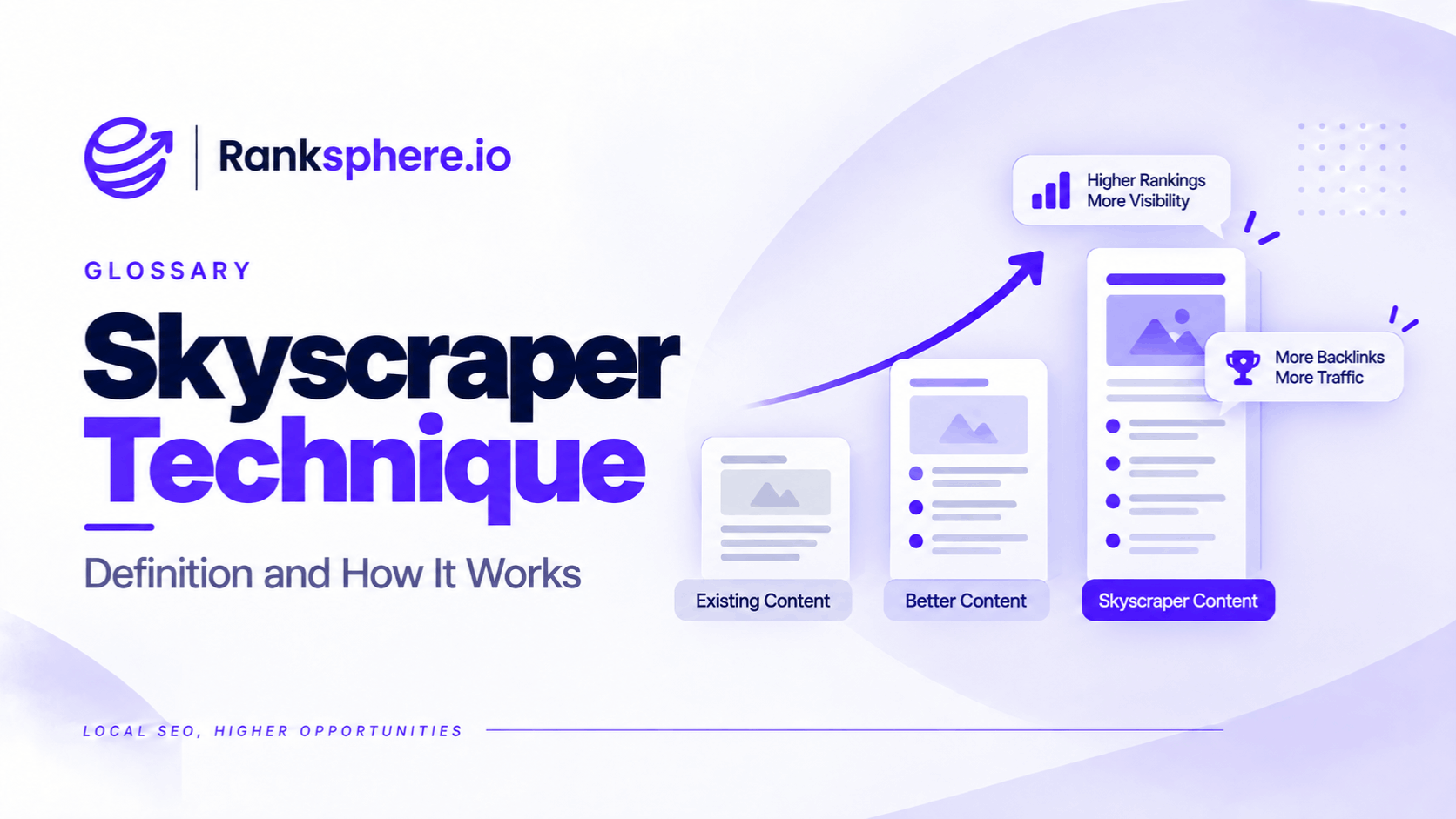
The skyscraper technique is an SEO content and link-building strategy that involves finding a successful piece of content, creating an improved version, and contacting websites that link to the original.
Popularised by Brian Dean of Backlinko in 2015, the technique is based on a simple idea: if people already link to a useful resource, they may also be interested in linking to a better one.
Traditionally, this meant creating a longer, more comprehensive guide than the articles already ranking in Google.
However, making an article longer doesn't automatically make it better.
A 4,000-word guide may provide less value than a 900-word article that answers the reader's question directly.
The skyscraper technique can still be useful when it leads to genuinely better content. Its limitations become clear when businesses focus on word count and outreach rather than offering something worth reading or referencing.
For local businesses, original project details, genuine customer questions, and first-hand experience often provide a stronger reason to choose their content than simply publishing the longest article on a subject.
How Does the Skyscraper Technique Work?
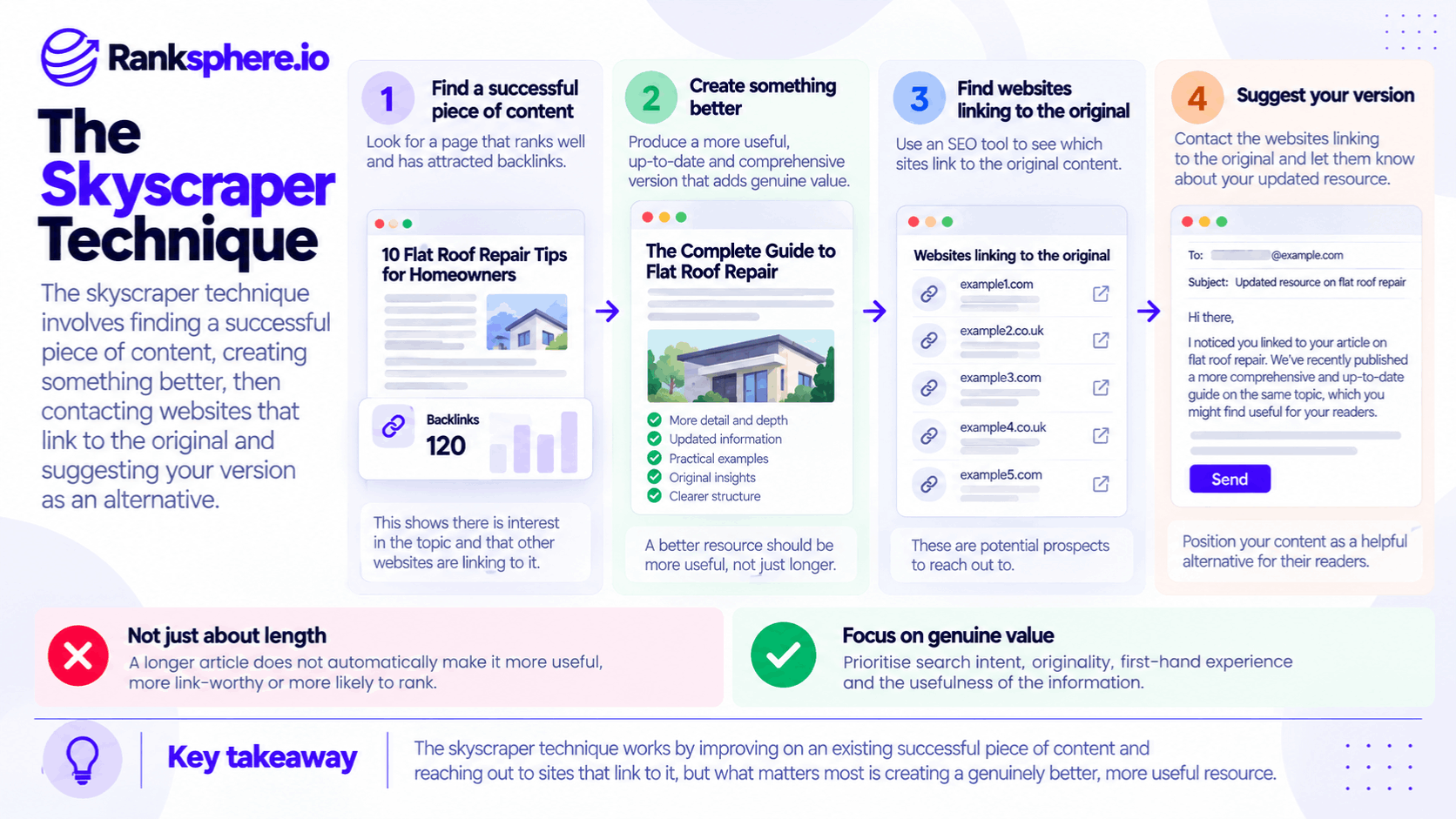
The traditional skyscraper technique follows three main stages: finding successful content, creating something better, and promoting the improved resource.
1. Find Popular Content with Backlinks
The first step is identifying an article that already performs well in search or attracts links from other websites.
For example, an SEO agency working with a roofing company might find a popular guide about flat roof repairs.
The agency then examines:
- The topics covered
- The information provided
- The article's structure
- The websites linking to it
- Questions the guide doesn't answer
- Opportunities to provide something more useful
The existing article serves as a reference point for understanding what publishers and readers find valuable.
However, a page's backlink count doesn't necessarily mean its content is the best answer to the search query.
2. Create a Better Resource
The second step is producing content that improves on the existing resource.
In the original approach, this often meant making the new article longer or more comprehensive.
For example, if a competing guide explained ten roof maintenance tips, the agency might publish twenty.
But adding more information isn't always an improvement.
A better resource might instead provide:
- Clearer explanations
- More accurate information
- Original photographs
- Current pricing
- First-hand experience
- Practical comparisons
- Answers to questions the original article overlooks
The improvement should be meaningful to the intended reader.
3. Contact Websites Linking to the Original
The final step is link-building outreach.
The publisher identifies websites linking to the original article and contacts them to introduce the new resource.
The message typically explains why the new page may be useful to their readers.
However, these websites have no obligation to change their links.
A publisher may have linked to the original article because of its author, research, reputation, or relevance to a particular passage.
Simply creating a longer article doesn't give that publisher a compelling reason to replace the link.
This is one of the main limitations of traditional skyscraper outreach.
Does the Skyscraper Technique Still Work for SEO?
The skyscraper technique can still work, but its effectiveness depends on the quality and distinctiveness of the new resource.
The original method remains useful for researching successful content and identifying opportunities to improve it.
What is less reliable is the assumption that a longer article will automatically attract backlinks or outrank competitors.
Several factors explain why.
Content Length Isn't a Google Ranking Factor
Google doesn't reward webpages simply for having more words.
A longer article can be useful when the topic requires detailed explanations.
However, unnecessary information may make the page harder to read.
For example, someone searching for "how much does a flat roof repair cost?" may want a realistic price range, the factors affecting the quote, and examples of common repairs.
They may not need a lengthy history of roofing materials before reaching the pricing information.
The best length depends on what the reader needs to know.
Search Intent Matters More Than Word Count
Search intent describes what someone is trying to accomplish when they search.
For example:
- "What is a flat roof?" suggests an informational query.
- "Flat roof repair cost" suggests an interest in pricing.
- "Flat roof repair near me" may indicate someone wants to find a contractor.
These searches serve different purposes.
A detailed educational guide may be appropriate for the first query.
A clear pricing page may be more suitable for the second.
A local service page may better serve the third.
Publishing an extensive guide without considering the intent can result in content that doesn't match what searchers want.
Search Engines Can Interpret Meaning Beyond Exact Keywords
Modern semantic search systems help search engines interpret queries and content using meaning and context.
This reduces the need to create excessively long articles that repeat every possible keyword variation.
For example, a well-written roof repair guide can naturally discuss leaks, damaged flashing, and repair costs without creating separate sections purely to repeat similar phrases.
However, semantic search doesn't mean shorter content always ranks better.
A detailed guide may still be the most appropriate format for a complex topic.
The goal is to cover the subject to the depth the query requires.
Generic Content Offers Little Reason to Link
A common weakness of skyscraper content is that it may summarise information already available elsewhere.
For example, an article combining fifteen roofing tips from competing websites may be accurate, but publishers have little reason to reference it if the information isn't new.
A resource containing original research, documented project details, or useful data may provide a stronger reason for another website to link to it.
This doesn't mean every article needs original research.
It means that when earning backlinks is the objective, the content should offer something genuinely worth citing.
Outreach Doesn't Guarantee Backlinks
Traditional skyscraper outreach often involves contacting websites that link to competing content.
However, a publisher may have no reason to replace an existing link.
They might also receive numerous similar requests.
A personalised, relevant outreach message can still be useful, particularly when a new resource addresses a genuine gap.
But outreach shouldn't be treated as a predictable process where a certain number of emails automatically produces a certain number of links.
What the Skyscraper Technique Gets Right
Despite its limitations, several parts of the original strategy remain valuable.
Research Existing Search Results
Before creating content, examine the pages already appearing for the target query.
This helps identify:
- The type of content searchers expect
- Questions competitors answer
- Common page formats
- Information that may be missing
- Opportunities to provide a different perspective
This research should form part of a good content brief.
However, competitor analysis should inform the article rather than determine everything it contains.
Identify Gaps in Existing Content
A useful article should address something readers aren't getting from existing results.
For example, several national roofing websites may explain flat roof materials without discussing realistic repair costs in a specific region.
A local contractor could provide useful information about the factors affecting prices in its service area.
This gives the business an opportunity to create content based on its own experience.
Focus on Making Content More Useful
The central idea of improving existing resources is still relevant.
But "better" should mean more useful to the reader.
That could involve:
- Answering the question sooner
- Providing clearer explanations
- Including original examples
- Correcting outdated information
- Explaining costs and limitations
- Adding practical steps
- Presenting information in a more suitable format
Sometimes the best improvement is making a page shorter.
What Works Better Than Simply Making Content Longer?
For local businesses, a more practical approach is to identify what existing articles lack and create something that provides a clear benefit.
Answer the Search Query Directly
Start with the main question.
If someone searches for the cost of repairing a roof, provide useful pricing information early.
Explain what affects the cost and when the final quote may differ.
Avoid burying the answer under several introductory sections simply to make the article more comprehensive.
Include First-Hand Experience
Real experience can make content more distinctive.
For example, a roofing contractor might explain why a particular repair failed, using photographs from a completed project.
That provides information based on the company's own work.
A detailed case study can support the explanation.
This also relates to Google's E-E-A-T concepts, particularly first-hand experience.
However, E-E-A-T isn't a single ranking score, and adding case studies doesn't guarantee improved visibility.
Provide Original Information
Original information can give publishers a stronger reason to reference a page.
For example, a roofing company might collect anonymised data from its completed projects to explain the factors affecting repair costs.
The article could include:
- Actual repair categories
- Typical materials used
- Common causes of damage
- Project durations
- Pricing ranges based on genuine records
Any figures should be accurate, appropriately contextualised, and based on information the business can substantiate.
Original information is valuable because it adds something beyond a summary of competing articles.
Address Questions Competitors Avoid
Some articles provide general advice but avoid practical questions.
For example:
- How much does the service cost?
- When isn't the service necessary?
- What commonly goes wrong?
- What should customers ask before buying?
- When is repair less suitable than replacement?
These questions may provide useful content gap opportunities.
Answering them clearly can make the page more useful to prospective customers.
Choose the Right Content Format
Not every query needs a long-form article.
For example:
| Search intent | Potentially useful format |
|---|---|
| Understanding a concept | Short explanation or guide |
| Comparing services | Comparison page |
| Researching costs | Pricing guide |
| Finding a local provider | Service or location page |
| Learning from completed work | Case study |
| Understanding a process | Step-by-step tutorial |
The format should reflect the reader's goal.
A long guide may be appropriate for one topic and unnecessarily complicated for another.
Earn Links Through Relevant Relationships
Instead of relying exclusively on emails asking websites to replace existing links, businesses can explore more relevant link-building opportunities.
For example:
- Providing original information to local journalists
- Contributing expertise to relevant publications
- Sharing useful research with industry organisations
- Building relationships with suppliers and professional associations
- Publishing resources that other websites genuinely want to reference
These activities overlap with digital PR.
However, not every relationship produces a backlink, and links should be earned or appropriately qualified rather than purchased or exchanged to manipulate rankings.
Skyscraper Technique vs Modern Content Research
The difference is primarily how success is defined.
| Traditional skyscraper approach | More useful alternative |
|---|---|
| Find a popular article | Study the search results and audience needs |
| Make the article longer | Address important gaps |
| Cover more subtopics | Cover the right subtopics |
| Repeat established information | Add useful original information |
| Contact websites linking to competitors | Promote resources to relevant audiences |
| Measure outreach and backlinks | Evaluate relevance, links, traffic, and business outcomes |
The original technique begins with a useful idea: understand what already works before creating something new.
The mistake is assuming that adding more words makes a page more valuable.
Common Skyscraper Technique Mistakes
Businesses and agencies can waste considerable time when they apply the technique without questioning its assumptions.
Writing Longer Articles Without Adding Value
An article shouldn't be expanded simply to exceed a competitor's word count.
Adding repetitive explanations or loosely related sections can make the page less useful.
If the reader's question can be answered clearly in 1,000 words, a 5,000-word guide may be unnecessary.
Ignoring Search Intent
A comprehensive informational article may not suit a query where visitors are looking for a service provider.
For example, someone searching for "emergency roof repair near me" is likely more interested in finding a contractor than reading an extensive roofing guide.
The content should match the purpose of the search.
Copying the Competitor's Structure
Studying competing content is useful, but simply rewriting its sections doesn't necessarily create a better resource.
A new article should have a clear reason to exist.
That might involve original data, first-hand experience, updated information, or a more useful explanation.
Sending Generic Outreach Emails
Mass emails asking websites to replace existing links often provide little value to recipients.
For example, telling an editor that your article is longer than the one they've linked to isn't a compelling reason to make a change.
Outreach should be selective, relevant, and respectful of the publisher's editorial decisions.
Treating Backlinks as Guaranteed Results
A page may be excellent and still attract few backlinks.
Link acquisition depends on whether relevant publishers discover the content and consider it worth referencing.
Don't assume that publishing a better article automatically produces links.
Paying for a Skyscraper Campaign Without Clear Deliverables
If an agency recommends the skyscraper technique, ask what the improvement will actually involve.
For example:
- What is missing from existing results?
- What original information will the new article provide?
- How does the format match search intent?
- Who is likely to find the resource useful?
- Why would another website reference it?
- How will success be measured?
A proposal focused entirely on word count and email volume may not address the most important questions.
Skyscraper Technique Best Practices
If you want to use the useful parts of the skyscraper technique:
- Research the current search results before creating content.
- Identify the audience and main search intent.
- Look for meaningful gaps in existing articles.
- Define how your content will be more useful.
- Add first-hand experience when relevant.
- Use accurate original data where available.
- Avoid unnecessary length and repetition.
- Select the content format that best serves the query.
- Create resources worth referencing.
- Use personalised outreach only where the content is genuinely relevant.
- Measure outcomes beyond the number of emails sent.
- Review existing content before publishing another overlapping article.
The purpose isn't to create the longest page on a topic.
It's to create a resource that answers the reader's question better or offers information they couldn't easily find elsewhere.
Example of the Skyscraper Technique for a Local Roofing Business
Consider a hypothetical roofing company working with an SEO agency.
The agency recommends a skyscraper campaign targeting flat roofing.
The proposed plan is to create a 5,000-word guide and contact websites linking to an established roofing article.
The Original Campaign
The agency researches competing guides and publishes a long article covering:
- Flat roofing materials
- Installation methods
- Maintenance
- Common problems
- Repair options
- Replacement considerations
The article contains useful information, but much of it is already available on manufacturer websites and established industry resources.
The agency then sends outreach emails to websites linking to competing articles.
For illustration, suppose the outreach generates few responses and no new backlinks.
The campaign has produced a substantial article, but it hasn't established a strong reason for other publishers to reference it.
What the Agency Changes
The agency reviews the company's actual experience and the questions customers ask most often.
It discovers that local homeowners regularly want to know:
- What does flat roof replacement cost in the area?
- How can they tell whether a roof needs repair or replacement?
- What causes recently installed flat roofs to fail?
Instead of producing another lengthy general guide, the agency plans three more focused resources.
1. A Local Flat Roof Replacement Cost Guide
The company provides genuine pricing information from relevant completed projects.
The article explains the factors affecting cost, including roof size, materials, access, and the condition of the underlying structure.
It also clarifies that individual quotes may vary.
2. A Repair vs Replacement Guide
The second article explains when repairs may be suitable and when replacement may be necessary.
It includes genuine photographs showing different types of damage.
The company explains the reasoning behind each recommendation.
3. A Flat Roof Failure Case Study
The third page documents a completed project involving a failed roofing installation.
It explains what the contractor discovered, how the problem was addressed, and what homeowners can learn from the situation.
The content uses actual project details, subject to appropriate customer permissions.
Example Shows
“The new resources serve different search intents.
They also contain information based on the company's work rather than repeating general advice from established websites.
The agency can measure whether these pages attract relevant searches, earn links, and generate enquiries.
However, there is no guarantee they will rank on the first page or attract backlinks within a particular timeframe.
Their advantage is that they provide useful information that the original long-form guide lacked.
The lesson from the skyscraper technique isn't that content needs to be bigger. It's that content needs a reason to be better.
For local businesses, that reason is often first-hand experience, practical detail, and clear answers to questions potential customers are already asking.”
See Also
- Content Gap — Identifying important information missing from existing search results.
- Content Brief — Planning content around search intent and audience needs.
- E-E-A-T — Understanding experience, expertise, authoritativeness, and trustworthiness.
- Digital PR — Building awareness and earning relevant coverage.
- Thin Content — Understanding why low-value or repetitive pages can be ineffective.
- Semantic Search — How search engines interpret content and queries using meaning and context.