Keyword stuffing is the practice of forcing keywords, phrases or location terms into content repeatedly in an attempt to influence search rankings.
It can appear as:
- The same phrase repeated unnaturally
- Long lists of keyword variations
- Blocks of town or city names
- Keyword-heavy title tags
- Stuffed image alt text
- Hidden text created for search engines rather than users
Google explicitly lists keyword stuffing in its spam policies.
Its current definition covers pages filled with keywords or numbers in a way that is unnatural, out of context or intended to manipulate rankings. Google specifically gives examples such as repeating the same phrase excessively and publishing blocks of cities or regions a page is trying to rank for.
The important distinction is that using keywords is not the problem.
Using them unnaturally is.
What is keyword stuffing?
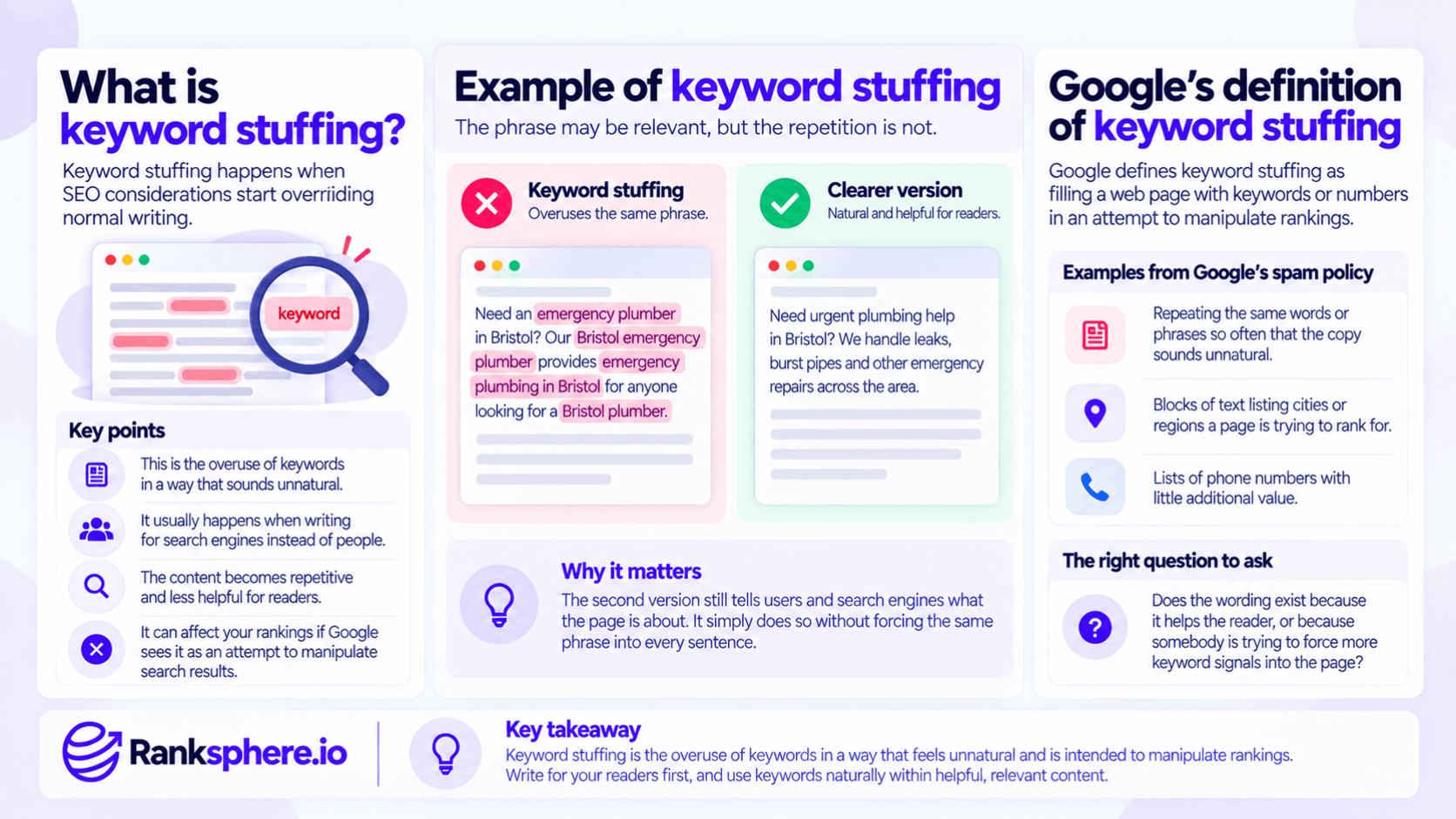
Keyword stuffing happens when SEO considerations start overriding normal writing.
For example:
Need an emergency plumber in Bristol? Our Bristol emergency plumber provides emergency plumbing in Bristol for anyone looking for a Bristol plumber.
The phrase may be relevant.
The repetition is not.
A clearer version might be:
Need urgent plumbing help in Bristol? We handle leaks, burst pipes and other emergency repairs across the area.
The second version still tells users and search engines what the page is about.
It simply does so without forcing the same phrase into every sentence.
Google's definition of keyword stuffing
Google defines keyword stuffing as filling a web page with keywords or numbers in an attempt to manipulate rankings.
Examples in Google's current spam policy include:
- Repeating the same words or phrases so often that the copy sounds unnatural
- Blocks of text listing cities or regions a page is trying to rank for
- Lists of phone numbers with little additional value
That is a useful way to diagnose it.
The question is not:
How many times does the keyword appear?
It is:
Does the wording exist because it helps the reader, or because somebody is trying to force more keyword signals into the page?
Keyword stuffing is not the same as keyword optimisation
A page about boiler servicing should naturally use phrases such as:
- Boiler service
- Boiler servicing
- Heating engineer
- Annual boiler check
That is normal.
Google itself recommends using words people might search for in prominent and descriptive places on a page.
The problem begins when those phrases are repeated without adding meaning.
SEO still needs clear language.
It just does not need artificial repetition.
What keyword stuffing looks like
Repeating the same phrase
A common example is forcing one exact phrase into almost every paragraph.
For example:
Our Manchester boiler repair team provides Manchester boiler repair services for customers needing boiler repair Manchester.
No fixed repetition count makes a page spammy.
The issue is whether the wording sounds unnatural.
Google's own spam policy uses unnatural repetition as the test.
Lists of keyword variations
Another pattern is putting several variations into one sentence or block:
plumber, plumbers, plumbing services, emergency plumber, local plumber, best plumber
This does not make the page more complete.
It simply exposes the optimisation attempt.
Modern search systems do not require every possible phrasing to appear explicitly on the page.
Google's current SEO Starter Guide says its language matching systems can understand how a page relates to many queries even when every exact variation is not present.
Location stuffing
Local businesses often inherit content such as:
Plumber Bristol, plumber Bath, plumber Weston-super-Mare, plumber Keynsham, plumber Clevedon...
at the bottom of every page.
Google explicitly lists blocks of cities and regions used to manipulate rankings as an example of keyword stuffing.
That makes this one of the clearest examples.
Footer location lists
A long footer containing dozens of towns is not automatically spam simply because locations are present.
A genuinely useful service-area navigation section may make sense.
The problem is a block of place names added primarily to rank for combinations such as:
service + town
without helping users navigate or understand the business.
Do not judge it by the number of towns alone.
Judge its purpose.
Hidden text
Text can also be hidden from normal visitors while remaining accessible to search engines.
Historic examples include:
- White text on a white background
- Text placed far off-screen
- Tiny or zero-size text
- Text hidden behind elements
When hidden content exists primarily to manipulate rankings, it can violate Google's spam policies.
This is more serious than simply writing an awkward sentence.
It is intentionally showing search engines something users are not meant to see.
Alt text stuffing
Alt text should describe an image and support accessibility.
Google says alt text also helps it understand an image, but specifically warns against filling the alt attribute with keywords because that creates a poor experience and may cause the site to be seen as spam.
Bad:
<img src="boiler.jpg"
alt="boiler repair boiler repairs emergency boiler repair cheap boiler repair London plumber">
Better:
<img src="boiler.jpg"
alt="Engineer inspecting a wall-mounted boiler">
The second describes the image.
That is the purpose of alt text.
Alt text does not need a target keyword every time
Another common mistake is requiring every image on a page to contain the target phrase.
For example:
- emergency plumber London van
- emergency plumber London tools
- emergency plumber London engineer
That is not useful accessibility.
Google recommends descriptive, contextual alt text rather than keyword lists.
If the image is decorative, it may not need descriptive alt text at all depending on the implementation.
Title tag keyword stuffing
Title tags are another common place for over-optimisation.
For example:
Plumber Bristol | Bristol Plumber | Emergency Plumber Bristol | Plumbing Bristol
Google specifically advises against repeating the same words or phrases in <title> elements.
Its own example shows that variants such as:
Foobar, foo bar, foobars, foo bars
do not help users and can make the result look spammy.
A cleaner title might be:
Emergency Plumber in Bristol | Smith Plumbing
Clear.
Descriptive.
No unnecessary repetition.
Google may rewrite stuffed titles
The HTML <title> element is one source Google can use when generating a search result title.
Google may also use:
- The visible page title
- Headings
- Other prominent text
- Anchor text
- Other page content
when creating the title link shown in Search.
That means stuffing the title does not guarantee the exact text will even appear.
Write the title for clarity.
Keyword density
One of the main reasons keyword stuffing survives is the old idea of keyword density.
Keyword density is usually calculated as:
number of keyword uses ÷ total words
For example:
10 mentions in 500 words = 2%.
That number can be calculated.
What does not exist is a published Google target saying:
2% is ideal
or:
4% ranks better than 1%.
Google has explicitly said it does not have a notion of optimal keyword density.
There is no safe keyword density percentage
Avoid rules such as:
- Use the target keyword every 100 words
- Maintain 2–3% density
- Put the keyword in every second heading
Those are content formulas created by SEO tools or writers.
They are not Google's requirements.
A page may naturally use an important term many times because the subject requires it.
Another page may use it only a few times and still be perfectly clear.
Context matters more than percentage.
Keyword-density tools are not Google scoring systems
Some writing tools provide indicators such as:
- Keyword usage: Low
- Target density: 1.5%
- Over-optimised
- Term frequency
These can be useful editorial prompts.
They are not a representation of Google's internal ranking system.
Treat them as writing assistance.
Not as ranking thresholds.
Why keyword stuffing is unnecessary
It is tempting to explain this simply as:
“semantic search replaced keyword matching.”
The reality is broader.
Google still uses words and textual relevance.
But its systems have become much better at understanding:
- Context
- Related language
- Query variations
- Synonyms
- Topic relationships
Google's current SEO Starter Guide explicitly says you do not need to anticipate every way somebody might search for a topic because its language matching systems can understand relationships between pages and many different queries.
So there is no need to write:
plumber, plumbing, plumbers, plumbing company, plumbing companies
simply to cover each wording.
Be explicit without being repetitive
The opposite mistake is becoming so afraid of keywords that the page never clearly says what the business does.
Google has also advised site owners to be explicit.
If you paint houses, say:
house painting
rather than relying entirely on vague marketing copy such as:
we transform beautiful spaces.
Google's own explanation of keyword density makes this distinction: optimal density does not matter, but clear terminology does.
Good SEO writing sits between:
vague
and:
stuffed.
Keywords still belong in important places
Google recommends using words people search for in prominent locations where they help describe the page.
That can include:
- Page title
- Main heading
- Useful body copy
- Relevant alt text
- Descriptive link text
This is not a checklist requiring exact-match keywords in every field.
Use the language where it fits.
Do not force the keyword into every heading
A page does not need:
Emergency Plumber Bristol
Why Choose Our Emergency Plumber Bristol
Emergency Plumber Bristol Services
Emergency Plumber Bristol Prices
Contact Our Emergency Plumber Bristol
Those headings tell the reader very little.
More useful headings might be:
Emergency plumbing services
Problems we can help with
What to expect when you call
Areas we cover
The topic remains perfectly clear.
Keyword stuffing in Google Business Profile names
Local SEO introduces a separate issue often called GBP name stuffing or keyword stuffing in the business name.
For example:
Real-world name:
Smith Plumbing
Profile name:
Smith Plumbing | Emergency Plumber Bristol | Boiler Repair
That extra information is not permitted unless it is genuinely part of the business's real-world name.
Google says Business Profile names should match the name used consistently on:
- Storefront signage
- Website
- Stationery
- Other real-world branding
and says unnecessary information in the name is not permitted and could result in suspension.
This is a Business Profile policy issue
Technically, this is different from Google's web-search keyword stuffing spam policy.
Website keyword stuffing is governed by Google's Search spam policies.
Business Profile name misuse is governed by Business Profile representation guidelines.
SEOs often use the same phrase:
keyword stuffing
for both.
But the enforcement systems are different.
That distinction is worth keeping clear.
Do not use the legal name automatically
Another common mistake is assuming the Business Profile name must exactly match the company's registered legal entity.
Google's rule is the real-world business name, not necessarily the Companies House or legal registration name.
For example, a company legally registered as:
Smith Plumbing Services Limited
may legitimately trade publicly as:
Smith Plumbing
if that is how it is consistently:
- Branded
- Signed
- Presented to customers
Google says the profile should reflect the name used in the real world.
Do not add or remove terms solely for SEO.
Business name changes can trigger reverification
Google also says changing the business name after verification may require the profile to be verified again.
So correcting a stuffed name should be handled carefully.
Make the profile accurate.
Keep evidence of the real-world business identity available.
Do not repeatedly change names simply to test rankings.
Does business name stuffing cause suspension?
Google says unnecessary information in the business name is not permitted and could result in suspension.
That is the defensible wording.
Avoid stronger claims such as:
“It is the number-one cause of suspension.”
Google does not publish a ranking of suspension causes.
Nor should every stuffed name be described as:
“a suspension waiting to happen.”
It is a policy risk.
That is enough reason to fix it.
Location pages and keyword stuffing
Location pages are another place where repetition appears frequently.
For example:
Looking for a plumber in Ashford? Our Ashford plumber provides plumbing in Ashford to customers who need an Ashford plumbing company.
Repeating the place name does not make the page more locally relevant.
Instead, useful location content might include:
- Services genuinely provided there
- Real project examples
- Travel or coverage details
- Local contact information where appropriate
- Genuine customer questions
The location should appear because it matters to the content.
Not because someone set an exact repetition target.
One page can mention a town several times naturally
Do not create a rule saying:
“Never use the town name more than three times.”
A genuine location page might need to mention the town repeatedly.
For example:
- Heading
- Service description
- Project example
- Directions
- Contact section
That is normal.
The test is whether each mention serves a purpose.
Service-area lists
Some businesses genuinely need to show where they operate.
A service-area section can therefore be useful.
For example:
We regularly work in Bristol, Bath, Keynsham and Portishead.
That is different from a giant block containing every possible:
service + location
combination.
Use service areas to help customers.
Not to manufacture keyword permutations.
Do not replace every town list with a location page
Removing a stuffed footer does not mean:
create 40 location pages instead.
A location page should have a genuine purpose.
Creating dozens of near-identical town pages with the place name swapped can create another SEO problem rather than solve the first one.
Build location pages where:
- The business genuinely serves the area
- Users need dedicated information
- The page can provide something distinct and useful
Otherwise, a clear service-area section may be enough.
Service lists
Keyword stuffing can also appear in service sections.
For example:
- Roof repair
- Roofing repair
- Roof repairs
- Local roof repair
- Emergency roof repair services
These may describe one service rather than five.
A useful service list should represent things customers can genuinely choose.
Do not create artificial service variations just to include more keywords.
Old SEO copy
Older pages are often where keyword stuffing survives unnoticed.
Examples include content written around:
- Density targets
- Exact-match keywords
- Town-name repetition
- Footer keyword blocks
Ranksphere's website audit flags over-optimised pages and weak on-page elements, helping surface pages that deserve manual review.
The important next step is human assessment.
A warning does not automatically mean a page violates Google's policies.
What happens if you keyword stuff?
There is no universal outcome.
At mild levels, the main problem may simply be:
- Awkward copy
- Poor readability
- Lower trust
- Worse conversion experience
At more extreme levels, keyword stuffing can fall within Google's spam policies.
Google says violations of its spam policies can result in pages or sites ranking lower or being omitted from Search results.
Do not promise a particular penalty.
Enforcement depends on the behaviour and context.
Poor writing can hurt before Google does anything
A page does not need a search penalty to be unsuccessful.
Suppose the copy reads:
Our divorce solicitor Manchester team provides divorce solicitor Manchester services...
A potential client may simply decide:
this does not sound trustworthy.
That can reduce:
- Enquiries
- Engagement
- Confidence
SEO copy still has to persuade a human being.
Keyword stuffing does not improve topical depth
Repeating:
boiler repair
20 times does not make a page comprehensive.
Useful topical coverage might instead explain:
- Common boiler faults
- What happens during a repair
- When replacement may be needed
- Expected process
- Safety considerations
- What customers should do before calling
Depth comes from answering useful questions.
Not repeating the topic name.
Keyword stuffing vs thorough content
A long, detailed page may use the main subject frequently.
That is not automatically keyword stuffing.
For example, a detailed guide about:
mortgage interest rates
will naturally use that phrase and related terminology multiple times.
The test is whether the repetition is required by the subject.
Do not reduce spam diagnosis to a word counter.
Related terms do not need to be inserted artificially
Another old technique is creating lists of supposedly related keywords and inserting every one.
For example:
- solicitor
- lawyer
- attorney
- legal expert
- legal specialist
Some may not even be natural terminology for the country or audience.
Write the vocabulary people genuinely use.
Semantic search does not require pages to contain every imaginable synonym.
Readability is a better practical test
One simple editorial test remains useful:
read the page aloud.
Forced repetition often becomes obvious immediately.
Ask:
- Would a salesperson say this?
- Would a customer understand it?
- Does the phrase repeat without adding meaning?
- Could one sentence say the same thing more naturally?
This is not a Google algorithm test.
It is a useful writing test.
Do not rewrite good content simply because a tool says “high keyword density”
If a page:
- Reads naturally
- Clearly explains the subject
- Helps users
do not automatically remove words simply to hit a lower density score.
Likewise, do not add repetitions because a tool says:
keyword usage is too low.q
Use the tool as a prompt.
Make the final decision from the content.
What to do instead of keyword stuffing
Focus on making the page unambiguous and useful.
A strong page should normally make clear:
- What the subject is
- Who it is for
- What the business provides
- What the user should do next
Relevant terminology will appear naturally when the topic is properly explained.
You do not need to engineer repetition.
Auditing an over-optimised page
When reviewing older content, inspect:
Main copy
Does the target phrase appear unnaturally?
Headings
Are they all variations of the same keyword?
Title
Is the same phrase repeated unnecessarily?
Alt text
Does it describe images or contain keyword strings?
Footer
Are there blocks of locations or services?
Internal links
Are exact-match anchors forced repeatedly?
Business Profile
Does the name match the genuine real-world business name?
This is more useful than checking one density percentage.
Rewrite for meaning, not synonyms
When fixing stuffing, do not simply replace:
plumber
with:
- plumbing expert
- plumbing professional
- pipe specialist
every second sentence.
That produces another unnatural page.
Rewrite the idea.
For example:
Stuffed:
Our Bristol plumber offers plumbing services throughout Bristol. If you need a Bristol plumber, call our Bristol plumbing team.
Better:
We handle leaks, burst pipes and general plumbing repairs across Bristol, with emergency appointments available when you need urgent help.
The improvement comes from adding meaning.
Not hiding repetition with synonyms.
Common keyword stuffing mistakes
- Following a fixed keyword-density target.
- Creating one sentence that lists every variation of a keyword.
- Repeating town names solely to target local searches.
- Adding large blocks of cities or service areas to site footers.
- Stuffing alt text with keywords instead of describing the image.
- Repeating the same phrase unnecessarily in the title tag.
- Adding services, locations or marketing language to a Google Business Profile name when they are not part of the real-world name.
- Assuming the Business Profile name must match the registered legal company name rather than the genuine public-facing name.
- Creating dozens of thin location pages after removing a stuffed town list.
- Using a keyword counter as the final judge of whether copy is optimised.
- Confusing thorough topical coverage with repeated phrasing.
Keyword stuffing best practices
- Write clearly for the person who needs the information.
- Use important terminology explicitly, but only where it fits naturally.
- Do not target a fixed keyword-density percentage.
- Use concise, descriptive title tags rather than repeating keyword variations.
- Write useful, descriptive alt text for images rather than keyword strings.
- Use service-area names where they genuinely help customers rather than creating blocks of location keywords.
- Keep Google Business Profile names consistent with the real-world business name.
- Audit inherited content written according to older density-based SEO practices.
- Create genuine location pages only where a distinct page provides useful local information.
- Read important pages aloud before publishing; forced repetition is usually easy to hear.
- Judge optimisation by clarity, usefulness and intent rather than keyword counts.
Example
Consider a hypothetical law firm called Aurora Family Law.
A new team takes over its website and Google Business Profile.
Several old SEO practices remain.
The Business Profile name has been changed from the firm's real-world name:
Aurora Family Law
to:
Aurora Family Law – Divorce Attorney Aurora CO
The firm's actual signage, website branding and stationery do not use the additional wording.
Under Google's current Business Profile guidelines, that unnecessary information should not be in the name and could create a policy problem.
The website has similar issues.
Its footer contains a long block of town names.
Several service pages repeat the same target phrases throughout short pieces of copy.
Image alt text contains keyword strings rather than descriptions.
The team does not begin by calculating an ideal density.
Instead, it fixes each problem according to its purpose.
Business Profile
The name is corrected to the genuine real-world business name used consistently by the firm.
Because Business Profile edits can sometimes trigger reverification, the team keeps the business information and supporting evidence consistent.
Footer
The long list of towns is removed.
The website keeps a concise service-area explanation that helps potential clients understand where the firm works.
Dedicated local pages are created only where the business can provide genuinely useful location-specific information.
Service pages
The copy is rewritten around:
- What the service involves
- Who it is for
- Common questions
- What happens next
The key terminology still appears.
It simply stops dominating every sentence.
Alt text
“Keyword strings are replaced with accurate image descriptions, following Google's image guidance.
The goal of the cleanup is not to claim:
“rankings will rise because keyword density fell.”
Nor should anyone promise that enquiries will double.
The improvement is more fundamental.
The site now:
- Follows Google's policies more closely
- Describes the business accurately
- Reads naturally
- Gives customers useful information
- Removes optimisation tactics that serve no genuine purpose
That is the right way to think about keyword stuffing.
Keywords help search engines and customers understand a page. Stuffing begins when the words are there for the algorithm rather than the reader. Clear language, useful coverage and accurate business information do more than repeating the same phrase ever will.”
See also
- Semantic search — why every keyword variation does not need to appear explicitly
- Google Business Profile suspension — what can happen when a profile violates Google's guidelines
- Alt text — descriptive image text that should not become a keyword field
- Title tag — where unnecessary repetition can make search results look spammy
- Location page — creating useful local content rather than blocks of location keywords
- Thin content — a separate quality problem that often appears alongside over-optimised copy