A landing page is the first webpage someone visits when they arrive at a website. In digital marketing, the term also describes a page created for a specific campaign, audience, or action.
These two meanings are related, but they aren't the same.
In website analytics, any page can be a landing page. Someone might enter a website through the homepage, a blog article, or a service page.
In campaign marketing, a landing page is usually designed to encourage one action, such as booking an appointment, requesting a quote, or submitting an enquiry.
For local businesses, understanding the difference is important because it affects how website performance is measured and which pages should be improved.
For example, a plumbing company might have a dedicated landing page for a Google Ads campaign while also receiving organic search traffic directly to its emergency plumbing service page.
Both pages can appear in landing page reports, but they serve different purposes.
What Is a Landing Page in Google Analytics?
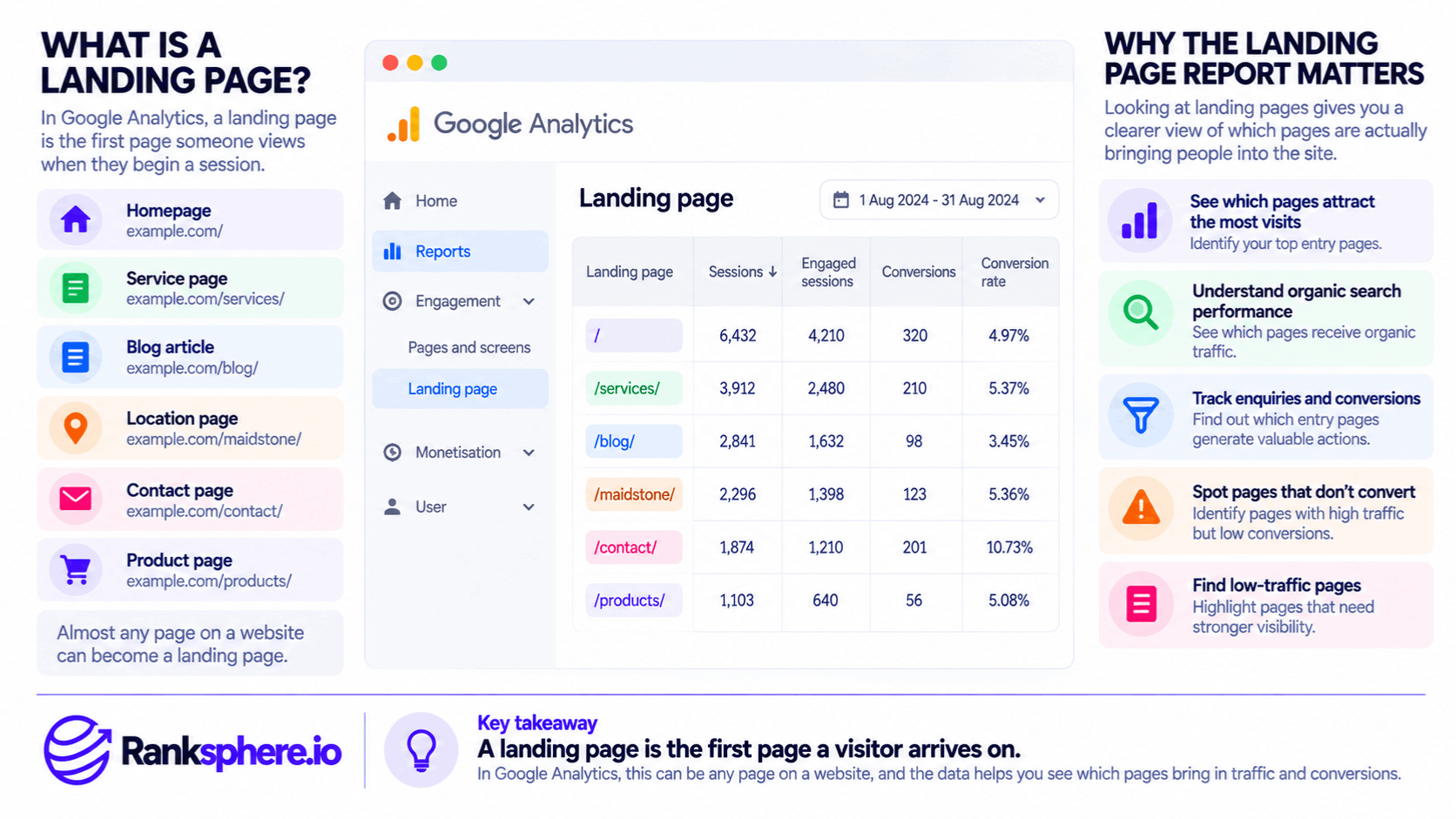
In Google Analytics 4, a landing page is the first page viewed during a session.
It doesn't need to be designed specifically for a marketing campaign.
For example, imagine someone searches Google for "flat roof repair cost" and clicks a roofing company's pricing guide.
That guide becomes the landing page for the session, even though the visitor didn't start on the homepage.
Similarly, someone clicking a paid advertisement may arrive on a purpose-built campaign page.
Google Analytics can identify both as landing pages.
Why the Landing Page Report Matters
The landing page report helps businesses understand which pages bring visitors into their websites.
This is useful because the homepage isn't always the main entry point.
For example, a local dental practice might receive organic traffic through:
- Its dental implants service page
- A guide about wisdom tooth removal
- A treatment pricing page
- An article about tooth sensitivity
These pages may attract visitors with different needs.
Reviewing them individually can reveal opportunities that website-wide traffic totals might hide.
Identify Which Pages Attract Organic Search Traffic
By examining landing pages alongside the relevant traffic source or channel, businesses can identify which pages bring people from Google Search.
For example, a physiotherapy clinic may discover that its article about lower back pain attracts substantial organic traffic.
However, its appointment booking page may receive fewer visitors.
This doesn't necessarily mean the article is performing better.
The two pages serve different purposes.
One may help people understand a condition, while the other is intended to support appointment bookings.
Compare Landing Pages With Conversions
Landing page reports can also help identify pages that attract visitors but contribute relatively few valuable actions.
For example, an emergency plumbing page may receive significant traffic but generate fewer tracked enquiries than expected.
That could justify reviewing:
- Whether the phone number is easy to find
- Whether the page matches search intent
- Whether the business's service area is clear
- Whether the contact form works
- Whether visitors can take action on mobile
However, a low conversion rate doesn't automatically mean the page is poorly designed.
The type of traffic, search intent, and accuracy of conversion tracking also matter.
See conversion rate for more information.
Find Pages That Receive Little Entry Traffic
The report can also reveal pages that rarely serve as the first page of a session.
This may be useful during a content audit.
However, a page with few landing sessions isn't necessarily unsuccessful.
Some pages are mainly accessed through internal navigation.
For example, a detailed pricing or booking information page may receive visitors after they've already explored another service page.
Evaluate each page according to its purpose before deciding whether it needs improvement.
What Is a Campaign Landing Page?
A campaign landing page is a webpage created to support a particular marketing activity.
For example, a local dental practice might run a Google Ads campaign promoting dental implant consultations.
Instead of sending visitors to the homepage, the advertisement could link to a page specifically about dental implant consultations.
That page would explain the service, answer common questions, and provide a clear booking option.
Campaign landing pages are commonly used for:
- Google Ads
- Paid social media advertising
- Email marketing
- Promotional campaigns
- QR codes on printed materials
- Event registrations
- Lead generation campaigns
The objective is to make the transition from the marketing message to the next action as straightforward as possible.
One Primary Conversion Goal
Campaign landing pages usually focus on a particular action.
For example:
- Book an appointment
- Request a quote
- Register for an event
- Download a guide
- Submit an enquiry
A roofing company's advertisement for roof inspections might direct visitors to a page with a prominent inspection enquiry form.
Other useful information can still appear on the page, but the primary action should remain clear.
Message Match
Message match means the landing page delivers what the advertisement or marketing message promised.
For example, if an advertisement promotes flat roof repairs in Bristol, the destination page should clearly discuss flat roof repairs in Bristol.
Sending visitors to a generic roofing homepage may require them to search for the advertised service.
That additional effort can create unnecessary friction.
The closer the page matches the visitor's expectations, the easier it is for them to find the relevant information.
Reduced Navigation
Some campaign landing pages remove or simplify the main website navigation.
The idea is to reduce distractions and keep visitors focused on the campaign's objective.
However, removing navigation isn't always necessary.
For example, someone considering an expensive medical treatment may want to review practitioner qualifications, other services, or contact information before booking.
The appropriate amount of navigation depends on the audience, offer, and decision involved.
The goal should be to help visitors make an informed decision, not prevent them from accessing useful information.
Landing Page vs Service Page
A campaign landing page and a service page can look similar, but they often have different purposes.
A service page is usually part of the website's main structure.
It explains a service and is commonly intended to remain useful for organic search visitors.
A campaign landing page is often created for a specific advertisement or promotion.
| Feature | Service page | Campaign landing page |
|---|---|---|
| Main purpose | Explain a service and support enquiries | Support a specific campaign action |
| Common traffic source | Organic search and internal navigation | Paid ads, email, or promotions |
| Content | Broad service information | Focused on campaign intent |
| Navigation | Usually retains normal website navigation | May use simplified navigation |
| SEO | Often intended for organic indexing | May or may not need indexing |
| Lifespan | Usually ongoing | May be temporary or ongoing |
For example, a plumbing company may have an emergency plumbing service page available through its main website.
It might also create a campaign page specifically for an advertisement promoting emergency call-outs.
Both can be useful, but they shouldn't be created without a clear reason.
Should Campaign Landing Pages Be Indexed by Google?
Not every campaign landing page needs to appear in Google's organic search results.
For example, a temporary page created for a limited promotional offer may have little value as a permanent search result.
In that situation, the business may decide to use a noindex directive.
A valid noindex directive tells supporting search engines not to include the page in their search index once they can crawl and process it.
However, campaign landing pages don't automatically need to be noindexed.
Some provide useful, original information and may be suitable for organic search.
The decision should depend on the purpose and content of the page.
When Noindex May Be Appropriate
Consider noindex when a page:
- Exists only for a short campaign
- Duplicates an existing service page without offering distinct value
- Contains campaign-specific information that shouldn't appear as an organic result
- Isn't intended to be discovered through search engines
However, noindex should be used deliberately.
Applying it to a page that already attracts valuable organic traffic could remove that page from search results.
Avoid Unnecessary Duplicate Pages
Businesses sometimes create several landing pages promoting essentially the same service.
For example, a roofing company might have:
- A flat roof repair service page
- A Google Ads flat roof repair page
- A promotional flat roof repair page
- Another landing page with nearly identical information
These pages may create unnecessary maintenance work.
They can also overlap in search intent, depending on how they're implemented.
This relates to keyword cannibalisation, although duplicate-looking pages don't automatically cause a ranking problem.
Before creating another page, decide whether it serves a genuinely different audience or purpose.
What Makes a Good Landing Page?
Whether a visitor arrives through Google Search or a paid campaign, the page should help them accomplish what they came to do.
Several elements can make that easier.
1. A Clear Heading
The main heading should explain what the page offers.
For example:
Emergency Plumbing Services in Maidstone
This is more useful than a generic heading such as "Solutions You Can Trust."
Visitors should be able to recognise the service without searching through the page.
2. Content That Matches Search Intent
The page should answer the questions associated with the visitor's search or campaign.
For example, someone looking for dental implant treatment may want to know:
- What treatment involves
- Who may be suitable
- How much it costs
- How long it takes
- How to arrange a consultation
A page that focuses only on promotional language may leave important questions unanswered.
3. A Clear Call to Action
Visitors should understand what they can do next.
Depending on the service, that might mean:
- Calling the business
- Booking an appointment
- Requesting a quote
- Completing a form
- Checking availability
For high-intent local searches, making the main action easy to find can reduce unnecessary steps.
4. Useful Above-the-Fold Content
The content visible before scrolling should help visitors confirm they've reached the right page.
As explained in above the fold, this may include the service, relevant location, and a clear next step.
However, not every detail needs to fit on the first screen.
The main goal is to provide enough information for visitors to understand the page and decide whether to continue.
5. Genuine Trust Information
Local service pages often benefit from information that helps customers evaluate the business.
Examples include:
- Genuine customer reviews
- Relevant professional qualifications
- Photographs of completed work
- Clear business contact information
- Accurate service availability
- Transparent pricing information
Use only claims and evidence the business can substantiate.
Avoid invented ratings, misleading testimonials, or unsupported guarantees.
6. Simple Contact Forms
Forms should collect the information genuinely needed to handle the enquiry.
For example, a roofing quote form may require a name, contact method, property location, and short description of the problem.
Asking for unnecessary information can make the process more demanding.
However, extremely short forms aren't always better.
The right form length depends on the information needed to provide the service.
7. Good Mobile Performance
Local business visitors may use mobile devices, particularly when searching for immediate services.
A useful mobile landing page should have:
- Readable text
- Tappable buttons
- Appropriate spacing
- A clear contact option
- Fast-loading important content
- Forms that work on small screens
Review the page on real devices rather than relying only on desktop previews.
How to Measure Landing Page Performance
Landing page performance should be measured according to the page's purpose.
A campaign page designed to generate appointment bookings needs different evaluation criteria from an educational article attracting organic search visitors.
Traffic by Channel
Review where visitors come from.
For example, a roofing company's service page may receive visitors from:
- Organic Search
- Paid Search
- Direct traffic
- Referral websites
- Email campaigns
Different traffic sources can bring visitors with different levels of intent.
Comparing all sessions without considering the source may lead to misleading conclusions.
Conversion Rate
Conversion rate measures the proportion of relevant interactions or sessions that result in a defined conversion, depending on the measurement method.
For example, if a campaign page receives 200 sessions and produces 12 tracked enquiry submissions, its session-based conversion rate would be 6%.
However, the calculation must match how conversions and sessions are configured.
Also remember that a phone number click doesn't necessarily represent a completed call.
Quality of Enquiries
A landing page may generate many form submissions without producing useful leads.
For example, a roofing company might receive enquiries from people outside its service area.
Reviewing lead quality helps the business understand whether the page is attracting appropriate customers.
Performance by Device
Compare mobile and desktop behaviour.
For example, a landing page may work well on desktop while hiding the phone number or booking button behind a large image on mobile.
Device-level reporting can help identify these differences.
Content Engagement
Educational landing pages may need different measurements.
For example, an article explaining the costs of roof replacement may attract visitors who are researching rather than immediately requesting a quote.
Its value may include helping readers understand the service and move to other relevant pages.
Don't evaluate every informational article solely by immediate enquiries.
Common Landing Page Mistakes
Several mistakes can make landing page performance difficult to understand or improve.
Confusing Analytics Landing Pages With Campaign Pages
A landing page report in Google Analytics doesn't contain only specially designed campaign pages.
It includes ordinary website pages where sessions begin.
Clarify which meaning is being discussed before recommending changes.
Sending Ads to Irrelevant Pages
A paid advertisement should direct visitors to information that matches the offer.
For example, an advertisement for emergency plumbing shouldn't lead to a general homepage where visitors need to find the emergency service themselves.
Removing Too Much Navigation
Reduced navigation can work for focused campaigns.
However, some visitors need additional information before contacting a business.
Removing all navigation without considering the customer's decision process may make the page less helpful.
Hiding Important Contact Options
A local service landing page shouldn't make visitors search through several menus to find a phone number or booking option.
Make the primary action easy to locate.
Using Unnecessarily Long Forms
Collecting too much information can add friction.
Ask for the information needed to respond appropriately.
Leaving Unnecessary Duplicate Campaign Pages
Businesses may accumulate old campaign pages that repeat existing service content.
Review whether those pages still serve a purpose.
Where appropriate, update, consolidate, redirect, or exclude them from indexing based on their actual use.
Measuring Only Traffic
A landing page with high traffic isn't necessarily successful.
Review relevant conversions, enquiry quality, and customer actions alongside traffic.
However, remember that some informational pages are designed to help users rather than generate immediate leads.
Landing Page Best Practices
To improve landing pages for local businesses:
- Clarify whether you're discussing analytics landing pages or dedicated campaign pages.
- Review landing page performance by traffic channel.
- Match page content to the search query or marketing message.
- Use a clear heading that explains the service.
- Make the primary action easy to find.
- Include genuine evidence and useful customer information.
- Keep forms appropriate to the enquiry.
- Test the page on mobile devices.
- Avoid unnecessary distractions.
- Retain useful navigation where visitors need it.
- Review campaign pages for duplication.
- Apply noindex only where it serves a clear purpose.
- Measure outcomes that match the page's goal.
- Review performance regularly rather than relying on site-wide totals.
The objective isn't to make every landing page look identical.
It's to help the visitor find what they expected and complete the next step with as little unnecessary effort as possible.
Example of a Landing Page Problem for a Local Business
Consider a hypothetical plumbing company called Aldermoor Plumbing.
The company works with an agency that reports poor landing page conversion performance.
The business owner assumes the agency is referring to dedicated landing pages created for a previous advertising campaign.
The agency, however, is discussing the Google Analytics landing page report.
What the Report Shows
The report indicates that the company's emergency plumbing service page receives a substantial share of organic search entries.
However, tracked contact actions are lower than expected.
The agency initially considers rebuilding the page.
Before making changes, it reviews the mobile experience.
What the Agency Discovers
On mobile, the page opens with:
- A large hero image
- A generic slogan
- A cookie consent banner
- A navigation menu containing the phone number
The service is relevant to the visitor's search, but the main contact option is difficult to find.
Someone looking for emergency plumbing assistance has to open the menu before reaching the phone number.
The problem may not require a completely new page.
It may simply require a clearer layout.
How the Agency Improves the Page
The team makes several changes.
It adds a clear emergency plumbing heading near the top.
A tappable phone button appears prominently beneath the introductory text.
The hero image is reduced so it doesn't dominate the first screen.
The page also explains the available service area and provides a straightforward alternative enquiry option.
The changes are designed to reduce unnecessary steps for visitors who are ready to contact the business.
How the Agency Measures the Results
After the changes, the agency reviews:
- Mobile contact button clicks
- Tracked phone calls, where available
- Contact form submissions
- Conversion rates by traffic source
- Relevant mobile performance data
The team compares results over an appropriate period rather than assuming the changes automatically increased calls.
It also checks whether traffic volume, search demand, or other factors changed.
Example Shows
“The original problem was a misunderstanding about the term "landing page."
The agency was discussing the first page of an analytics session, while the business owner was thinking about dedicated marketing pages.
Once the meaning was clarified, the team could investigate the actual issue.
A landing page isn't always a page created for a campaign. Sometimes it's simply the page where a visitor begins their journey through your website.
For local businesses, understanding both meanings helps teams make better decisions about website content, campaign design, and conversion performance.”
See Also
- Service Page — Explaining a specific service and supporting customer enquiries.
- Conversion Rate — Measuring how often visitors complete important actions.
- Above the Fold — Understanding what visitors see before scrolling.
- Google Analytics 4 — Measuring landing pages, traffic sources, and website interactions.
- UTM Parameters — Tracking campaign traffic using tagged URLs.
- Noindex — Preventing selected pages from appearing in search engine indexes.