Listing Accuracy Score
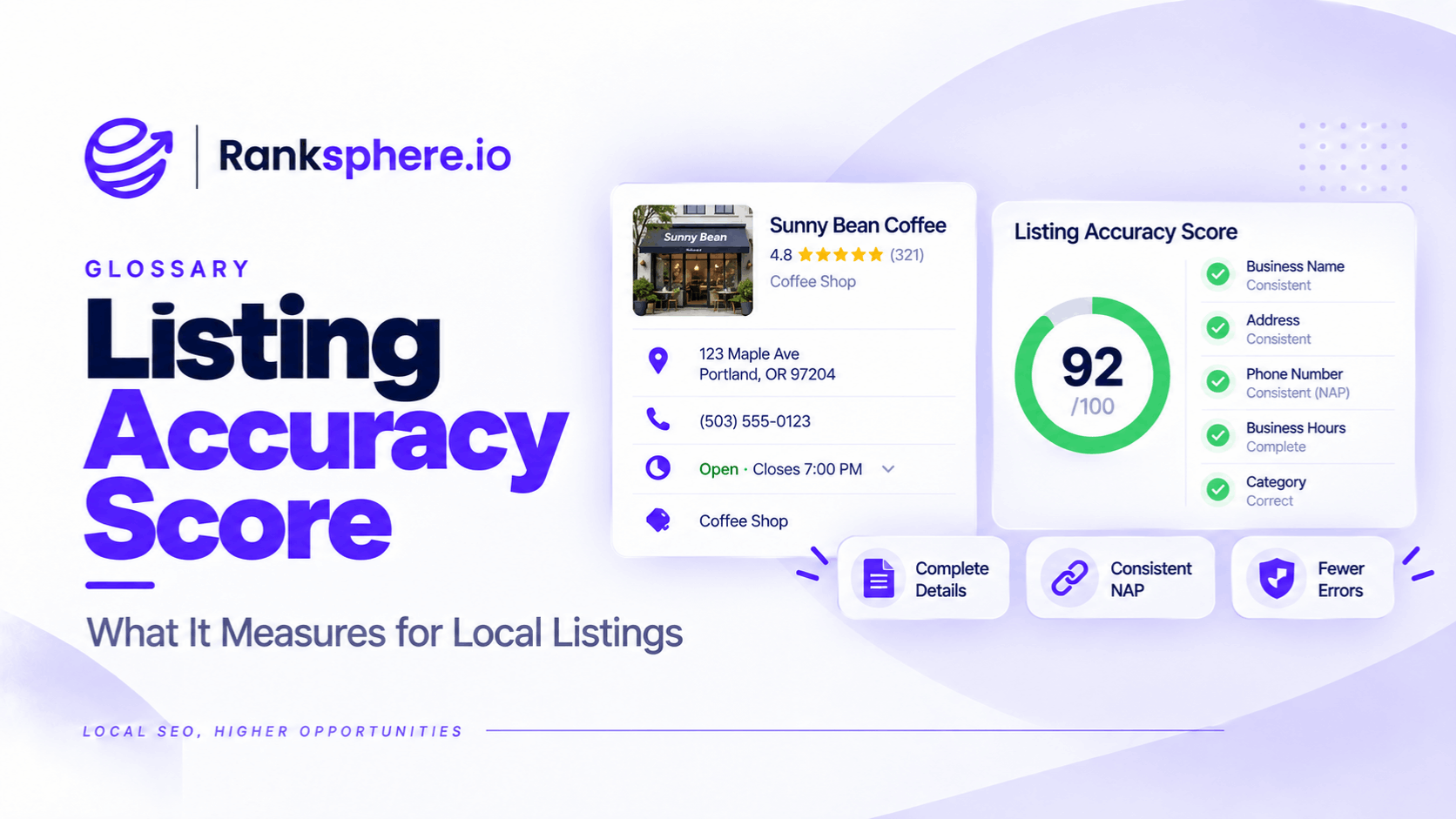
A listing accuracy score is a metric used by local SEO tools to measure how accurate and consistent a business's information is across online directories.
It is usually expressed as a percentage or numerical rating based on information such as the business name, address, telephone number, missing listings, and duplicates.
For example, a citation management tool might report that a plumbing company has a listing accuracy score of 78%.
That figure summarises the tool's assessment of the directories it checked. It doesn't mean Google considers the business 78% accurate.
Listing accuracy scores are created by software providers. Google doesn't publish a universal listing accuracy score or use a publicly documented percentage as a local ranking factor.
The underlying work still matters. Incorrect phone numbers, outdated addresses, and duplicate listings can cause real problems for customers.
However, the score should help businesses identify those issues rather than become the main objective of a local SEO campaign.
How Is a Listing Accuracy Score Calculated?
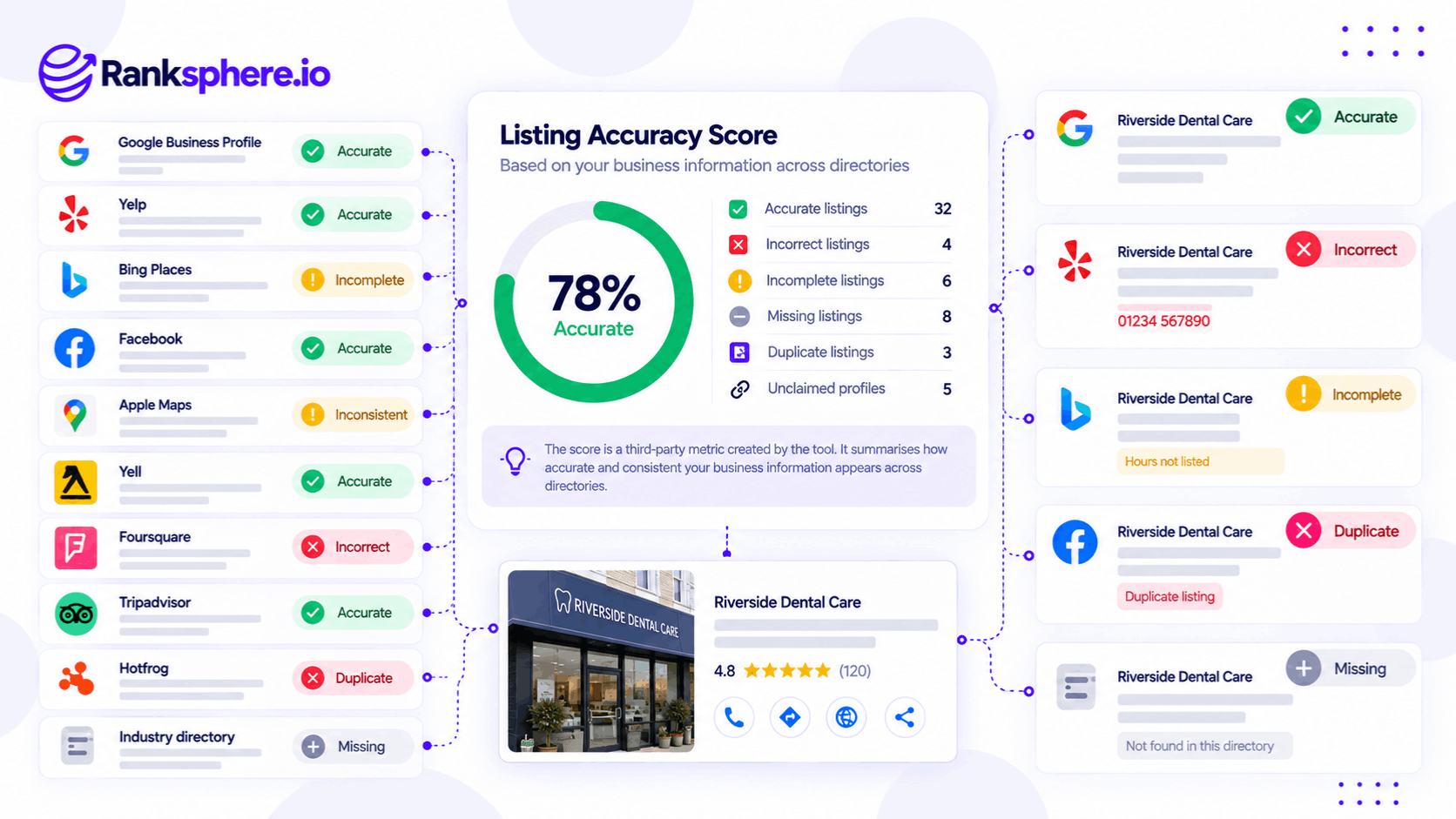
Most listing accuracy tools compare information found in online directories against a reference business record.
That reference usually contains the correct:
- Business name
- Address
- Telephone number
- Website URL
- Other supported business details
The tool then checks whether directory listings match the reference information.
For example, a dental practice might have the following records:
| Directory | Information found | Status |
|---|---|---|
| Directory A | Correct name, address, and phone | Accurate |
| Directory B | Previous phone number | Inaccurate |
| Directory C | Previous business address | Inaccurate |
| Directory D | Two listings for the same location | Duplicate |
| Directory E | No listing found | Missing |
The software uses these findings to calculate its score.
However, there is no universal formula.
Some tools calculate the percentage of accurate listings. Others apply different weights to missing, inconsistent, or duplicate records.
This means two tools can audit the same business and report different scores.
Neither result is automatically incorrect. Each reflects its own database and calculation method.
Why Listing Accuracy Scores Differ Between SEO Tools
Several factors influence how a tool calculates listing accuracy.
1. Different Directory Databases
Not every local SEO platform checks the same websites.
For example, one tool might analyse 100 directories, while another checks several hundred.
The results can differ depending on which directories are included.
A business could receive a high score from a tool that checks a smaller set of accurate listings.
Another tool might find outdated information on directories the first one doesn't monitor.
The difference doesn't necessarily mean one platform is more reliable.
It means their coverage and assessment methods differ.
2. Different Matching Rules
Tools may handle formatting differences differently.
For example:
123 High Street
and
123 High St
may refer to the same address.
Some tools recognise common abbreviations and treat them as equivalent.
Others may flag them as inconsistent.
Minor formatting variations don't necessarily mean the business information is wrong.
The important question is whether the listing accurately identifies the business and allows customers to find or contact it.
3. Different Treatment of Missing Listings
Some tools reduce the score when a business is missing from a directory.
Others calculate accuracy using only the listings they find.
This can produce substantially different results.
For example, being absent from a relevant industry directory may represent a missed opportunity.
However, being absent from an obscure directory that customers never use isn't automatically a problem.
A missing listing and an inaccurate listing are different findings.
4. Different Weighting Systems
Some tools assign greater importance to particular directories or error types.
Others may treat all checked listings similarly.
For example, a wrong telephone number on a widely used mapping platform may be more important to a local business than a minor address formatting variation on an obscure website.
A score that doesn't reflect those differences can be misleading.
5. Different Duplicate Detection Methods
A tool may find more than one listing for the same business.
However, identifying genuine duplicates isn't always straightforward.
Two listings may represent:
- An accidental duplicate
- Two eligible business locations
- Separate practitioners
- Different business departments
- Outdated records
Automated duplicate detection can provide useful leads, but the findings may need manual review.
Does a Listing Accuracy Score Affect Google Rankings?
Google doesn't identify any third-party listing accuracy score as a ranking factor.
Its published guidance states that local results are primarily influenced by relevance, distance, and prominence.
Google also recommends keeping Business Profile information accurate and complete.
That distinction is important.
Accurate business information helps customers understand where a business operates and how to contact it.
However, raising a vendor's listing accuracy score from 70% to 95% doesn't guarantee better Google Maps rankings.
A business can improve its score without changing any information that Google relies on for its local results.
Similarly, an important listing error may remain unresolved even after the overall score increases.
The most useful question isn't whether the percentage improved.
It's whether important inaccuracies were corrected.
Why NAP Consistency Matters
NAP consistency refers to maintaining accurate business names, addresses, and phone numbers across relevant sources.
For example, a physiotherapy practice might move to a new address.
Its website and Google Business Profile are updated, but several directories still show the previous location.
Customers finding those listings could travel to the wrong address.
A listing audit can identify the outdated records and help the business prioritise corrections.
However, NAP consistency doesn't mean every source must use identical punctuation or abbreviations.
For example, "Street" and "St" can describe the same address.
The priority is accurate, unambiguous information rather than matching every character across the internet.
Where Listing Accuracy Scores Can Be Misleading
A score is useful for summarising findings, but it can hide differences in the importance of those findings.
A High Score Can Hide Serious Errors
Imagine a business has accurate information on 95 directories.
However, its Apple Maps listing displays an old telephone number.
The tool may report a high accuracy score because most checked listings are correct.
Yet the incorrect number could still prevent customers from contacting the business.
The overall percentage doesn't communicate the importance of that individual error.
For businesses using Apple's services, information maintained through Apple Business Connect and its successor business management tools may deserve particular attention.
Missing Listings Can Reduce the Score Unnecessarily
Some tools penalise businesses for being absent from directories.
However, not every directory is worth joining.
For example, a dental practice may have no practical reason to create profiles on dozens of unrelated or low-value websites.
Submitting the business to more directories simply to increase a percentage can waste time and money.
This is why citation building should focus on relevant, legitimate platforms.
A Perfect Score May Be Unrealistic
Some directories don't allow business owners to claim or edit listings easily.
Others may have outdated records, technical problems, or limited support.
A tool may continue reporting those listings as inaccurate even after reasonable correction attempts.
That doesn't necessarily mean the business should keep investing time in them.
A perfect score isn't the objective.
Accurate information on useful platforms is.
A Score Can Improve Without Meaningful Business Benefits
For example, an agency may submit a business to dozens of additional directories.
Its listing accuracy score increases because more records now match the reference data.
However, the new listings may have little relevance to customers.
The campaign's numerical result improves without a clear improvement in how customers discover or contact the business.
This is why a listing accuracy score should be treated as a supporting metric rather than a business outcome.
See KPI for more information about choosing meaningful performance measures.
What Should a Citation Audit Prioritise?
Instead of working only towards a higher score, businesses should review the findings behind it.
Incorrect Phone Numbers
A wrong telephone number can prevent customers from reaching the business.
For example, an optician may have an old number displayed on a directory that ranks prominently for its name.
Correcting that information should generally take priority over minor formatting differences elsewhere.
Outdated Addresses
Businesses that relocate should review important online listings.
For example, a restaurant might have moved premises while an old directory still displays its previous address.
Customers relying on the listing could arrive at the wrong location.
This is an actionable problem regardless of how much it affects the overall accuracy score.
Duplicate Listings
Duplicate listings may display conflicting information or confuse customers.
However, not every similar-looking record is an invalid duplicate.
Before requesting removal or merging, confirm whether the listings represent the same business or separately eligible entities.
Incorrect Business Names
A directory might display an outdated trading name or incorrect brand information.
For example, a business that has rebranded may still appear under its previous name.
Updating relevant sources can help customers recognise the current business.
Unclaimed Important Listings
Some directories allow business owners to claim and manage their profiles.
Claiming relevant listings can help businesses maintain accurate information.
However, not every directory requires a claimed listing to provide useful information.
Outdated Data Aggregator Records
A data aggregator collects and distributes business information to other systems.
An outdated record may contribute to incorrect information appearing across multiple destinations.
For example, a business that moved premises may find its former address in several directories using related data sources.
Investigating the underlying source may be more efficient than treating every incorrect listing as an unrelated problem.
However, businesses should confirm how information is being distributed before assuming a particular aggregator caused the errors.
What Should Agencies Report Instead of Just the Score?
Clients need to understand what was found, what was corrected, and what still requires attention.
For example, instead of reporting:
Listing accuracy improved from 65% to 82%.
An agency could explain:
"The audit identified an outdated telephone number on two important directories, one duplicate business listing, and several records showing your previous address. The telephone numbers have been corrected, the duplicate is under review, and the address updates are pending."
The second explanation is more useful because it describes actual work and outstanding problems.
A good citation report can include:
- Platform name
- Listing URL
- Type of error
- Priority
- Action taken
- Current status
- Date last checked
For example:
| Platform | Finding | Priority | Status |
|---|---|---|---|
| Apple Maps | Previous business address | High | Correction submitted |
| Industry directory | Incorrect phone number | High | Corrected |
| Local directory | Suspected duplicate | Medium | Under review |
| Minor directory | Street abbreviation differs | Low | No action needed |
The priority depends on the business and the practical impact of each issue.
A duplicate shouldn't automatically outrank every other problem.
For example, an incorrect telephone number on a major customer-facing platform may need attention first.
How Ranksphere Helps With Listing Accuracy
Ranksphere's Local Citation Management audits business information across more than 500 directories using a reference business record.
It helps identify:
- Accurate listings
- Incomplete listings
- Inconsistent business information
- Missing listings
- Potential duplicates
This allows businesses and agencies to review specific problems rather than relying only on an overall accuracy figure.
The findings can then be prioritised according to their importance and the available correction options.
A score can provide a useful overview, but the individual findings explain what needs attention.
How to Use a Listing Accuracy Score Properly
A listing accuracy score isn't necessarily useless.
It can help businesses monitor progress within a particular software platform.
For example, an agency may run an audit at the beginning of a client engagement and repeat it after correcting several directory listings.
If the score improves, that can indicate progress according to the tool's methodology.
However, several precautions matter.
Compare Scores Within the Same Tool
Because different vendors use different calculations, scores shouldn't be compared directly.
For example, 85% in one tool doesn't necessarily represent better listing accuracy than 72% in another.
If you use a score to monitor progress, keep the tool and assessment method consistent where possible.
Review the Underlying Findings
Before taking action, inspect the records that contributed to the score.
For example, a missing listing on an important industry platform may be worth addressing.
A minor formatting discrepancy on a directory customers rarely use may not be.
Avoid Arbitrary Targets
There is no official Google requirement to achieve 90%, 95%, or 100% listing accuracy.
Businesses should aim to keep important information accurate rather than chase a particular number.
Account for Unresolved Listings
Some records may be difficult or impossible to correct.
Document those limitations rather than repeatedly spending resources on low-value changes.
Measure Practical Outcomes
Where appropriate, consider whether corrections improved:
- Accuracy of customer-facing contact details
- Business location information
- Duplicate listing problems
- Access to important directory profiles
- Relevant referral traffic
- The business's ability to maintain accurate information
Not every correction will produce a measurable increase in enquiries.
Preventing customers from receiving incorrect information is still valuable.
Common Listing Accuracy Score Mistakes
- Treating the score as a Google ranking factor. It is calculated by the software provider, not Google.
- Comparing scores from different tools. Directory coverage and scoring methods differ.
- Reporting only the percentage. Clients need to know which problems were found and corrected.
- Creating unnecessary citations to improve the score. More listings aren't automatically better.
- Chasing 100% accuracy. Some discrepancies may be insignificant or difficult to resolve.
- Ignoring important individual errors. A wrong telephone number can matter more than dozens of formatting differences.
- Treating missing listings as inaccuracies. Absence and incorrect information are separate issues.
- Assuming every duplicate is invalid. Some similar records represent legitimate businesses or locations.
- Spending too much time on obscure directories. Prioritise sources relevant to customers.
- Assuming score improvements guarantee more traffic. A numerical increase doesn't establish better search performance.
Listing Accuracy Score Best Practices
To use listing accuracy scores effectively:
- Establish an accurate reference business record.
- Review the directories included in the audit.
- Prioritise incorrect contact details on important platforms.
- Investigate genuine duplicate listings.
- Correct outdated addresses and business names.
- Check relevant data aggregator records where appropriate.
- Use the score as a supporting progress indicator.
- Compare results consistently within one tool.
- Avoid unnecessary directory submissions.
- Document unresolved or uneditable listings.
- Report specific corrections and outstanding issues.
- Evaluate results based on practical business value.
The score should make citation work easier to understand, not determine which tasks receive attention.
Example of a Listing Accuracy Score That Hides Important Problems
Consider a hypothetical local plumbing company working with an SEO agency.
The agency runs a citation audit and receives a listing accuracy score of 54%.
To improve the result, it begins creating and updating directory listings.
Several months later, the score increases to 89%.
The agency presents the 35-point improvement as the campaign's main achievement.
What the Agency Overlooked
A closer review reveals two unresolved problems.
First, the business's Apple Maps listing still displays an old address.
Second, several other directories contain outdated information that may have originated from an older data source.
The agency's original audit tool didn't adequately identify or prioritise those records.
Meanwhile, much of the score improvement came from adding new listings to less relevant directories.
Why the Score Was Misleading
The score increased because the software detected more accurate records within its own directory set.
However, customers could still encounter incorrect information on an important mapping platform.
The improvement was real according to the tool's scoring method.
It simply wasn't a complete measure of the business's listing accuracy.
How the Agency Changes Its Approach
The agency rebuilds the report around specific findings.
It prioritises:
- Correcting the outdated Apple Maps address.
- Investigating the source of conflicting address records.
- Reviewing suspected duplicate listings.
- Updating relevant industry directories.
- Documenting low-priority issues that don't require immediate action.
The agency continues monitoring the listing accuracy score, but it no longer uses the percentage as the main measure of success.
What the Example Shows
A listing accuracy score can improve while important customer-facing problems remain unresolved.
The most valuable work isn't always the work that produces the largest numerical increase.
Correcting an old address on a major mapping platform may have a smaller effect on a vendor score than creating dozens of new citations.
However, it can be much more useful to customers trying to find the business.
A listing accuracy score summarises what a tool finds. It doesn't tell you which problems matter most.
For local businesses, the priority should be accurate contact information, reliable business listings, and a clear process for resolving meaningful errors.
See Also
- Citation Audit — Reviewing business listings for inaccurate, incomplete, or duplicate information.
- NAP — Maintaining accurate business names, addresses, and phone numbers.
- Duplicate Listing — Identifying multiple records that may represent the same business.
- Data Aggregator — Understanding sources that distribute business information.
- Domain Authority — Another third-party SEO metric that should not be mistaken for a Google ranking score.
- KPI — Choosing meaningful performance indicators.