The meta keywords tag is an HTML element that lists keywords associated with a webpage. It was once used by search engines to help understand what a page was about.
Today, Google ignores it entirely.
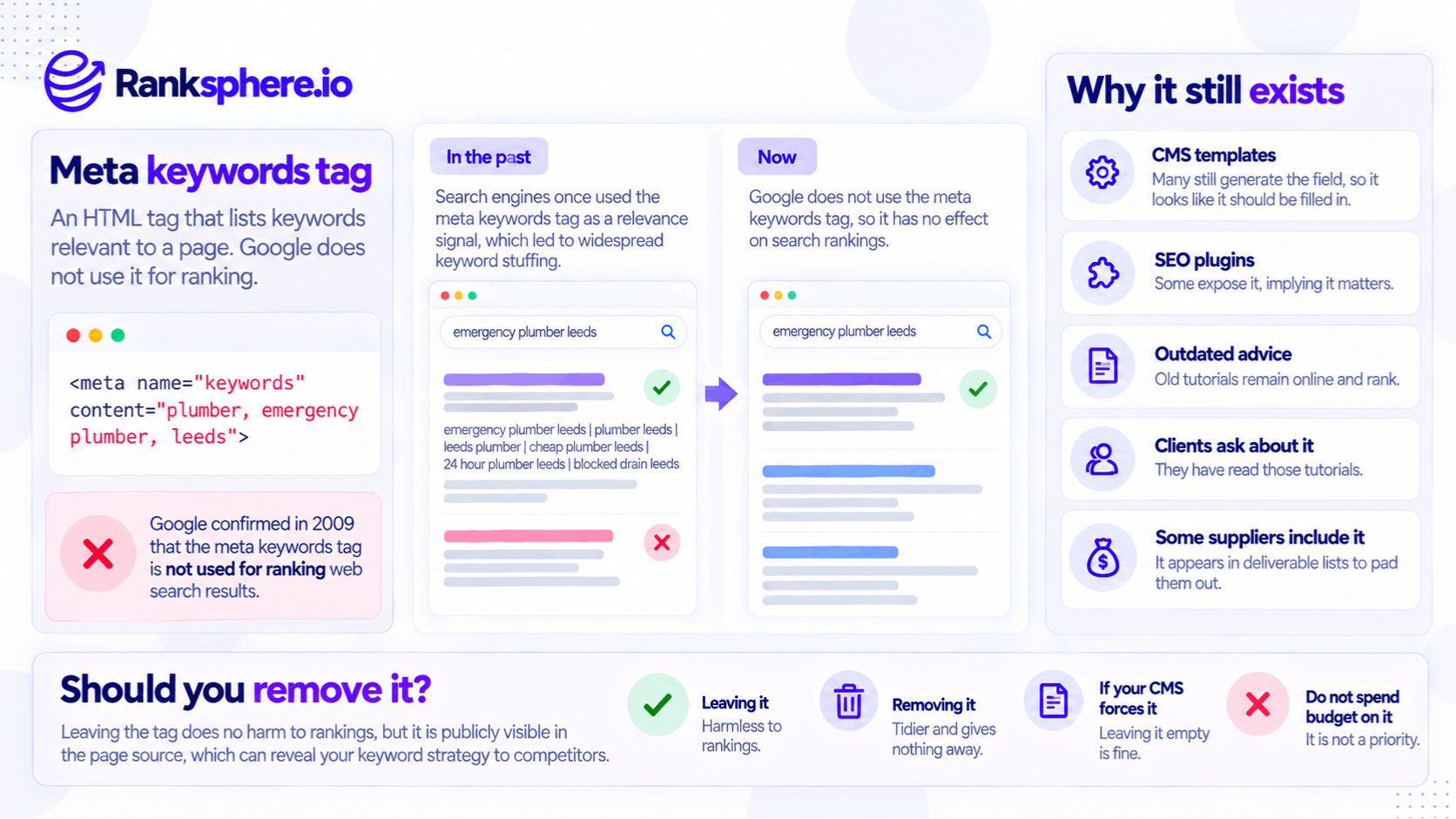
Google confirmed in 2009 that the meta keywords tag is not used in its web search rankings. Its current documentation also states that the tag has no effect on indexing or ranking.
Yet the field still appears in some content management systems, SEO plugins, and agency proposals.
If an SEO supplier charges for meta keyword optimisation, they're offering work that has no ranking value in Google Search.
For most website owners, the tag is something to recognise and ignore, not something to optimise.
What Does the Meta Keywords Tag Look Like?
The tag sits within the HTML <head> section of a webpage.
For example:
<meta name="keywords" content="plumber, emergency plumber, leeds">Historically, these keywords were intended to describe the page's subject.
A plumbing company might list its services, location, and related search terms.
The problem was that website owners could enter almost anything.
Some added hundreds of keywords, including irrelevant terms and competitors' names, hoping to influence rankings.
Because the information was easy to manipulate, it became unreliable as a measure of relevance.
Google ultimately stopped using it for web search rankings.
Does Google Use Meta Keywords for SEO?
No.
Google explicitly states that the meta keywords tag has no effect on indexing or ranking.
For example, adding the following keywords to a roofing service page won't help it rank:
<meta name="keywords" content="roof repair, roofing company, emergency roofer">Repeating the terms, adding locations, or updating the field every month won't change that.
This is different from using relevant keywords naturally in page titles, headings, and useful content.
Those elements help describe what a page actually offers.
The meta keywords tag does not.
Why Do Websites Still Have Meta Keywords?
Despite being obsolete for Google SEO, the field continues to appear for several reasons.
Old CMS templates. Some websites were built when meta keywords were still commonly used, and the field remains in the source code.
SEO plugins. Certain tools still expose a keywords field, even when it isn't useful for Google rankings.
Outdated tutorials. Older guides continue to circulate without explaining that Google's treatment of the tag changed years ago.
Client expectations. Business owners sometimes ask agencies to optimise meta keywords after encountering older SEO advice.
Outdated agency deliverables. Some proposals still include meta keyword optimisation as a recurring task.
The presence of a field in a CMS doesn't mean Google uses it.
Should You Remove the Meta Keywords Tag?
You can remove it, but there's usually no urgent reason to do so.
Google ignores the tag whether it contains keywords or is left empty.
If an old website generates meta keywords automatically, removing them can simplify the page's code and eliminate an unnecessary field.
However, it shouldn't take priority over genuine technical or content problems.
There is also a practical consideration: meta keywords are publicly visible in the HTML source.
A competitor can inspect them and see which terms you've listed.
That isn't the same as revealing your entire keyword strategy, but there's little reason to publish an unnecessary list of targets.
A reasonable approach is to leave the field empty or remove it when convenient.
Ranksphere's Website Audit Tool can help review website metadata and other technical SEO elements. A populated meta keywords field, however, shouldn't be treated as an urgent Google ranking issue.
Do Other Search Engines Use Meta Keywords?
Historically, some search engines used the tag, and smaller search systems may still interpret it.
Bing representatives have previously discussed using keyword stuffing in the tag as a possible spam indicator rather than a positive ranking signal.
However, this shouldn't be interpreted as proof that every populated meta keywords tag causes a Bing penalty.
For businesses primarily concerned with Google Search, there is no SEO benefit to optimising the tag.
What Meta Keywords Reveal About an SEO Proposal
The tag is particularly useful when evaluating an SEO agency's deliverables.
For example, suppose an agency proposes monthly meta keyword optimisation.
Before approving the work, ask what benefit it provides and which current Google documentation supports the recommendation.
Google's own documentation confirms that the tag has no ranking value.
Its inclusion may indicate an outdated proposal template or a misunderstanding of modern SEO.
Other items worth questioning include:
- Guaranteed first-page rankings
- Bulk citation building without checking directory relevance
- Fixed keyword density targets
- Toxic link removal services justified solely by third-party scores
- Preventive disavow work without evidence of a relevant manual action risk
Not every directory submission or backlink investigation is unnecessary. The issue is whether the work addresses a genuine problem and has a credible explanation.
An agency should be able to distinguish useful optimisation from obsolete practices.
What Should You Optimise Instead?
Rather than spending time on meta keywords, focus on elements that Google actually uses or recommends.
Title Tags
A title tag helps describe the page and is one of the sources Google uses when generating title links in search results.
For example, a dental practice should give its dental implants page a clear, descriptive title rather than a generic label such as "Services."
Google may rewrite the displayed title, but useful title elements remain important.
Meta Descriptions
A meta description summarises a page's content.
Google may use it when generating a search snippet if it considers the description useful.
Meta descriptions aren't a direct ranking factor, but a relevant summary can help searchers understand what the page offers.
Helpful Page Content
Make sure the page answers the questions visitors actually have.
For example, a roofing service page should clearly explain the work offered, the types of problems addressed, and how customers can make an enquiry.
Relevant keywords should appear naturally rather than being repeated to meet an arbitrary target.
Common Meta Keywords Mistakes
- Paying for meta keyword optimisation. Google doesn't use the tag for rankings.
- Filling it with keyword variations. More keywords don't create additional value.
- Including competitors' names. The tag is publicly visible and unnecessary.
- Assuming every SEO plugin field matters. Some fields remain for historical reasons.
- Treating missing meta keywords as an audit error. Their absence isn't a Google SEO problem.
- Confusing meta keywords with meta descriptions. They serve different purposes.
- Prioritising removal over important SEO issues. Fix indexing, usability, and content problems first.
Meta Keywords Best Practices
Ignore the meta keywords field for Google SEO.
If your CMS allows you to remove or disable it easily, doing so is reasonable. If it doesn't, leaving it alone is generally fine.
Don't include meta keyword optimisation in an SEO plan, and question proposals that present it as valuable ranking work.
Instead, invest in descriptive title tags, useful meta descriptions, accurate business information, and content that meets searchers' needs.
Example
“Consider a hypothetical dental practice evaluating two SEO agencies.
The first proposal includes monthly meta keyword optimisation, submission to hundreds of search engines and directories, and guaranteed first-page rankings.
The second proposes a Google Business Profile audit, a review of service pages, improvements to local search visibility, and reporting on enquiries.
The practice manager doesn't know which technical recommendations are valid, so she checks Google's documentation.
She quickly discovers that Google hasn't used meta keywords for rankings since 2009.
She also finds that no agency can guarantee specific Google rankings.
This raises questions about the first proposal.
Rather than choosing an agency based on the number of tasks listed, she asks both suppliers to explain how their work relates to the practice's goals.
The example illustrates a useful lesson.
An obsolete SEO task can sometimes tell you more about a proposal than it tells you about your website.
Knowing what Google doesn't use is just as important as understanding what it recommends.”
See Also
- Title Tag — An HTML element that helps Google understand and display page titles.
- Meta Description — A page summary that Google may use in search snippets.
- Meta Robots Tag — A meta tag that can control crawling-related and indexing behaviour.
- Keyword Stuffing — Unnatural keyword repetition intended to manipulate search rankings.
- Domain Authority — A third-party metric that isn't an official Google ranking requirement.
- Toxic Link — Understanding backlink toxicity scores and their limitations.