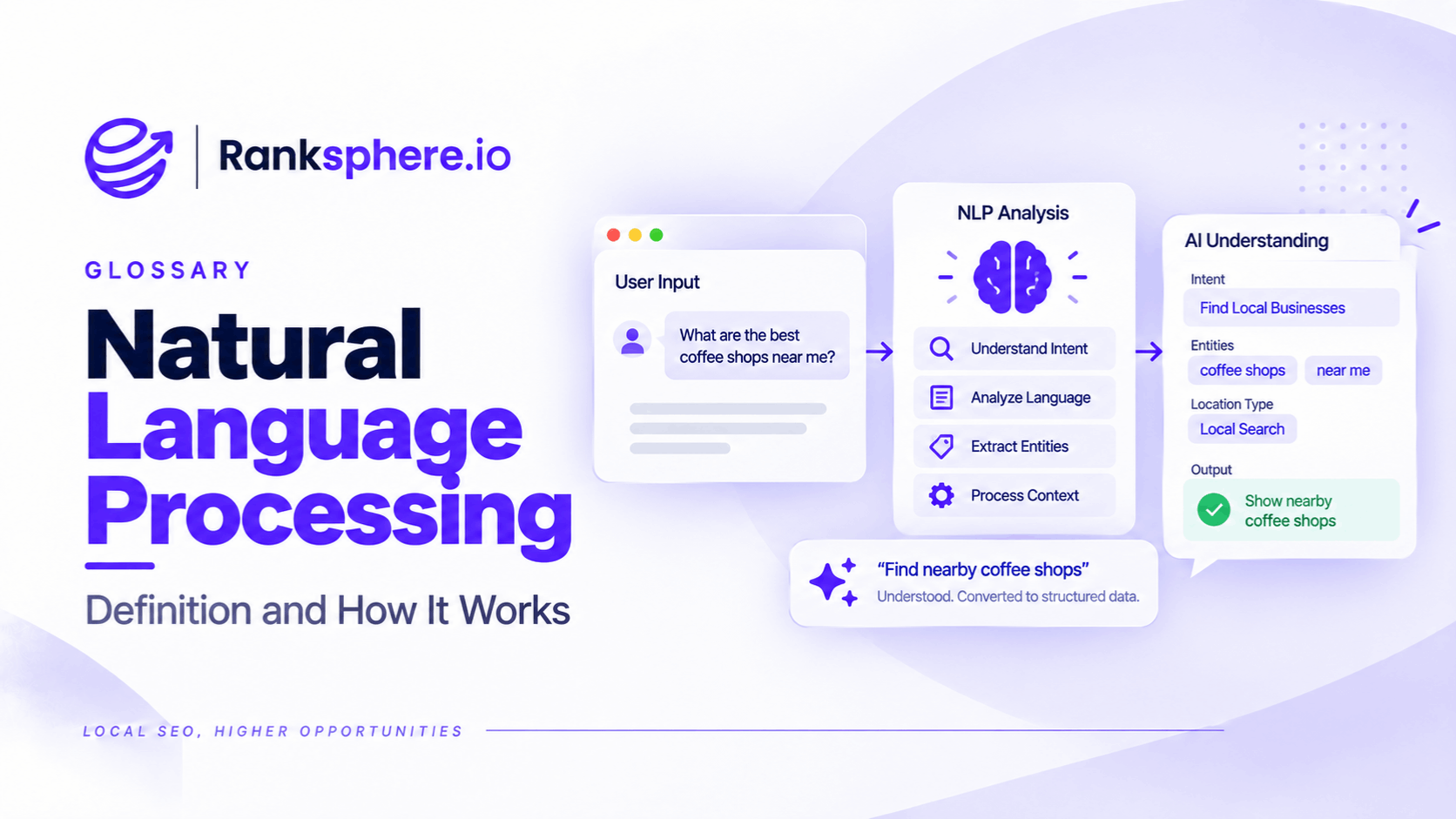
Natural language processing (NLP) is a branch of artificial intelligence that helps computers understand, interpret, and generate human language.
It allows machines to recognise the meaning behind words, understand context, and respond to questions written or spoken in everyday language.
In search engines, NLP helps connect what someone types into Google with information that answers their question, even when the webpage doesn't use the exact same words.
For example, someone searching for "how much does it cost to fix a leaking roof?" may find relevant pages discussing roof repair prices.
The search engine can recognise the relationship between those phrases without requiring an exact keyword match.
NLP supports technologies such as semantic search, conversational search, and AI-generated search experiences.
However, NLP and semantic search aren't the same thing. NLP provides techniques for understanding language, while semantic search uses meaning and context to retrieve relevant information.
For SEO, the practical lesson is simple: write content that answers people's questions clearly instead of repeating keywords to satisfy an algorithm.
How Does Natural Language Processing Work in Search?
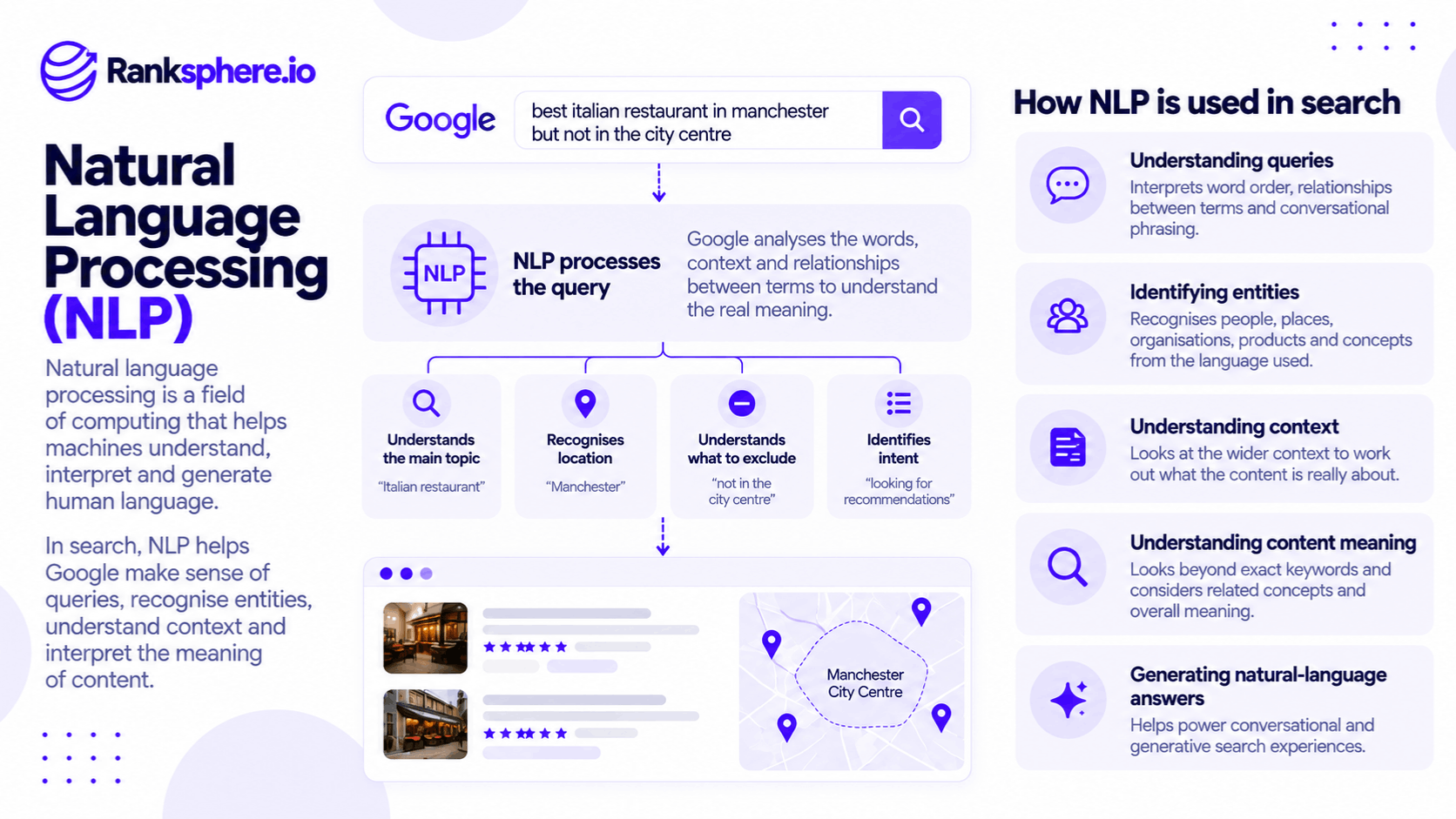
Modern search engines use language-understanding systems to interpret queries and evaluate relevant information.
Several NLP capabilities contribute to this process.
Understanding Search Queries
Words can change meaning depending on their order and relationship to one another.
For example:
- Dentist in Manchester
- Dentist near Manchester
- Dentist outside Manchester
These searches contain similar words but express different location preferences.
Language-understanding systems help search engines recognise those differences.
Google has publicly discussed systems such as BERT, which help interpret how words relate to one another within a query.
Recognising Entities
NLP can help identify entities, such as people, businesses, places, products, and organisations.
For example, the word "Apple" could refer to a fruit or a technology company.
A search for "Apple iPhone warranty" clearly relates to the company.
A search for "Apple fruit nutrition" refers to the food.
Recognising the intended entity helps search systems interpret the query correctly.
Understanding Context
The same word can have several meanings.
Consider "bat."
Someone searching for "best cricket bat" wants sporting equipment, while someone searching for "bat habitat" wants information about wildlife.
The surrounding words establish the context.
This allows search engines to retrieve content that matches the intended meaning rather than simply matching individual terms.
Understanding Related Concepts
Modern search systems can recognise relationships between different expressions.
For example:
- Roof repair cost
- Price to fix a leaking roof
- How much does roof repair cost?
These queries are closely related.
A useful page may be relevant to all three without repeating each phrase throughout the content.
However, this doesn't mean keywords are irrelevant. The language used on a webpage still helps communicate its subject.
Generating Natural Language Answers
NLP also contributes to AI systems that produce conversational responses.
For example, Google's AI-powered search features can generate explanations in response to complex questions.
These experiences use several technologies, including language models, information retrieval, and Google's search systems.
NLP is part of that broader process rather than the only technology involved.
How Has NLP Changed SEO?
Natural language understanding has made it less necessary to create separate pages for every minor keyword variation.
It has also reduced the usefulness of writing tactics that focus on repetition instead of meaning.
One Page Can Target Related Keyword Variations
Consider these searches:
- Dental implant cost
- Dental implant prices
- How much are dental implants?
- Cost of getting dental implants
A dental practice doesn't necessarily need four separate pages.
One useful pricing guide may answer all these questions.
This is where keyword mapping matters.
Closely related queries with the same search intent can often be grouped on one page.
However, different search intents may justify separate content.
For example, someone researching dental implant costs may need different information from someone looking for an implant specialist nearby.
Topic Coverage Matters More Than Keyword Repetition
A useful article about roof repairs might naturally discuss:
- Common causes of roof leaks
- Damaged flashing
- Missing or broken tiles
- Repair costs
- When replacement may be necessary
These topics belong together because they help explain the service.
Repeating "roof repair" throughout every paragraph doesn't provide the same value.
The objective is to cover the subject properly, not reach a particular keyword density.
Conversational Queries Are Easier to Interpret
People increasingly interact with search systems using complete questions.
For example:
"Can I repair a flat roof, or does it need replacing?"
This is more specific than simply searching for "flat roof repair."
Modern language-understanding systems can help search engines interpret conversational queries.
These often overlap with long-tail keywords.
However, NLP alone isn't responsible for changes in search behaviour. Mobile search, voice interfaces, and other developments also influence how people search.
Keyword Stuffing Is Still a Problem
Keyword stuffing involves repeating keywords unnaturally in an attempt to manipulate rankings.
For example:
Looking for a dentist in Bristol? Our Bristol dentist provides dental services in Bristol for patients searching for a Bristol dentist.
The location is relevant, but the repetition adds nothing useful.
A clearer version would be:
Our dental practice in Bristol offers routine appointments, cosmetic treatments, and emergency dental care.
The second example describes the service naturally.
Google explicitly identifies unnatural keyword repetition as a spam practice.
What Does NLP Mean for SEO Content Writing?
You don't need to understand the technical architecture behind natural language processing to write effective SEO content.
The important thing is understanding your audience.
Use the Language Your Customers Use
Businesses often describe their services differently from customers.
For example, a dental practice may use the term "osseointegration" when discussing implants.
Patients are more likely to ask how long a dental implant takes to heal.
A useful article can explain the technical term, but it should also answer the patient's question directly.
Answer Questions Before Adding Detail
If someone searches for dental implant costs, they should be able to find pricing information without reading several paragraphs about the history of implant dentistry.
Explain the answer first, then provide relevant details.
For example, a pricing guide might cover:
- The typical price range, where accurate figures are available
- Factors affecting the final cost
- Whether additional procedures may be needed
- What is included in a consultation
- How patients can request an assessment
This makes the page more helpful without forcing additional keywords into it.
Cover Related Topics When They're Relevant
A comprehensive article doesn't need to include every related term suggested by an SEO tool.
It should cover the information necessary to answer the reader's question.
For example, an emergency roofing page may need to explain availability, common repairs, service areas, and how customers can request assistance.
It doesn't need a lengthy section about the history of roofing materials simply to increase topical coverage.
Structure Content Clearly
Use descriptive headings and paragraphs that explain one idea at a time.
This helps readers find relevant information.
It can also make individual sections easier for search and retrieval systems to interpret.
The same principle is useful in retrieval-augmented generation, where AI systems may retrieve information from external sources.
However, using question-based headings or self-contained paragraphs doesn't guarantee that AI search systems will cite a page.
NLP SEO Myths and Misconceptions
Several SEO tools use NLP terminology to describe their content recommendations.
Some of these tools can help identify missing subjects or improve writing.
However, their proprietary metrics shouldn't be confused with Google's ranking systems.
LSI Keywords
LSI stands for latent semantic indexing, an information retrieval technique developed decades ago.
Some SEO tools use "LSI keywords" to describe words related to a primary keyword.
For example, a tool analysing "roof repair" might suggest terms such as flashing, roof tiles, water damage, and inspections.
These terms may be useful because they're relevant to roofing.
However, Google doesn't identify LSI keywords as a requirement for SEO, and Google representatives have rejected the claim that websites need them for ranking.
You don't need to insert a predetermined list of related terms into every article.
NLP Optimisation Scores
Some platforms provide an NLP content score.
For example, a tool might rate an article 65 out of 100 and suggest adding particular words to improve its score.
That number represents the tool's own analysis.
It isn't an official Google ranking metric.
A higher score may reflect closer alignment with the tool's recommendations, but it doesn't guarantee better rankings.
Entity Density
Some tools measure how frequently particular entities appear in content.
However, Google doesn't publish a required entity density.
Mentioning a company, location, or technical concept several more times doesn't automatically improve relevance.
Entities should appear when they help explain the subject.
Entity Salience Scores
Language-processing tools can estimate how prominent an entity is within a piece of text.
These scores may be useful for text analysis.
However, a salience score from a third-party tool or public language API isn't a confirmed Google Search ranking factor.
Treat these scores as diagnostic suggestions rather than targets.
The distinction is similar to proprietary toxic link scores.
They may help guide an investigation, but they aren't the same as Google's internal assessment.
Common NLP SEO Mistakes
- Treating LSI keywords as a ranking requirement. Related terms can be useful, but they aren't mandatory SEO keywords.
- Chasing NLP scores. A high score from a content tool doesn't guarantee better search performance.
- Repeating entities unnaturally. More mentions don't automatically improve relevance.
- Stuffing synonyms into content. Using variations of the same phrase repeatedly can still make writing unnatural.
- Confusing NLP with semantic search. One concerns language processing; the other concerns retrieving information based on meaning.
- Ignoring search intent. A page can contain relevant terminology but still fail to answer the reader's question.
- Removing necessary technical language. Accurate specialist terms are useful when explained clearly.
- Writing for a tool rather than the reader. Content should remain useful regardless of its optimisation score.
NLP SEO Best Practices
- Research how customers describe their needs.
- Use important keywords naturally.
- Group related queries when they share the same search intent.
- Answer the main question clearly.
- Explain relevant concepts without unnecessary repetition.
- Use descriptive headings.
- Include original examples and accurate information.
- Explain technical terminology where necessary.
- Review the search results to understand what users expect.
- Treat NLP optimisation scores as suggestions, not ranking requirements.
- Read content aloud to identify awkward phrasing.
- Evaluate success through relevant rankings, traffic, and business outcomes.
The goal isn't to remove keywords or make every article sound conversational.
It's to communicate information clearly using the terminology appropriate to the subject and audience.
Example of NLP Content Optimisation for a Dental Practice
Consider a hypothetical dental practice working with an SEO agency.
The agency offers an "NLP content optimisation" package for the practice's dental implants page.
The package includes reports showing related terms, entity frequencies, and recommended content scores.
The agency advises the practice to include enough suggested terms to reach a higher score.
The First Rewrite
The agency adds numerous technical phrases to the page.
These include terminology about implant materials, bone integration, and treatment procedures.
The tool's content score improves.
However, the page becomes harder for patients to read.
The information most visitors want is still difficult to find.
For example, the page doesn't clearly answer:
- How much do dental implants cost?
- How long does treatment take?
- What happens during the procedure?
- Who may be suitable for treatment?
The content meets the tool's recommendations but doesn't adequately address the patient's needs.
The Second Rewrite
The practice reviews questions patients commonly ask during consultations.
The page is reorganised around those concerns.
It explains the treatment, provides appropriate pricing information, outlines the typical stages, and answers common questions.
Technical terms remain where necessary, but they're explained in language patients can understand.
The revised page is clearer and more useful.
Measuring the Results
The practice monitors organic search visibility, relevant search queries, and appointment enquiries.
It also considers other factors that may affect performance, including competition and changes in search demand.
The business doesn't assume that improving readability or removing unnecessary keywords will automatically produce first-page rankings.
The value of the rewrite is that it better addresses what patients need to know.
Example Shows
“The original page was optimised to meet a third-party scoring system.
The revised page was written around the questions people actually ask.
That is the more practical lesson from NLP for SEO.
Natural language processing helps search engines interpret meaning, but effective SEO content still begins with understanding the reader.
For businesses, the priority should be clear answers, relevant information, and natural language rather than arbitrary keyword or entity targets.”
See Also
- Semantic Search — How search engines interpret meaning and context.
- Entity — Identifiable people, places, organisations, and concepts.
- Keyword Stuffing — Why unnatural keyword repetition can violate Google's spam policies.
- Retrieval-Augmented Generation — How AI systems retrieve external information to support answers.
- Long-Tail Keyword — Understanding specific and conversational search queries.
- Keyword Mapping — Grouping related searches and assigning them to relevant pages.