A content refresh is the process of improving an existing webpage rather than creating a completely new one.
That might involve:
- Correcting outdated information
- Expanding weak sections
- Removing unnecessary copy
- Improving structure
- Updating screenshots or examples
- Adding stronger internal links
- Improving titles and descriptions
- Adding first-hand experience
The goal is not to make an old article look new.
It is to make the page useful and accurate again.
For pages that already have search visibility, backlinks or established internal links, improving the existing URL can often be more sensible than publishing another page covering the same subject.
What is content decay?
Content can lose value over time even when the writing itself has not changed.
A guide written several years ago may contain:
- Old prices
- Outdated regulations
- Closed government schemes
- Screenshots of interfaces that have changed
- Products that no longer exist
- Broken links
- Advice that no longer reflects current practice
The page may still be technically live and indexed.
It may even continue attracting search traffic.
But the information becomes less useful as reality moves on.
This is often described as content decay.
Content decay can also appear when the page itself remains accurate but competing pages improve, search intent shifts or the search-results page changes.
So declining traffic does not automatically mean the content is outdated.
It means the page deserves investigation.
Content refresh vs new content
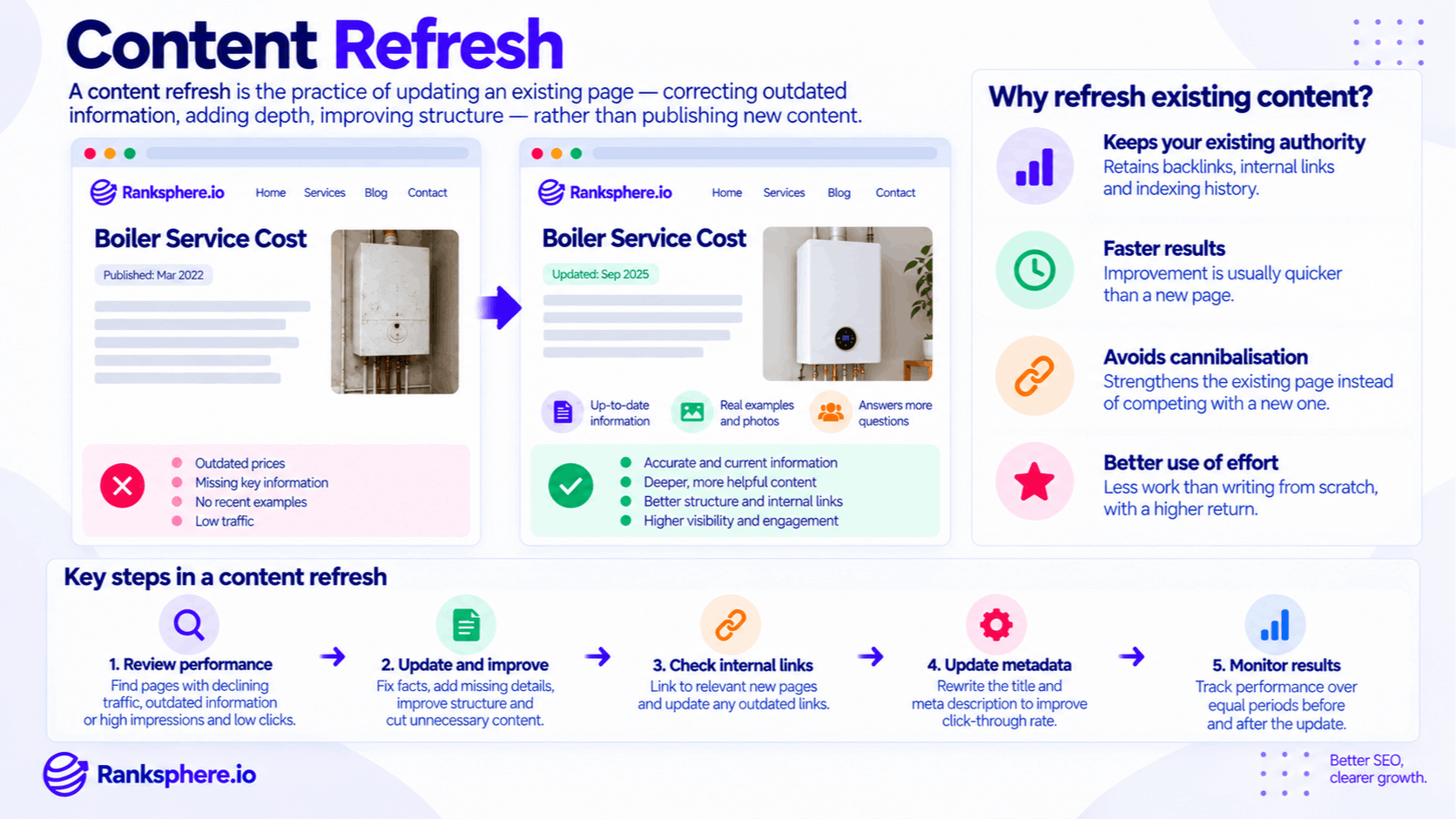
Publishing something new is not always the answer.
An existing page may already have:
- Search history
- Backlinks
- Internal links
- Organic impressions
- Rankings
- User engagement
- Brand recognition
Creating another URL for essentially the same subject can introduce unnecessary overlap and potentially create keyword cannibalisation.
For example, suppose you already have:
/first-time-buyer-mortgages/
Publishing:
/first-time-buyer-mortgage-guide-2026/
may create two pages competing for very similar intent.
If the original topic is still valid, updating the existing page is often cleaner.
When should you create a new URL instead?
Keeping the existing URL is usually sensible when the page still serves the same fundamental purpose.
A new page may be more appropriate when:
- The new topic serves a genuinely different search intent
- The old page should remain available for a separate audience
- The subject has changed substantially
- The new page belongs in a different part of the site
- The content represents a new product, service or offering
The decision should be based on purpose rather than freshness alone.
Do not create a new URL simply because the year changed.
Why refresh existing content?
A useful content refresh can improve a page without forcing it to start again from scratch.
It preserves useful signals
An established URL may already have:
- External links
- Internal links
- Indexation history
- Search impressions
- Existing rankings
Keeping the URL allows those connections to remain intact.
That does not guarantee improved rankings after a refresh, but it avoids unnecessary duplication and migration work.
It can reduce cannibalisation
If one page already covers the topic, improving it is often better than publishing another version.
This keeps the site's structure clearer and avoids multiple URLs competing for the same search intent.
It can be more efficient
Updating an existing article may require less work than:
- Researching a new topic
- Creating a new URL
- Building internal links from scratch
- Redirecting or consolidating later
That makes refreshes particularly valuable when the website already contains a large archive of content.
Which pages should you refresh first?
Not every old page needs attention.
The best candidates usually have a clear reason to be improved.
Pages with declining performance
Look for pages where:
- Organic clicks are falling
- Impressions are falling
- Rankings are declining
- Conversion performance is weakening
But diagnose the reason before rewriting.
A traffic decline could result from:
- Search intent changing
- Competitors improving
- A new SERP feature
- Seasonality
- Ranking changes
- Outdated content
Refreshing content only helps when the content itself is part of the problem.
Pages already close to stronger visibility
Pages with meaningful impressions and reasonably competitive rankings can be worth reviewing.
For example, a page appearing consistently around the lower part of page one or upper part of page two may have more immediate potential than a page that barely appears at all.
But do not use ranking position as the only priority.
Also consider:
- Commercial value
- Conversion potential
- Search intent
- Competition
- Current page quality
A page ranking eighth for an important service may deserve more attention than a page ranking sixth for an irrelevant informational query.
High-impression, low-click pages
A page with strong impressions but weak clicks deserves investigation.
Possible causes include:
- An unhelpful title tag
- A weak meta description
- Search intent mismatch
- SERP features absorbing clicks
- A ranking position that generates naturally low CTR
- A competing result with a stronger proposition
Do not assume rewriting the title will automatically solve it.
Check the search results first.
Factually outdated pages
These are among the clearest refresh candidates.
Review pages containing:
- Prices
- Regulations
- Dates
- Government programmes
- Software interfaces
- Product specifications
- Statistics
- Availability information
Accuracy should come before SEO.
If the page gives users incorrect information, fix that first.
Pages affected by ranking changes
A significant ranking decline may justify reviewing the page, particularly after a major Google algorithm update.
But avoid assuming:
Ranking drop = content needs more words.
Review the wider picture.
Ask:
- Has search intent changed?
- Did competitors improve?
- Did the SERP change?
- Is the page still accurate?
- Is the content genuinely useful?
- Has internal linking changed?
- Are there technical issues?
Refresh only what actually needs improvement.
Your highest-performing pages
High-performing content should not be ignored simply because nothing appears broken.
A page responsible for a large share of organic leads deserves periodic review.
Check:
- Are the facts still accurate?
- Are the links still working?
- Are examples still relevant?
- Are competitors offering something better?
- Has the business changed?
Protecting strong content can be just as valuable as trying to rescue weak content.
What should a content refresh include?
A genuine refresh changes the substance where necessary.
It is not simply changing the publication date.
Correct outdated information
Start with factual accuracy.
Update:
- Prices
- Dates
- Regulations
- Product names
- Service details
- Screenshots
- Links
- Statistics
If something is no longer true, remove or replace it.
Add missing information
Search intent can develop over time.
Customers may start asking questions the original page never covered.
Add useful sections where there is a clear gap.
That could include:
- FAQs
- Comparisons
- Pricing information
- Practical examples
- Troubleshooting
- Limitations
- Next steps
Do not add sections simply because competitors have them.
Add them because they help the reader.
Remove filler
Refreshing does not always mean adding more words.
Some pages improve when you remove:
- Long introductions
- Repeated explanations
- Generic marketing copy
- Obsolete sections
- Unnecessary definitions
A refreshed article can be shorter than the original and still be much better.
Improve the answer placement
Pages often take too long to answer straightforward questions.
For example:
How often should a boiler be serviced?
The next sentence should probably answer that question.
Do not force readers through several paragraphs before reaching the point.
A clear heading followed by a direct answer can improve readability.
Then expand underneath where additional explanation is useful.
Add first-hand experience
A refresh is a good opportunity to strengthen E-E-A-T through genuine experience and expertise.
Depending on the business, you might add:
- Original photographs
- Real project examples
- First-hand observations
- Named authors
- Relevant credentials
- Case examples
- Lessons learned
This can make an old generic article significantly more useful without simply making it longer.
Update internal links
Older content often misses newer pages that did not exist when it was written.
Check whether the page should link to:
- New services
- Updated guides
- Location pages
- Relevant commercial pages
- Related topic-cluster content
Also remove or replace links pointing to:
- Redirected URLs
- Deleted pages
- Outdated resources
Strong internal linking keeps older content connected to the current site.
Review the title and meta description
If the page still matches the intended search query but receives fewer clicks than expected, review its search appearance.
The title may be:
- Too vague
- Outdated
- Repetitive
- Poorly aligned with search intent
The meta description may also need updating.
But remember that Google can rewrite title links and snippets, and CTR can change because of the wider SERP.
Optimise them for relevance and clarity rather than treating CTR as a copywriting problem by default.
Ranksphere's website audit flags pages with stale content and weak on-page elements, helping build a refresh list from actual site findings rather than memory alone.
Should you update the publication date?
Only when the page has genuinely been updated.
Changing:
Published: March 2023
to:
Updated: September 2026
makes sense if meaningful revisions were made.
Changing the date while leaving the article untouched does not make the information fresher.
If you display an updated date, it should reflect a real editorial change.
How often should content be refreshed?
There is no universal schedule.
The right frequency depends on the subject.
Fast-changing content
Pages about:
- Prices
- Regulations
- Software
- Tax rules
- Financial products
may need frequent review.
Evergreen content
A page explaining:
What is anchor text?
may remain accurate for much longer.
High-value commercial content
Important service pages should be reviewed periodically even if their topic is relatively stable.
For many businesses, a yearly review of high-value pages is a sensible starting point.
But do not refresh content simply because twelve months have passed.
Review it because there may be something worth improving.
Use content audits to find refresh opportunities
A content audit can help identify pages that deserve attention.
Look for patterns such as:
- Previously strong pages losing traffic
- Pages with growing impressions but weak CTR
- Outdated articles
- Old high-value pages
- Weakly linked content
- Pages with good backlinks but declining visibility
This creates a prioritised refresh queue rather than relying on memory.
Content refresh vs content rewrite
A refresh does not necessarily mean rewriting the entire page.
Sometimes the best update is relatively small.
For example:
- Replace an outdated table
- Rewrite the introduction
- Add one missing section
- Update several statistics
- Improve internal links
Other pages need a much deeper rewrite because the original no longer matches the topic or search intent.
Make the size of the refresh proportional to the problem.
Content refresh vs content consolidation
Sometimes a page should not be refreshed at all.
If two or more pages cover essentially the same subject, consolidation may be better.
For example:
/boiler-service-cost/
and:
/how-much-is-a-boiler-service/
may be better merged into one stronger page.
Keep the best URL, combine the useful material and use redirects where necessary.
Refreshing both would preserve the overlap instead of solving it.
Does a content refresh improve rankings?
It can.
But there is no guaranteed ranking boost simply because a page has been updated.
Search performance may improve when the refresh makes the page:
- More accurate
- More useful
- Better aligned with intent
- Easier to navigate
- Better internally linked
- More competitive
If the original page was already excellent, changing it unnecessarily can achieve little or even make it worse.
Refresh because there is something meaningful to improve.
Not because freshness itself is the objective.
How long does a content refresh take to work?
There is no fixed timeline.
Google needs to recrawl and process the updated page before search performance can reflect the changes.
Some updates may be recognised relatively quickly.
Others may take longer.
Large ranking changes can also depend on factors beyond the page itself.
Do not judge a substantial refresh after two or three days.
Monitor performance over a meaningful period and compare like with like, particularly when seasonality is involved.
Content refresh after a core update
A ranking decline during or after a core update often prompts immediate editing.
Be careful.
A core update can change how Google's systems assess results across many sites and queries.
If the page lost visibility:
- Wait until the update has finished rolling out before drawing strong conclusions.
- Review what changed across the site and query set.
- Compare the page against search intent and competing results.
- Improve genuine weaknesses rather than making reactive cosmetic edits.
You do not necessarily need to wait for another core update before improvements can be reassessed.
The more useful approach is to improve the page because the changes make it better, then allow time for Google's systems to process them.
Measuring a content refresh
Record a baseline before making substantial changes.
Useful metrics include:
- Search impressions
- Organic clicks
- Rankings for relevant queries
- CTR
- Organic sessions
- Conversions
- Engagement
- Internal traffic to commercial pages
Compare equivalent periods where possible.
For a seasonal page, comparing June with December may tell you very little.
Measure the outcome the page is actually meant to produce.
Common content refresh mistakes
- Changing the date without meaningfully updating the page.
- Publishing another URL for the same search intent.
- Assuming newer automatically means better.
- Adding more content without removing outdated or unnecessary sections.
- Updating weak pages while ignoring important high-performing ones.
- Changing a successful URL unnecessarily.
- Assuming every CTR problem is caused by the title tag.
- Refreshing immediately after a ranking drop without diagnosing the cause.
- Trying to improve word count rather than usefulness.
- Expecting rankings to respond immediately.
- Refreshing two overlapping pages when they should be consolidated instead.
Content refresh best practices
- Keep the existing URL when the page still serves the same purpose.
- Correct factual inaccuracies first.
- Review search intent before changing the structure.
- Add missing information only when it is genuinely useful.
- Remove padding and outdated sections.
- Add first-hand evidence and expertise where appropriate.
- Update internal links to reflect the current website.
- Review titles and descriptions when search-result performance warrants it.
- Protect high-performing pages with periodic reviews.
- Use content audits to prioritise refresh work.
- Measure performance before and after meaningful changes.
- Do not refresh content simply to make it look recent.
Example
“Warrenden Financial has a guide for first-time buyers that performed consistently for several years.
Traffic begins to decline even though the page still appears for many of its main queries.
A review finds that the writing itself is not the main problem.
The information is outdated.
The guide contains:
- Old affordability figures
- References to a government scheme that has ended
- A worked example using outdated market conditions
- Several questions customers regularly ask that the article never addresses
The firm updates the existing page rather than creating a second first-time buyer guide.
It:
- Corrects outdated information
- Removes references to the closed scheme
- Rebuilds the example
- Adds answers to current customer questions
- Cuts unnecessary introductory copy
- Updates relevant internal links
- Adds a named adviser and appropriate credentials
The URL remains unchanged.
The page is not simply made longer. In fact, some sections become shorter.
What changes is the usefulness of the information.
That is the point of a content refresh: keep what still works, replace what no longer does, and make an established page more useful rather than creating another URL simply because the original has aged.”
See also
- Content audit — identifying pages that need updating, consolidation or removal
- Thin content — low-value content that a refresh should not turn into longer low-value content
- E-E-A-T — experience, expertise, authoritativeness and trust
- Google algorithm update — a reason to investigate performance changes carefully
- Click-through rate — one part of search performance that may change over time
- Content marketing — the wider process of creating and maintaining useful content