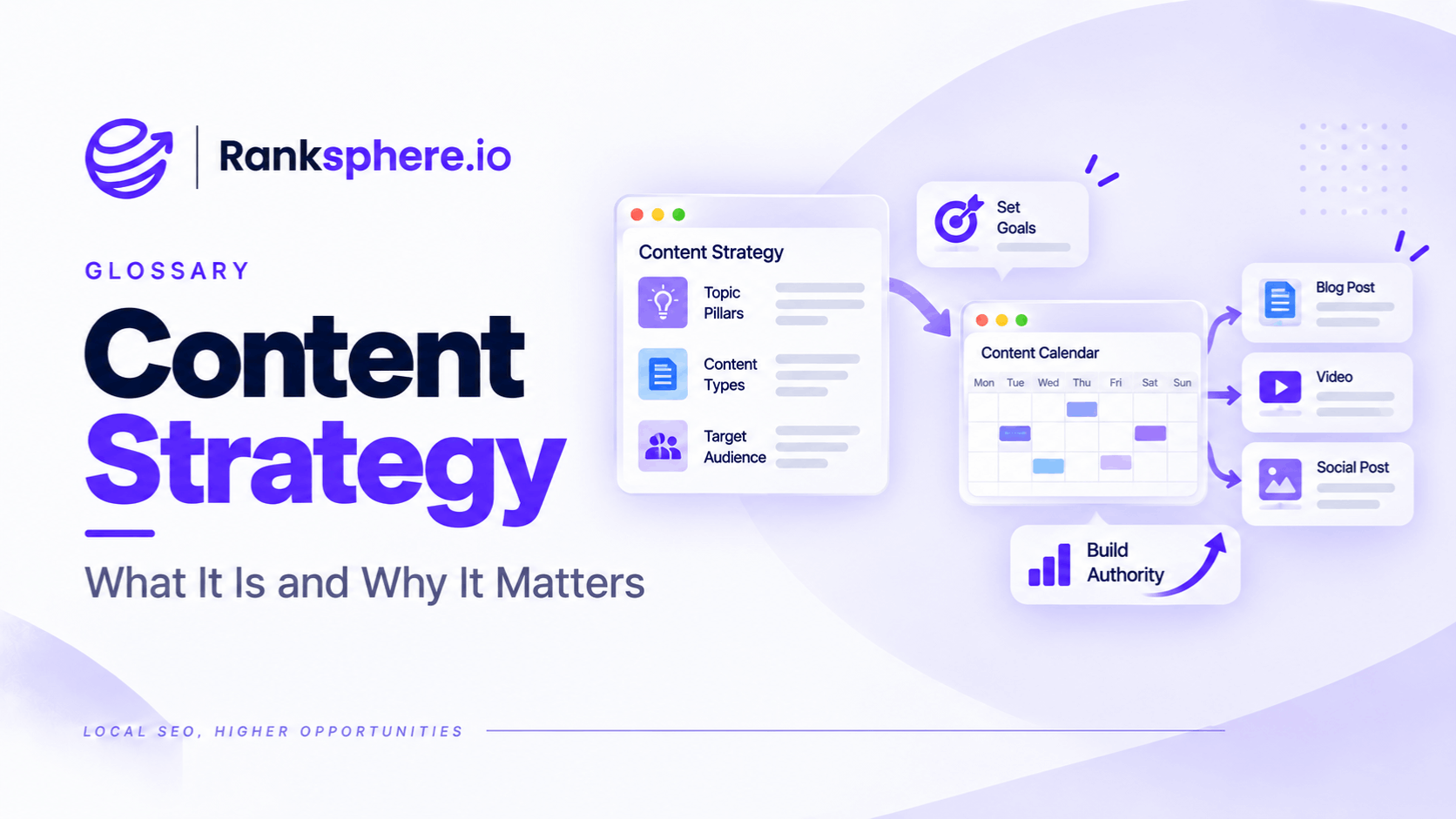
A content strategy is the plan that determines what content a business should create, who it is for, why it needs to exist and how its performance will be measured.
It comes before individual articles, landing pages or campaigns.
A useful content strategy answers questions such as:
- Who are we trying to help?
- What do they need to know?
- Which subjects are genuinely relevant to our business?
- Which pages already exist?
- What needs creating, improving, consolidating or removing?
- How does each piece support a customer or commercial objective?
- How much can we realistically maintain?
- How will we know whether the work was useful?
That makes a content strategy different from both a content calendar and content marketing.
A calendar tells you:
when something will be published.
A strategy explains:
why that content deserves to exist in the first place.
A business can publish every fortnight and still have no meaningful strategy.
Consistency is useful only when the content itself has a purpose.
Content strategy vs content marketing
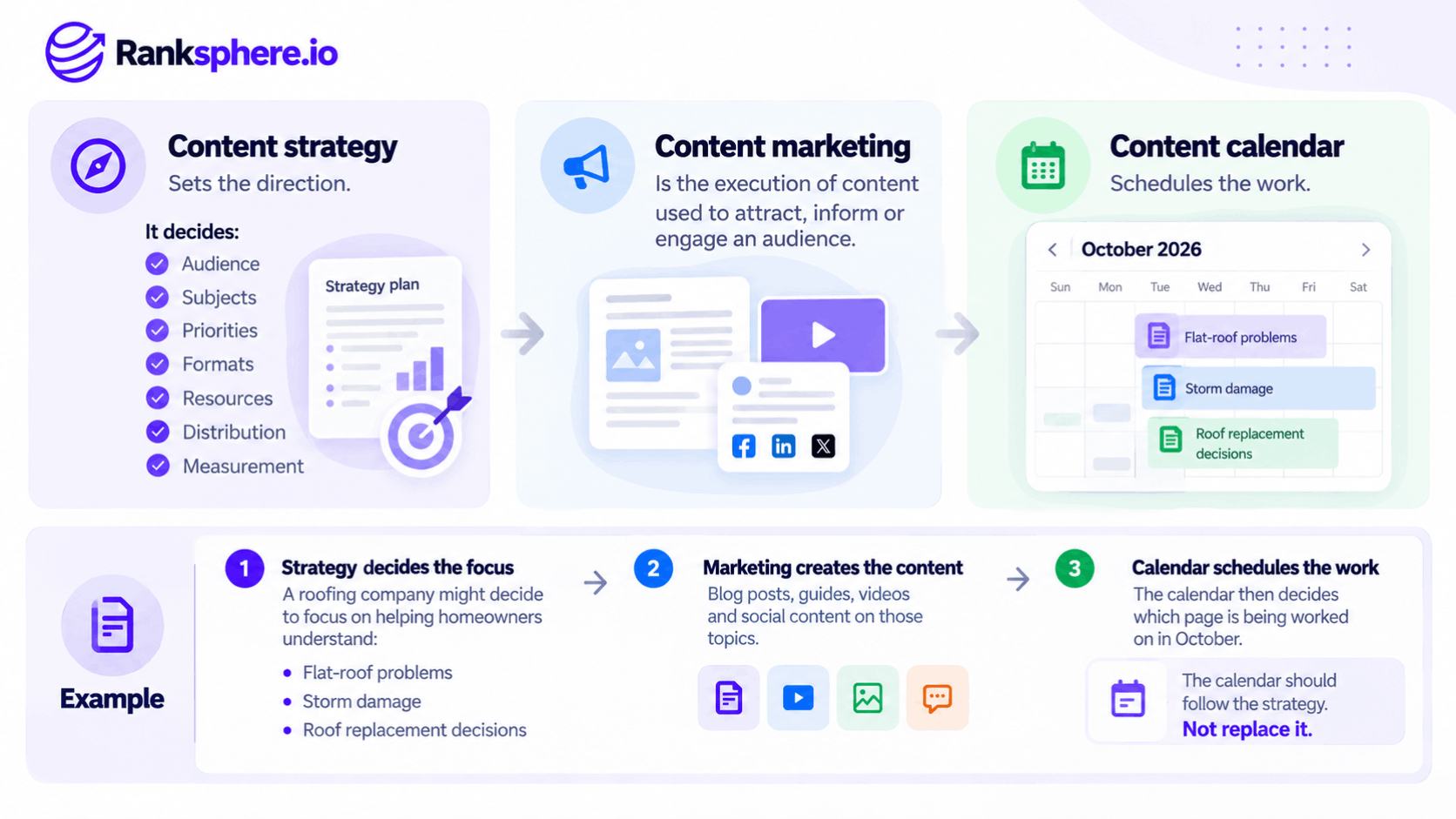
The terms are related, but they are not identical.
Content strategy
Sets the direction.
It decides:
- Audience
- Subjects
- Priorities
- Formats
- Resources
- Distribution
- Measurement
Content marketing
Is the execution of content used to attract, inform or engage an audience.
Content calendar
Schedules the work.
For example:
A strategy might decide that a roofing company should focus on helping homeowners understand:
- Flat-roof problems
- Storm damage
- Roof replacement decisions
The calendar then decides:
which page is being worked on in October.
The calendar should follow the strategy.
Not replace it.
What a content strategy should decide
A useful strategy creates boundaries.
Without them, content tends to grow according to:
- Random keyword suggestions
- Competitor articles
- Seasonal ideas
- Whatever somebody happens to think of that week
That usually produces a lot of pages without a clear relationship to the business.
Who the content is for
Do not start with:
What keywords should we write about?
Start with:
Who needs this information?
For a local solicitor, audiences might include:
- Someone beginning to consider separation
- Someone comparing mediation with court proceedings
- Someone already looking for a family solicitor
Those people have different questions and different levels of commercial intent.
The content should reflect that.
What problems the content should solve
Every planned page should have a reason for existing.
It might help someone:
- Understand a problem
- Compare options
- Estimate costs
- Prepare for a service
- Decide whether they need professional help
- Choose between services
- Take the next step
Google's current content guidance encourages publishers to create material that genuinely helps an intended audience and leaves readers feeling they have learned enough to achieve their goal.
That is a much stronger basis for a strategy than:
“this keyword has 300 searches a month.”
Which subjects belong on the site
A strategy should define both:
what you will cover
and:
what you will not cover.
Google specifically warns against producing large amounts of content across many subjects primarily in the hope that some of it attracts search traffic. It recommends maintaining a clear purpose and focus for the site.
For example, a physiotherapy clinic may have genuine expertise around:
- Sports injuries
- Post-operative rehabilitation
- Back pain
That does not mean it needs articles about:
- General nutrition trends
- Running shoes
- Sleep gadgets
- Celebrity fitness routines
simply because those topics have search volume.
Relevance to the audience and business matters.
What not to create
This is one of the most useful parts of the strategy.
Write down the exclusions.
For example:
We will not create:
- Generic health news
- Topics outside our clinical expertise
- Near-duplicate location articles
- Content written only because a competitor has it
- Pages with no clear customer need
A strategy that allows every possible topic provides very little strategic guidance.
What makes the content worth publishing
Do not plan a page merely because another website ranks for it.
Google's people-first guidance asks whether content provides:
- Original information
- First-hand experience
- Useful analysis
- Additional value beyond what already exists
and whether the site genuinely has expertise or experience with the subject.
Google's 2026 guidance for generative AI search makes the same point even more explicitly: unique, useful, non-commodity content based on genuine knowledge or experience is more valuable than simply restating information already available elsewhere.
For a local business, useful originality might come from:
- Real project photographs
- Common customer questions
- First-hand examples
- Actual process explanations
- Local considerations
- Pricing methodology
- Mistakes customers regularly make
- Experience dealing with a particular problem
You do not need a revolutionary idea.
You need something more useful than another generic summary.
Content strategy is not just blogging
This distinction matters for local SEO.
Content can include:
- Service pages
- Location pages
- FAQs
- Guides
- Case studies
- Comparison pages
- Project pages
- Help content
- Videos
- Existing pages that need improving
A business with poor service pages does not necessarily need more blog posts.
Its content strategy may decide:
do not publish another article until the main service pages have been improved.
That is still content strategy.
New content is only one option
For an established website, the right decision may be:
Create
A useful page does not exist.
Improve
The page exists but does not answer the customer's needs properly.
Consolidate
Several weak pages cover substantially the same purpose.
Remove
The page has no meaningful reason to remain.
Leave alone
The content already works.
A content audit can help make those decisions.
The strategy should therefore govern the existing library as well as new production.
How much content should a business create?
There is no correct:
- Number of topics
- Number of cluster pages
- Monthly publication frequency
Google does not publish an SEO rule saying:
publish four articles a month
or:
build eight pages per topic cluster.
In fact, Google's current guidance explicitly says there is no preferred word count and warns against producing content mainly because publishers believe additional volume or freshness will improve rankings.
Capacity should determine cadence.
A business capable of producing one strong page a month should not build a strategy requiring four.
A slower plan that actually gets completed and maintained is more useful than an ambitious calendar that collapses after a few weeks.
A simple strategy can be enough
A small local business does not necessarily need a 40-page strategy document.
A practical version might define:
Audience
Who the business needs to help.
Priority subjects
The areas most closely connected with customer needs and the business's expertise.
Existing assets
Pages that already cover those needs.
Gaps
Questions or customer journeys that are currently poorly served.
Priorities
What should be improved or created first.
Owner
Who supplies expertise, approves content and maintains accuracy.
Measurement
What will indicate whether the work was worthwhile.
That may fit on a page.
That is fine.
The sophistication should match the business.
Topic clusters
Topic clusters can be one useful way to organise related content.
For example, a roofing business might have a broad subject around:
flat roofing
with useful supporting pages covering:
- Common flat-roof problems
- Repair versus replacement
- Expected lifespan
- Maintenance
- Materials
Those pages might naturally connect to the business's commercial flat-roof service page.
But do not turn topic clusters into a formula.
There is no Google rule requiring:
one pillar + eight supporting articles.
Nor does a cluster receive a special ranking bonus simply because the pages were labelled as a cluster.
Use the structure when it makes the information easier for customers and the site to organise.
Internal linking
Content should connect logically to other useful pages.
A guide explaining:
how to recognise a damaged flat roof
may naturally link to:
- A repair-versus-replacement guide
- A relevant service page
- A useful maintenance resource
Google says internal links help it discover pages and understand relationships between content, while descriptive anchor text helps both users and Google make sense of the destination.
See internal linking.
But avoid the rule:
every article must link to exactly one money page.
Some pages may legitimately connect to several relevant resources.
Others may have no immediate commercial destination.
Links should be useful in context.
Content and commercial pages
A strong content strategy should still understand the business journey.
If someone reads:
How do I know whether my boiler needs replacing?
and the company sells boiler replacement, a natural route to the relevant service page makes sense.
But do not force a sales link into every paragraph.
The content should first satisfy the reason the person came to the page.
Commercial relevance matters.
So does usefulness.
Local SEO content strategy
The original draft needs an important distinction here.
A local business should not think of SEO as:
Business Profile first, content later.
Different assets serve different parts of search.
A Google Business Profile is central to Google's local results.
Google says local rankings are mainly based on:
- Relevance
- Distance
- Prominence
and recommends complete, accurate Business Profile information.
The website serves a different but connected role.
It can provide:
- Service information
- Location information
- Helpful resources
- Organic search landing pages
- Evidence of expertise and experience
- Pages customers can visit from the Business Profile
So the right priority depends on what is missing.
There is no universal local SEO order
This sequence is too rigid:
Profile → reviews → citations → service pages → content
Consider three different businesses.
Business A
Excellent profile.
Strong reviews.
No proper service pages.
Its website should probably be a priority.
Business B
Excellent website.
Incomplete Business Profile.
Wrong opening hours.
Its profile deserves immediate attention.
Business C
Good website and profile.
No recent reviews and recurring customer complaints.
Its priority may be reputation and operations.
The correct sequence comes from diagnosis.
Ranksphere's smart tasks prioritise work by impact, which can help keep content work in context with the other SEO issues competing for attention.
Website content and the local pack
Avoid saying:
“No amount of publishing affects the local pack.”
Google's documented local-ranking framework is more nuanced.
Relevance depends on how well the business matches the search.
Prominence can use information Google has about the business, including links from websites and other information from across the web.
That does not mean:
publish ten blog posts and your Maps ranking rises.
There is no such rule.
The better conclusion is:
blog volume is not a direct Local Pack lever, but the website is still part of the wider local-search ecosystem.
Service pages usually deserve special attention
For many local businesses, the most commercially important website content is not the blog.
It is pages explaining:
- What the business does
- Who the service is for
- How the service works
- Where it is available
- What the customer should do next
A roofing company with excellent informational articles but a weak:
Flat Roof Repair
service page may have its priorities backwards.
Content strategy should protect the pages closest to the customer decision, not automatically favour publishing frequency.
Location pages
The same applies to genuine location pages.
A business serving several areas may need useful pages addressing real place-specific needs.
But those pages should not exist simply to generate combinations such as:
service × 100 towns.
Each page needs a legitimate purpose and enough value to justify existing.
A content strategy should decide when a location page is useful and when it would merely duplicate information already covered elsewhere.
Content for informational searches
Informational content becomes useful when customers have genuine questions before buying.
For example:
- How long does a flat roof last?
- Can a leaking roof be repaired?
- How much disruption does replacement involve?
- Which roofing material suits an extension?
Those searches may occur well before an enquiry.
Answering them can:
- Help customers
- Introduce the business
- Support internal navigation
- Create organic-search entry points
That is a legitimate role for content.
But not every question deserves a standalone page.
Start with customer questions
One of the best strategy inputs is information the business already has.
Ask:
- What do customers repeatedly ask by phone?
- What confuses people before buying?
- What objections delay a decision?
- What information does sales repeatedly explain?
- What goes wrong when customers misunderstand the service?
Those questions come with real-world context that keyword tools cannot provide.
They also align well with Google's recommendation to create content for an existing or intended audience rather than producing pages primarily to attract search traffic.
Keyword research still matters
Customer questions should not replace keyword research entirely.
They tell you:
what customers care about.
Search data helps investigate:
how people look for that information online.
Google's SEO Starter Guide recommends anticipating the different words people might use when looking for content, while also noting that Google's language systems can understand related terminology without every exact variation being written into the page.
The strongest strategy uses both.
Content gap analysis
A content gap analysis can identify subjects competitors cover that your site does not.
But a competitor gap is not automatically your opportunity.
Suppose five competitors have written:
Best Roofing Trends for 2026
That does not mean you need the sixth version.
Ask:
- Does our customer need it?
- Is it relevant to our services?
- Can we add something genuinely useful?
- Does it fit the site's purpose?
A gap is something to evaluate.
Not an instruction to publish.
Search Console
Search Console is particularly useful for understanding how existing content is already appearing in Google Search.
Its Performance report can show:
- Queries
- Pages
- Clicks
- Impressions
- CTR
- Average position
Google specifically recommends using query data to understand what searches are already bringing or exposing users to your site and to improve SEO efforts.
For example, you might discover that a service page already receives impressions for:
flat roof repair cost
even though the page barely discusses pricing.
That may reveal a useful content opportunity.
Search Console is not a complete keyword database
Do not use it as your only source of demand.
Search Console shows queries for which your existing site appeared.
It does not tell you every query in the market.
Google also notes that query filtering and totals can be affected by anonymised queries and data truncation.
Use it alongside:
- Customer questions
- Keyword research
- Search-result analysis
- Competitor research
Review sentiment
Review sentiment can also feed content strategy.
Customer reviews may reveal recurring questions or concerns around:
- Waiting times
- Pricing
- Installation
- Communication
- Aftercare
Positive feedback can reveal what customers value.
Negative feedback can reveal what they misunderstand or dislike.
That does not mean every review theme deserves an SEO page.
Some belong with:
- Operations
- Customer service
- Product development
The strategy should distinguish them.
First-hand expertise
Local businesses often have one of the strongest content resources available:
real experience.
Google's people-first content guidance specifically asks whether content demonstrates first-hand experience and genuine depth of knowledge.
That could include:
- Actual projects
- Real photographs
- Common mistakes
- Local conditions
- Pricing variables
- Questions customers repeatedly ask
- Things the business has learned from doing the work
This is usually more valuable than publishing another generic page assembled from competing articles.
Content strategy and AI search
Content strategy now needs to account for AI-powered search experiences as well as traditional results.
Google's current guidance for AI features does not introduce a separate optimisation formula.
Instead, Google recommends the same fundamentals:
- Useful content
- Original value
- Clear expertise
- Good page experience
- Crawlable pages
Its 2026 AI-search guidance particularly emphasises creating unique, non-commodity content based on genuine knowledge and experience rather than merely summarising existing material.
That strengthens the case for a focused strategy.
It does not create a reason to publish more pages.
Publishing cadence
A cadence is useful operationally.
It is not an SEO ranking factor.
Google does not reward:
one article every Tuesday
simply because it appears regularly.
And Google explicitly warns against adding or removing large amounts of content merely because you believe doing so makes the site appear “fresh”.
Choose a cadence the business can sustain.
That might be:
- Two useful pages this month
- Nothing next month
- An update to three important existing pages after that
A strategy does not need an identical publishing schedule every month.
Topic clusters are optional
Likewise, do not prescribe:
five to eight pages per topic.
A subject might need:
three pages
to answer the relevant customer needs.
Another might genuinely justify:
twenty.
The number should come from the subject.
Not a template.
Topic clusters are an organisational model, not a quota.
Give every page a job
Before creating something, define what it is supposed to do.
For example:
Page
How long does a flat roof last?
Audience
Homeowner with an ageing flat roof.
Need
Understand lifespan and signs of failure.
Business relevance
Flat-roof repair and replacement.
Next useful action
Read repair-versus-replacement guidance or view the relevant roofing service.
Measurement
Organic visibility, useful engagement and relevant enquiries where attribution is available.
That is more strategic than simply adding:
“Publish flat-roof lifespan article”
to a calendar.
Not every page needs to produce a direct lead
Do not force a direct conversion target onto every piece of content.
Some content may:
- Introduce the business
- Answer an early-stage question
- Support another page
- Earn links
- Reduce sales friction
- Help existing customers
The commercial relationship can still be legitimate without:
Article → enquiry form → lead
happening in one session.
Measurement
A content strategy should define success before publication.
Useful metrics may include:
Search visibility
- Impressions
- Clicks
- Relevant queries
Business behaviour
- Enquiries
- Bookings
- Calls
- Assisted conversions where measurable
Content usefulness
- Whether the page answers the intended question
- Whether sales teams use it
- Whether customers refer to it
- Whether it supports other pages
Search Console provides useful visibility and click data, but Google itself recommends focusing on trends rather than treating individual position values as the main performance measure.
Traffic alone is not enough
Suppose an article gets:
5,000 visits
but attracts readers with no relationship to the business.
Another gets:
300 visits
from people researching exactly the service the company provides.
The second may be strategically more useful.
That is why:
“increase blog traffic”
is usually too weak as the sole content objective.
Measure traffic in context.
Assign ownership
A strategy also needs to define who is responsible for supplying the expertise.
For a local business, the writer may not be the person who knows the subject best.
A useful workflow might be:
Business owner or specialist
Supplies:
- First-hand knowledge
- Photographs
- Examples
- Process details
- Fact checking
Writer or SEO team
Handles:
- Research
- Structure
- Search analysis
- Drafting
- Editing
- Internal links
That produces much stronger content than expecting an outside writer to invent expertise the business never supplied.
Review the strategy when circumstances change
There is no SEO rule requiring:
one annual content strategy review.
Annual review may be perfectly sensible for a stable business.
But review it sooner if:
- Services change
- A new location opens
- Search demand changes
- A major site restructure occurs
- New customer questions emerge
- Existing pages consistently underperform
- The business changes priorities
A strategy is a working decision framework.
It should not be rewritten every week.
But it should not become a document nobody looks at for three years either.
Common content strategy mistakes
- Using a publishing calendar as a substitute for strategy.
- Starting with keyword volume instead of audience needs.
- Producing content across too many unrelated topics.
- Copying competitors' subjects without deciding whether they matter to your customers.
- Assuming every content gap must be filled.
- Using fixed rules such as two topics, eight cluster pages or four posts a month.
- Treating topic clusters as a special Google ranking mechanism.
- Publishing new pages when existing pages need improving first.
- Assuming local SEO must always follow one fixed sequence.
- Saying website content has no relationship at all to local-search performance.
- Prioritising blog posts while key service pages remain weak.
- Creating location pages that add no genuine local value.
- Giving every article the same commercial CTA regardless of context.
- Judging success only by traffic.
- Publishing regularly merely to appear fresh.
- Planning more content than the business can realistically maintain.
Content strategy best practices
- Define the audience before choosing topics.
- Start with real customer problems and questions.
- Choose subjects where the business has genuine expertise or experience.
- Write down what is outside the strategy as well as what is inside it.
- Audit existing content before automatically commissioning more.
- Use content gap research as an input, not a publishing checklist.
- Use Search Console to understand how existing pages and queries perform.
- Use review sentiment and customer conversations as qualitative research.
- Use topic clusters when they genuinely help organise related needs rather than following a fixed page count.
- Use internal linking to connect genuinely related pages.
- Prioritise service, location and informational pages according to the business's actual gaps.
- Set a workload the team can sustain.
- Give each planned page a purpose and measurement method.
- Review and adjust the strategy when business needs or evidence change.
Example
“Consider a hypothetical roofing company called Thornley Roofing.
For several years, the company has published a blog post every two weeks.
The calendar is organised.
The subjects are not.
The archive includes articles about:
- Flat roofs
- Chimneys
- Loft insulation
- Solar panels
- Interior mould
- Garden drainage
- DIY gutter cleaning
- Conservatory maintenance
Some are reasonable topics individually.
Together, they reveal no clear content strategy.
A content audit is carried out.
Instead of judging the old articles only by traffic, the team looks at:
- Search visibility
- Customer relevance
- Overlap
- Quality
- Service connection
- Whether the information is still accurate
Some pages deserve improvement.
Some overlap and can be consolidated.
Some have no useful relationship with the company's current services.
The team then reviews:
- Customer questions
- Search Console queries
- Sales conversations
- Existing service pages
- Competitor coverage
Two areas emerge as particularly important to Thornley's customers and business:
A major service where homeowners repeatedly ask about:
- Lifespan
- Leaks
- Repair versus replacement
- Materials
A commercially important need where customers want to know:
- What to do immediately
- Whether a roof is safe
- Whether repair is possible
- When professional inspection is needed
The strategy does not declare:
“six pages per cluster because SEO requires six.”
Instead, it maps the customer questions that genuinely deserve their own pages.
Some become new resources.”
“Others are added to existing service pages.
Several old articles are improved or consolidated instead of being replaced with more content.
The owner supplies:
- Project photographs
- Typical problems
- Real process details
- Technical fact checking
The content team handles:
- Search research
- Structure
- Writing
- Editing
- Internal linking
The publishing pace slows.
That is not a failure.
The company is now producing fewer pages with clearer reasons for existing.
And instead of inventing a result such as:
“twelve pages generated more enquiries in two quarters than 78 articles did in three years,”
the team measures what actually happens:
- Which pages earn relevant impressions and clicks
- Which queries they appear for
- Whether users move into service pages
- Whether enquiries reference the information
- Which pages continue to deserve investment
The lesson is not:
less content always wins.
It is:
content volume is not a strategy.
A useful strategy decides what the business can genuinely help people understand, which pages deserve investment and what should not be produced at all.
Google's own guidance aligns closely with that principle: create useful, original, people-first content for an intended audience rather than publishing across many topics simply because they might generate search traffic.
For a local business, that means content should support the real customer journey and the services the business actually provides. Sometimes the priority will be a new guide. Sometimes it will be a stronger service page, a better location page or an update to something already published.
The strategy is what tells you which one comes next.”
See also
- Content marketing — the publishing and promotion activity a strategy guides
- Topic cluster — one way to organise related subjects
- Content gap — identifying potentially useful subjects that are not yet covered
- Content brief — translating a strategy into requirements for an individual page
- Content audit — deciding what existing content should be kept, improved, consolidated or removed
- Local SEO — the wider search strategy that website content sits within