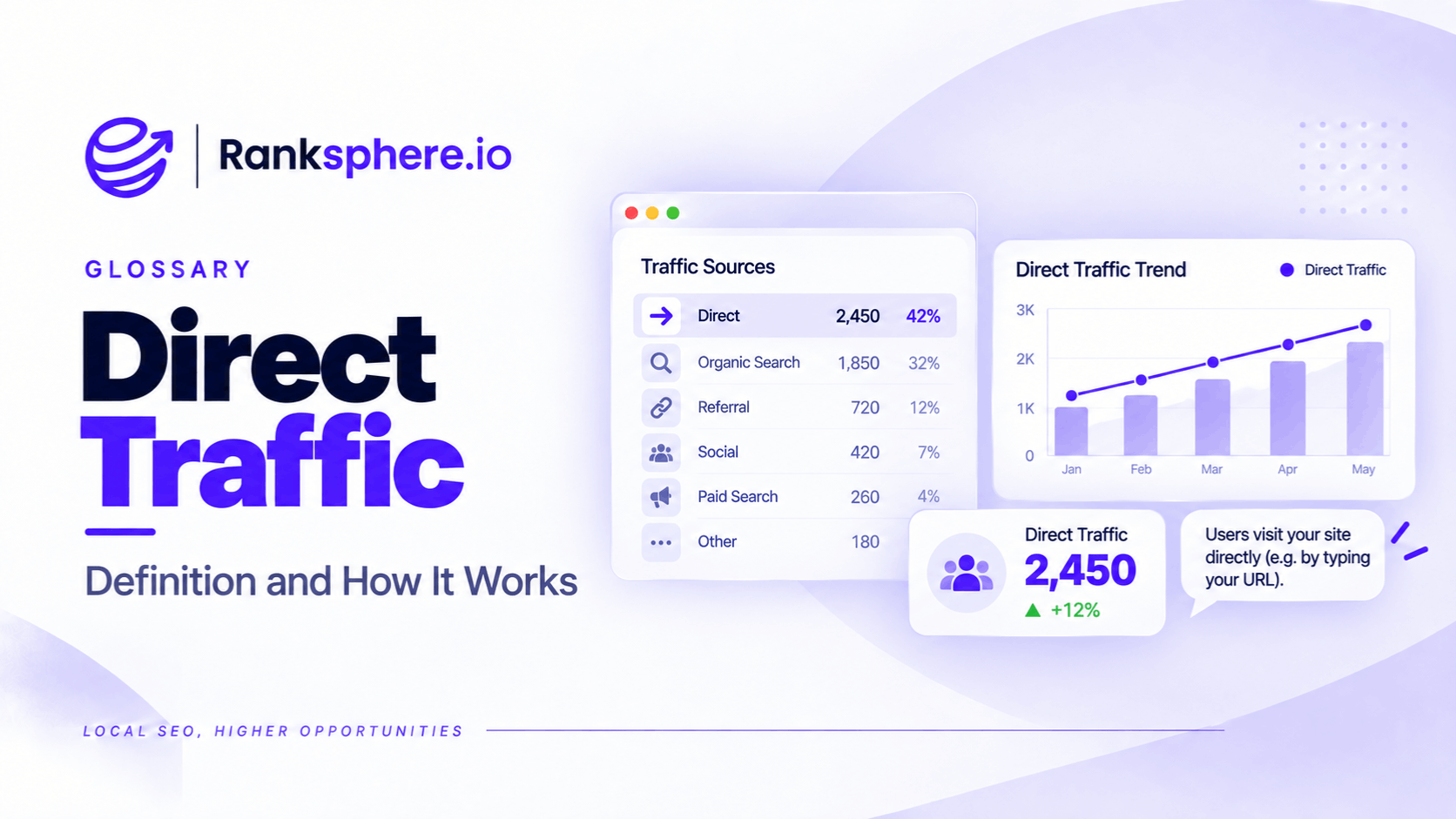
Direct traffic refers to website visits that analytics tools cannot attribute to a specific marketing channel or referral source. In Google Analytics 4 (GA4), these visits are typically grouped under the Direct channel.
The name can be misleading.
Direct traffic includes people who type a website address into their browser or open a saved bookmark. But it can also include visits from messaging apps, documents, QR codes, and other sources that don't pass enough information for analytics to identify where the visitor came from.
For example, someone might share a roofing company's website in a WhatsApp group. When another person opens the link, GA4 may record the visit as Direct, even though it originated from a personal recommendation.
That's why direct traffic shouldn't be interpreted simply as people typing your website address.
For local businesses, it can provide useful clues about brand awareness and word-of-mouth referrals, but it needs to be evaluated alongside other marketing and analytics data.
What Counts as Direct Traffic in Google Analytics 4?
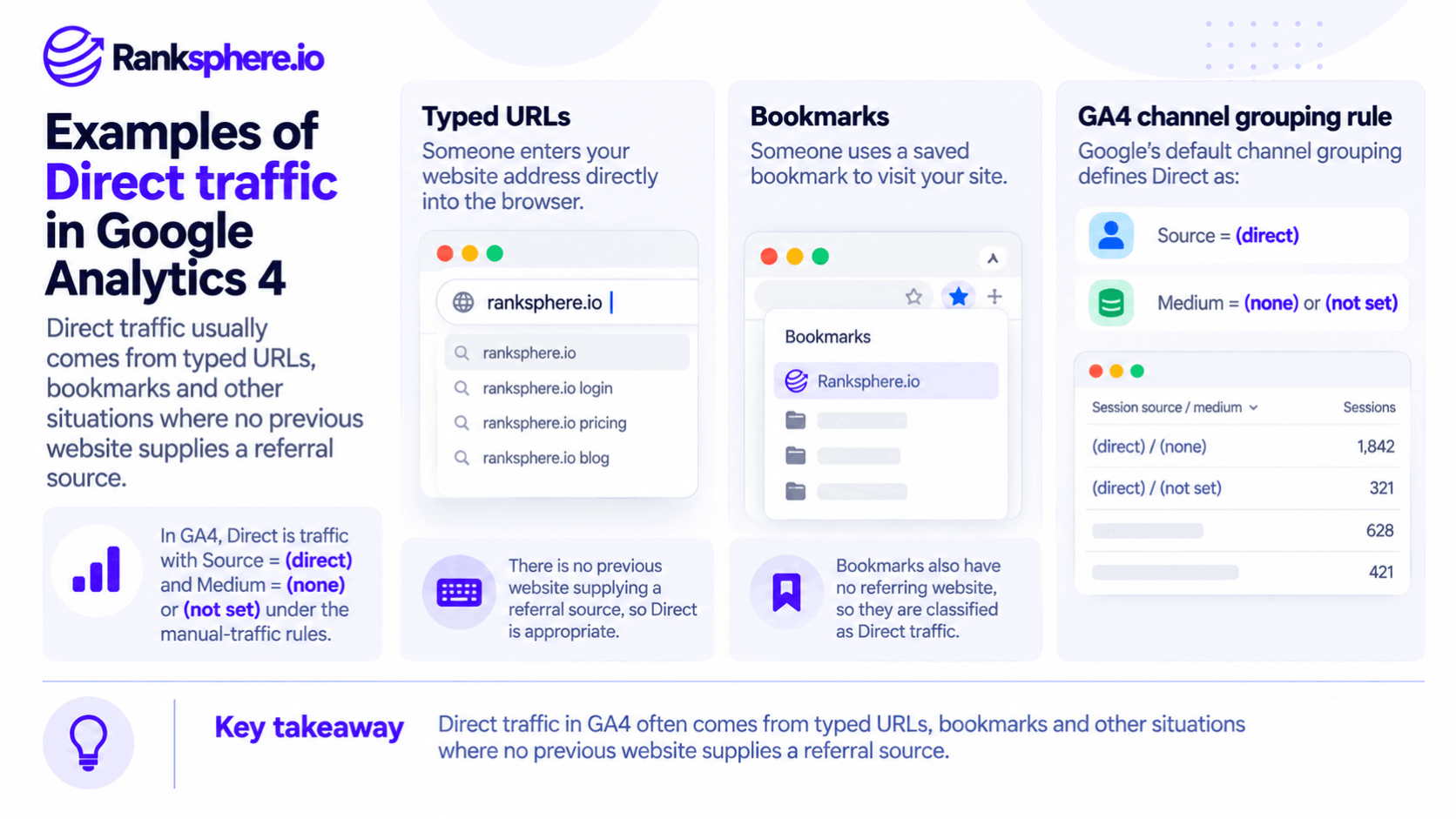
Google Analytics 4 uses information such as referral sources, campaign parameters, and traffic-source data to assign sessions to marketing channels.
When GA4 doesn't have enough information to identify a source, a session may be classified as Direct.
Several types of visits can contribute to this channel.
Typed URLs and Bookmarks
These are the most straightforward examples of direct traffic.
Someone types a business website address into their browser or opens a bookmarked page.
Because the visit doesn't come through another identifiable website or tagged campaign, GA4 generally classifies it as Direct.
This is the traditional definition, but it doesn't explain every visit reported in the channel.
Links Shared Through Messaging Apps
Messaging apps can generate visits without passing usable referral information.
Examples include:
- Facebook Messenger
- Slack
- Private messaging platforms
- Some email applications
Imagine a homeowner asking neighbours for a roofing recommendation.
Someone shares a contractor's website in a WhatsApp group, and several people open it.
Depending on the app and how the link is opened, those visits may appear as Direct rather than referral or social traffic.
This is particularly relevant to local businesses because personal recommendations often influence purchasing decisions.
However, not every messaging-app visit is classified as Direct. Some apps preserve referral information, and tagged links can provide more reliable attribution.
Links from PDFs and Other Documents
Visitors may also open website links from:
- PDF documents
- Word files
- Presentations
- Downloadable brochures
- Email attachments
These links don't always pass referral information to analytics.
For example, a roofing company might include its website in a downloadable maintenance guide.
If someone opens the guide and clicks the link, GA4 may classify the visit as Direct unless the link contains appropriate tracking parameters.
QR Code Scans
QR codes are commonly used on:
- Business cards
- Flyers
- Packaging
- Posters
- Printed brochures
- In-store displays
When a QR code opens an ordinary website URL without tracking parameters, the resulting visit may be classified as Direct.
This makes it difficult to measure how many visitors came from a particular printed campaign.
Adding UTM parameters to the destination URL helps identify the campaign that generated the visit.
Google Business Profile Website Clicks
Visitors can reach your website through the website button on your Google Business Profile.
When referral information is available, these visits may be attributed to Google organic search.
However, attribution can vary depending on how the link is opened, whether tracking information is preserved, and the website's analytics configuration.
Adding UTM parameters to the Business Profile website link makes it easier to distinguish those visits from other Google traffic.
This is especially useful for businesses managing multiple locations.
Missing Referral Information
Some visits lose their original source information before analytics can record it.
Possible causes include:
- Privacy settings that restrict referrer information
- Browser extensions or tracking protections
- Redirect configurations
- Links from secure HTTPS pages to non-secure HTTP pages
- Applications that don't pass referral information
For example, navigating from an HTTPS page to an HTTP page generally prevents the referrer from being passed.
If no other campaign or attribution information is available, the visit may be classified as Direct.
The important point is that Direct is an analytics classification, not necessarily proof of how someone discovered the business.
Is an Increase in Direct Traffic Good for SEO?
An increase in direct traffic can be a positive sign, particularly when it happens alongside growth in branded searches and customer enquiries.
But direct traffic is not a direct Google ranking factor, and growth in this channel doesn't automatically mean SEO performance has improved.
There are several possible explanations.
Growing Brand Awareness
As more people become familiar with a business, they may start visiting its website directly.
Instead of searching for a general service, they might remember the business name, enter its website address, or use a saved link.
This can happen after exposure through:
- Local advertising
- Digital PR
- Customer recommendations
- Social media
- Brand mentions
- Search results
- AI-generated recommendations
A growing Direct channel may reflect some of this activity.
However, analytics cannot tell you which of these influences caused an untagged visit.
Direct Traffic and Branded Search
One useful way to interpret direct traffic is to compare it with branded keywords.
Branded searches happen when someone looks for a business by name or includes its brand in the search query.
For example, a homeowner searching for "Kingsdown Roofing" is demonstrating awareness of that business.
If branded searches and direct traffic increase during the same period, that may suggest more people are becoming familiar with the company.
It's stronger evidence when the same trend appears in customer enquiries, repeat visits, and other business data.
However, correlation doesn't establish exactly which marketing activity caused the growth.
Do Direct Visitors Convert Better?
Direct visitors may include people who already know the business and have a specific reason to return.
That can make them valuable.
For example, someone who previously researched a dental clinic may return directly to book an appointment.
However, direct traffic also contains visits with missing attribution data.
You shouldn't assume every Direct visitor has high purchase intent or that Direct traffic always converts better than organic search, referral, or other channels.
Check the actual conversion data before drawing that conclusion.
When Direct Traffic Growth Is a Warning Sign
A sudden increase in Direct traffic may indicate a measurement or attribution problem rather than stronger brand awareness.
Possible causes include:
- A change to the website's tracking setup
- Missing UTM parameters
- Redirect changes
- Referral information being lost
- Changes to consent settings
- Incorrect campaign tagging
- Changes to GA4 channel attribution
If Direct traffic increases sharply while another channel declines by a similar amount, investigate whether traffic has been reclassified.
Don't immediately treat the change as evidence of a successful brand campaign.
How to Reduce Unattributed Direct Traffic
You can't eliminate Direct traffic completely, and there's no reason to try.
Some visitors genuinely arrive by typing an address, using a bookmark, or returning without an identifiable referral source.
The objective is to reduce misattribution for traffic sources you can control.
Use UTM Parameters on Marketing Links
UTM parameters help analytics tools identify where traffic came from.
They can be added to links used in:
- Email campaigns
- Social media posts
- Digital advertising
- QR codes
- Downloadable documents
- Google Business Profile website links
For example, an email campaign can use tracking parameters that identify the source as email and the medium as email.
When someone clicks the tagged link and GA4 records the visit, that information can help attribute the traffic to the correct channel.
However, UTM parameters should be applied consistently. Incorrect tagging can create reporting problems of its own.
Avoid adding campaign parameters to ordinary internal navigation links because doing so can interfere with attribution.
Track QR Codes Separately
If a local business uses printed marketing materials, QR codes should point to properly tagged URLs.
For example, separate QR codes can be used for:
- Business cards
- Flyers
- In-store posters
- Local event materials
This helps the business compare visits generated by different offline campaigns.
Without tracking parameters, those visits may be grouped under Direct.
Review Redirects
Redirects are common when businesses change website URLs, migrate platforms, or launch new landing pages.
Poorly configured redirects may contribute to lost referral information.
Review unnecessary redirect chains and make sure campaign parameters are preserved when visitors are redirected.
However, redirects don't automatically cause Direct traffic. Whether attribution is lost depends on the redirect behaviour, browser, and tracking setup.
Keep the Website on HTTPS
A website should use HTTPS across its pages.
HTTPS protects data in transit and helps avoid attribution problems associated with visits from secure pages to non-secure HTTP destinations.
However, HTTPS alone won't fix every referral or attribution issue.
It's one part of a properly configured website.
Ask Customers How They Found You
Analytics can't always identify the original reason someone discovered a business.
A simple question on an enquiry or booking form can provide additional context:
How did you hear about us?
Possible answers might include:
- Google Search
- Google Maps
- Friend or family recommendation
- Social media
- Local newspaper
- Previous customer
- Other
This is particularly useful for local businesses where recommendations and offline awareness play a significant role.
Customer answers won't provide perfect attribution, but they can reveal patterns that website analytics misses.
For agencies managing several locations, Ranksphere's Google Business Profile management tool helps keep profile information and website links organised across locations.
How to Analyse Direct Traffic in GA4
Direct traffic becomes more useful when you look beyond the total number of sessions.
Track Trends Over Time
Compare Direct sessions over several months rather than focusing on one reporting period.
Look for gradual changes and unusual spikes.
Where seasonality matters, compare the same period across years, provided the measurement setup has remained consistent.
A steady increase may be worth investigating as a possible awareness trend, while a sudden change may indicate a technical or campaign attribution issue.
Compare Direct Traffic with Branded Search
Use Google Search Console to review searches that include the business name.
If Direct sessions and branded search demand increase together, the trend may support an awareness explanation.
However, don't expect the figures to match.
Branded searches and Direct sessions measure different types of activity.
Check Landing Pages
Look at where Direct sessions begin.
A high proportion landing on the homepage may be consistent with people entering the main website address or using bookmarks.
Direct sessions landing on long, specific URLs may suggest links shared through applications, documents, or other sources that don't pass referral information.
These patterns are clues, not proof of the original source.
Review Conversions
Compare Direct traffic with meaningful website actions, such as:
- Enquiry form submissions
- Appointment bookings
- Tracked phone clicks
- Quote requests
- Purchases
If Direct traffic grows but enquiries remain unchanged, you may need to investigate whether the additional visits are relevant.
If Direct traffic and conversions increase together, examine branded search, customer feedback, and other channels to understand the broader picture.
Investigate Sudden Changes
When Direct traffic changes significantly, check:
- GA4 tracking implementation
- Referral exclusions and unwanted referrals
- UTM parameters
- Website redirects
- Consent settings
- Recent website changes
- Changes in other acquisition channels
A sudden shift in channel classification doesn't necessarily mean visitor behaviour has changed.
Common Direct Traffic Reporting Mistakes
Common mistakes include:
- Assuming Direct means typed URLs and bookmarks. Many visits are classified as Direct because their source can't be identified.
- Trying to eliminate Direct traffic. Genuine direct visits are normal and should remain part of the reports.
- Treating every increase as stronger brand awareness. Attribution issues and campaign tagging problems can also cause growth.
- Ignoring sudden spikes. Unexplained changes should prompt a measurement review.
- Forgetting UTM parameters on QR codes. Printed campaigns may otherwise be difficult to distinguish from ordinary Direct traffic.
- Failing to tag marketing links. Email, documents, and messaging campaigns may generate unattributed visits.
- Assuming Direct conversions have no marketing source. The source may exist but be unavailable to analytics.
- Reporting Direct traffic without comparing it with other channels. The trend is more meaningful when viewed alongside branded search, referral traffic, and conversions.
Direct Traffic Best Practices
To make Direct traffic reporting more useful:
- Use UTM parameters on external campaign links you control.
- Track QR codes used in printed marketing materials.
- Keep the website fully on HTTPS.
- Check that redirects preserve important campaign parameters.
- Review Direct sessions by landing page and conversion activity.
- Compare Direct trends with branded search demand.
- Investigate sudden increases or decreases before drawing conclusions.
- Ask customers how they discovered the business.
- Explain to clients that Direct doesn't always mean someone visited the website deliberately.
- Use Direct traffic as one piece of the attribution picture, not as a standalone measure of brand awareness.
The goal isn't to reduce the Direct channel to zero.
It's to understand what can be measured accurately and where attribution remains incomplete.
Example of Direct Traffic Growth at a Local Business
Consider a hypothetical roofing company called Kingsdown Roofing.
Over 18 months, the company notices that Direct traffic has grown from around 12% to 31% of its reported website sessions.
The owner initially assumes something is wrong with analytics.
Instead of immediately treating the increase as a tracking problem or a marketing success, the team investigates.
What the Team Finds
The company has recently started providing information about storm damage and roof repairs to a local newspaper.
The coverage mentions Kingsdown Roofing by name and increases the company's visibility in the area.
Around the same time, the team notices that more people are searching for the business by name in Google.
This supports the possibility that brand awareness has increased.
The company is also being recommended in local Facebook groups and private messaging conversations.
Some of those recommendations include links to its website.
Depending on how those links are opened, the resulting visits may appear as Direct in GA4.
Example
“The company adds a simple question to its enquiry form:
How did you hear about us?
Over time, customers begin mentioning:
- Recommendations from neighbours
- Local community groups
- Newspaper coverage
- Previous customers
The feedback suggests that word-of-mouth and brand recognition are contributing to enquiries.
However, the team doesn't assume it can identify the exact source of every Direct session.
It also reviews the website's tracking setup to rule out obvious attribution problems.
The increase in Direct traffic may reflect stronger brand awareness, particularly when it occurs alongside branded searches and customer recommendations.
But Direct traffic alone can't prove what caused the growth.
By combining GA4 reporting with Search Console and customer feedback, the business gets a clearer picture of how people discover it.
Direct traffic isn't simply a count of people typing your website address. It's a mixture of genuine direct visits and traffic that analytics couldn't attribute to another source.
For local businesses, understanding that difference helps prevent misleading reports and gives useful context to the impact of brand awareness, referrals, and offline marketing.”
See Also
- UTM Parameters — Tracking traffic from campaigns and marketing links.
- Attribution — Understanding how analytics assigns credit to marketing channels.
- Branded Keywords — Searches that include a business or brand name.
- Referral Traffic — Visits originating from links on other websites.
- Brand Mention — References to a business across websites and other media.
- Google Analytics 4 — How website activity and acquisition channels are measured.