Evergreen content is content built around a topic that remains useful and relevant long after publication.
Unlike news, event coverage or short-lived trends, an evergreen topic continues to answer a question people are likely to ask months or years from now.
Examples include:
- How something works
- How to choose between two options
- Common problems and their causes
- Definitions
- Process guides
- Cost explanations
But the word evergreen can be misleading.
It does not mean:
publish once and never touch it again.
The topic may be durable.
The page still needs to remain accurate.
Prices change. Regulations change. Products change. Search results change. Customer expectations change.
Evergreen describes the lasting relevance of the subject, not permanent accuracy of the page.
What is evergreen content?
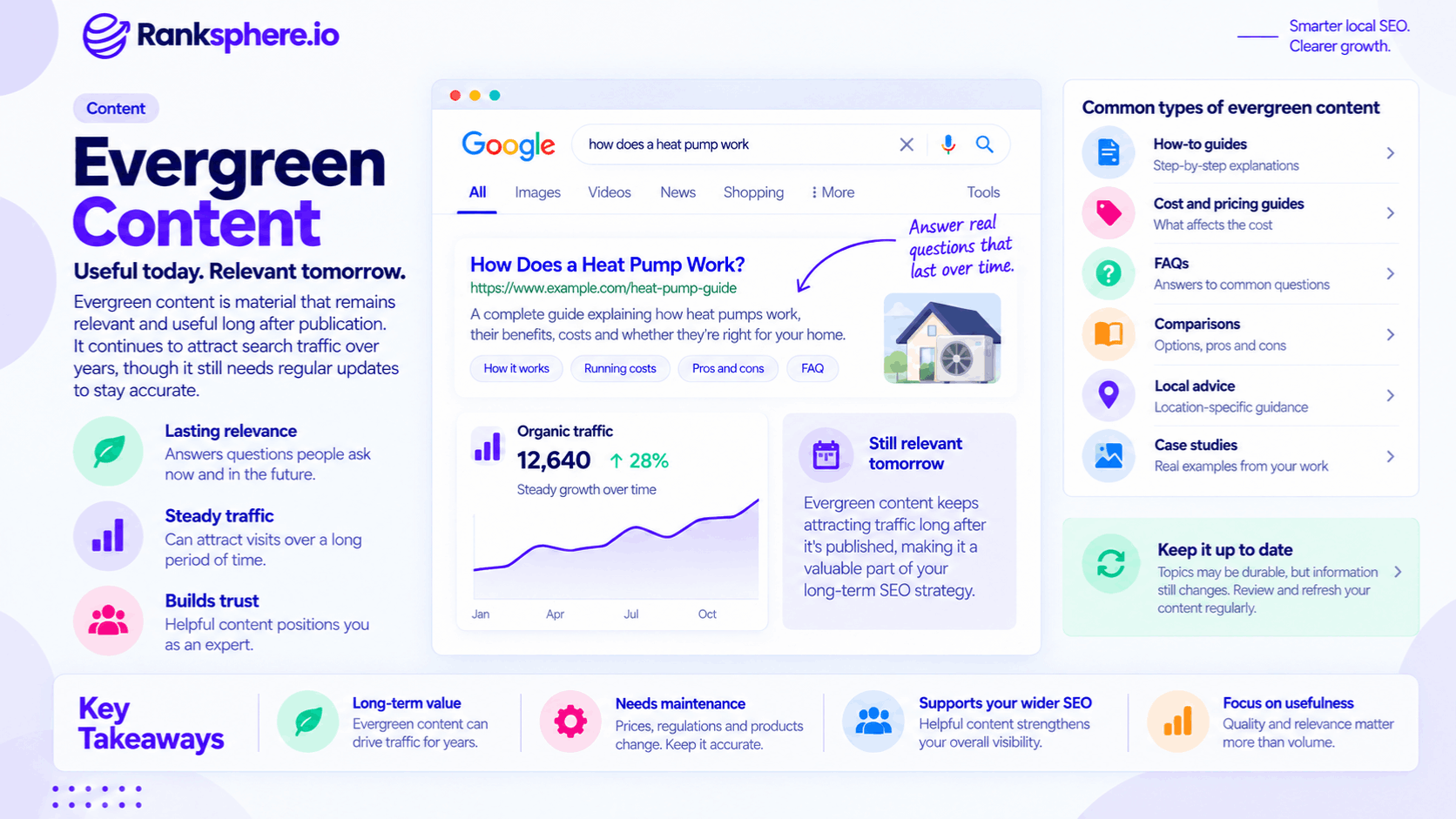
Evergreen content answers questions that continue to matter over time.
For example:
How does a heat pump work?
will probably remain a useful question for years.
So will:
How do I choose a roofer?
or:
What causes damp around a window?
The exact details may need updating, but the underlying search need is durable.
That is what makes the topic evergreen.
Evergreen content vs time-sensitive content
The easiest way to understand evergreen content is to compare it with content tied to a particular moment.
Evergreen
- How something works
- Definitions and explanations
- Buying guides
- Process guides
- Common problems
- Long-term maintenance advice
- Cost factors
- Frequently asked questions
Time-sensitive
- News
- Event coverage
- Product launch announcements
- Predictions
- Industry updates
- Content tied to a specific deadline
- Commentary on a current change
Neither type is inherently better.
They serve different purposes.
A news story may attract substantial attention for a short period.
An evergreen guide may attract smaller but more consistent interest over a much longer time.
Evergreen does not mean permanent traffic
An evergreen topic can remain useful while the page itself loses visibility.
That can happen because:
- Competitors publish better resources
- Search intent changes
- Search demand falls
- SERP features change
- The content becomes outdated
- The page develops technical problems
So avoid describing evergreen content as:
traffic that continues forever.
A better way to think about it is:
content with the potential to remain useful for a long time if it is maintained well.
Why evergreen content matters for SEO
Evergreen pages can be valuable because they do not depend entirely on short-lived interest.
A strong evergreen resource can continue to:
- Attract relevant search traffic
- Answer customer questions
- Support commercial pages
- Earn links and mentions
- Help users move through the buying journey
That makes evergreen content useful within a broader content marketing strategy.
But longevity depends on quality and maintenance.
Evergreen topics still change
Some topics change very slowly.
For example:
What is internal linking?
The basic concept is unlikely to change dramatically.
Other apparently evergreen topics contain information that moves regularly.
For example:
How much does a boiler replacement cost?
The question remains evergreen.
The prices do not.
That distinction is important.
The search intent can stay stable while the facts inside the page need regular revision.
What makes a topic evergreen?
A useful test is:
Will people still ask essentially the same question in a few years?
If the answer is yes, the topic may be evergreen.
For example:
How long does a roof last?
The specific recommendations may evolve, but the customer need is unlikely to disappear.
By contrast:
Best roofing trends for 2026
has a built-in expiry date.
Cost content can be evergreen
Pricing pages are often evergreen topics with volatile details.
For example:
How much does a driveway cost?
is an evergreen question.
But the answer depends on:
- Labour costs
- Materials
- Location
- Inflation
- Project size
That means the page may need updating regularly even though the topic remains relevant.
Evergreen and static are not the same thing.
Evergreen content and search intent
Search intent can change even when the keyword does not.
For example, Google may once have shown mostly:
- Informational guides
for a query.
Later, the results may become dominated by:
- Product pages
- Videos
- Local results
That can indicate that the search environment around the query has changed.
It does not automatically mean your content became poor.
But it may mean the page no longer matches what people appear to want from that search.
Where evergreen content becomes outdated
Evergreen pages tend to decay in predictable places.
The most common are:
- Prices
- Statistics
- Laws
- Regulations
- Product information
- Screenshots
- Interfaces
- External links
- Examples
These are often the first things to check during a content review.
Prices and figures
Numbers date quickly.
A page may still read well while quietly displaying:
- Outdated prices
- Old tax thresholds
- Obsolete statistics
This is particularly damaging because numerical information often looks authoritative.
If you publish figures, keep a record of where they came from and when they were checked.
Regulations and legal information
Legal, financial, medical and regulated subjects require closer maintenance.
A guide may become misleading even if only one:
- Threshold
- Regulation
- Eligibility rule
- Deadline
changes.
For these topics, content review should be based on risk and volatility rather than an arbitrary annual schedule.
Screenshots and interfaces
Software guides can look outdated very quickly.
A tutorial written around an interface from three years ago may be technically correct in principle but difficult to follow.
Check:
- Button names
- Navigation
- Screenshots
- Menu locations
If the interface changes regularly, consider writing around the underlying workflow rather than documenting every click unless those exact steps are necessary.
Broken and outdated links
External sources disappear.
URLs change.
Old studies are replaced.
Periodically check whether important references still:
- Exist
- Support the claim
- Represent the best source available
A broken citation can undermine an otherwise strong article.
Competitive depth
A page does not exist in isolation.
What counted as comprehensive several years ago may now look incomplete compared with newer resources.
That does not mean:
make the page longer.
It means asking:
- Are important questions now missing?
- Is newer evidence available?
- Can we provide more useful first-hand experience?
- Is part of the content now unnecessary?
Improvement is not always expansion.
Search demand can change
A decline in traffic does not necessarily mean the content has decayed.
Demand itself may have fallen.
For example:
A topic may become:
- Less popular
- Seasonal
- Replaced by a new technology
So before rewriting the page, check whether:
- Rankings changed
- Impressions changed
- Search demand changed
- SERP layout changed
Do not diagnose content decay from traffic alone.
SERP changes can reduce clicks
A page may retain roughly the same ranking while receiving fewer clicks because Google changed the result page.
For example, the SERP might now include:
- Featured snippets
- Videos
- AI-generated answers
- Local results
- More ads
The content may still be good.
The search environment may simply send fewer clicks.
That distinction matters before deciding what to refresh.
Writing evergreen content for durability
Some writing choices can make a page easier to maintain.
The goal is not to eliminate all future updating.
That is unrealistic.
The goal is to reduce unnecessary decay.
Avoid unnecessary dates
Do not add:
2026
to a title simply because it looks fresh.
For example:
How to choose a physiotherapist in 2026
probably does not need the year unless the advice genuinely changes annually.
A cleaner title might be:
How to Choose a Physiotherapist
However, dates can make sense where freshness is part of the topic.
For example:
UK Tax Thresholds for 2026/27
is inherently date-specific.
Use dates when they add meaning, not as decoration.
Be careful with dates in URLs
A year in the URL can create unnecessary maintenance if the page is intended to stay live for many years.
For example:
/boiler-cost-guide-2026/
can become awkward in 2028.
For a long-lived resource, something like:
/boiler-cost-guide/
is often easier to maintain.
But this is not a universal rule.
Event archives, annual reports and genuinely year-specific pages may reasonably include dates.
Use precise figures when precision matters
Do not avoid precise numbers simply because they may age.
If:
£212
is the accurate figure the user needs, publish £212.
If only a range can be stated responsibly, use a range.
The goal is accuracy.
Not choosing vaguer numbers because they require less maintenance.
Explain what affects the number
For volatile figures, it can help to explain the underlying variables.
For example:
Roof replacement costs vary according to roof size, material, access and the condition of the existing structure.
That explanation remains useful even if the price range later changes.
The principle outlasts the specific figure.
Keep volatile information together
Where practical, group rapidly changing information into a clearly defined section.
For example:
Current pricing
or:
Current eligibility thresholds
That makes maintenance easier than scattering changing figures through fifteen paragraphs.
Avoid relative time language
Phrases such as:
- Recently
- Last year
- This year
- Currently
can become unclear quickly.
Instead of:
Google recently changed this feature
write something like:
Google changed this feature in March 2026
when the date matters.
Absolute dates age more clearly than relative wording.
Use durable examples
Examples can help explain a concept, but avoid making the entire page depend on one short-lived platform feature or interface.
Explain the underlying principle first.
Then use the current example.
When the example becomes outdated, the core explanation remains useful.
Evergreen content does not have to be generic
Durable content can still be highly specific.
For example, a roofing company could publish:
Why flat roofs fail around parapet walls
and support the page with:
- Real project photos
- First-hand observations
- Repair examples
That can remain useful for years while being far more distinctive than a generic:
10 roofing tips
article.
First-hand experience ages well
Original experience is often one of the strongest ways to make evergreen content distinctive.
Examples include:
- Real customer questions
- Lessons from completed jobs
- Original photographs
- Common mistakes staff repeatedly see
These details are harder to reproduce than generic summaries of information already available elsewhere.
Evergreen content and E-E-A-T
Evergreen content can support the broader E-E-A-T principles when it demonstrates:
- Real experience
- Relevant expertise
- Accurate sourcing
- Clear authorship
But E-E-A-T is not a score that automatically rises because a page has existed for several years.
An old page can be trustworthy.
It can also be outdated.
Age alone proves nothing.
How often should evergreen content be reviewed?
There is no universal schedule.
Review frequency should depend on how quickly the subject changes.
High-volatility topics
May need checking frequently:
- Pricing
- Regulations
- Software
- Financial thresholds
Low-volatility topics
May need much less attention:
- Definitions
- Basic processes
- Stable concepts
A yearly review can be a useful operational habit for important content, but it should not be treated as an SEO requirement.
Review your most important pages first
Do not spend equal maintenance time on every article.
Prioritise pages according to:
- Traffic
- Leads
- Revenue contribution
- Link value
- Strategic importance
- Risk of outdated information
A page generating significant business deserves more attention than a low-priority article with almost no readership.
Content refresh
A content refresh means improving an existing page when the topic and search intent remain substantially the same.
A refresh might involve:
- Correcting outdated facts
- Replacing broken links
- Updating screenshots
- Improving examples
- Removing obsolete sections
- Adding useful new information
Refreshing does not automatically mean making the page longer.
Sometimes the best update removes half the content.
Keep the existing URL when the purpose is unchanged
If the page still serves the same fundamental search intent, updating it at the existing URL is often the sensible approach.
For example:
How Much Does a New Roof Cost?
can usually be updated in place when prices change.
There is normally no reason to publish:
/roof-cost-guide-2027/
and abandon the existing page solely because the year changed.
However, a new URL may make sense if the new content has a genuinely different:
- Purpose
- Audience
- Intent
Decide based on the content, not a blanket rule.
Do not update the date without updating the page
Changing:
Published 2024
to:
Updated 2026
without materially revising anything does not improve the content.
If an updated date is displayed, it should reflect a genuine review or meaningful change.
Freshness labels should help users understand the page.
Not create the appearance of maintenance.
Cutting content can be a refresh
Evergreen pages often accumulate clutter.
Over time, editors add:
- Extra introductions
- Repeated explanations
- Old examples
- Unnecessary sections
A refresh may improve the page by removing material rather than adding more.
The question should be:
Is this still useful?
not:
What can we add?
Core updates and evergreen content
A Google algorithm update does not cause content to decay in the literal sense.
A ranking change after an update may reflect:
- Different ranking systems
- Stronger competitors
- Search-intent changes
- Existing weaknesses becoming more visible
If an important evergreen page loses performance around an update, investigate it.
Do not automatically rewrite it simply because the update occurred.
Content decay
Content decay describes a decline in a page's performance or usefulness over time.
It can happen because:
- Information became outdated
- Competitors improved
- Search intent changed
- Demand changed
- Internal linking weakened
- SERP features reduced clicks
The diagnosis matters.
Otherwise, you may rewrite a perfectly good page when the real problem is declining demand.
Evergreen content does not automatically become thin content
Old content is not necessarily thin content.
A page can be:
- Old
- Short
- Low traffic
and still be genuinely useful.
Likewise, a 4,000-word page can be thin in value if it says very little.
Evaluate usefulness rather than age or word count.
Use Search Console to investigate decline
When an evergreen page loses traffic, check:
- Impressions
- Clicks
- Queries
- Average position
For example:
Clicks down, impressions stable, position stable
Possible SERP or CTR change.
Impressions down, position stable
Possible demand decline.
Impressions stable, position down
Possible ranking or competitive issue.
This is more useful than assuming every traffic decline means:
the page needs more content.
Content audits and evergreen pages
A content audit can identify pages that deserve attention.
Possible actions include:
- Keep
- Improve
- Consolidate
- Remove
Do not automatically refresh everything older than:
12 months
or:
24 months.
Some old pages are perfectly healthy.
Spend maintenance effort where there is evidence it will help.
Website auditing
Ranksphere's website audit flags stale pages and weak on-page elements, helping businesses identify pages that may deserve review instead of relying entirely on memory.
Automated signals can help build the queue.
They still need human interpretation.
A tool can tell you something changed.
It cannot always tell you whether the information is genuinely outdated.
Evergreen content and links
A useful evergreen resource can accumulate backlinks over time.
That can make maintaining the existing page particularly worthwhile.
If an important page has strong external links, think carefully before:
- Deleting it
- Moving it unnecessarily
- Replacing it with a new URL
If consolidation or migration is genuinely needed, preserve relevant signals appropriately.
Evergreen content and AI search
Useful evergreen pages may also be discovered and referenced by AI-powered search systems.
But there is no guarantee.
Do not tell clients:
“Keep the figures fresh and AI systems will cite you.”
Accurate, well-supported and clearly written information is simply more useful across many discovery systems.
That includes traditional search and potentially generative search.
Common evergreen content mistakes
- Treating evergreen as “write once and forget”.
- Assuming an evergreen topic guarantees permanent traffic.
- Adding a year to titles purely to make the page look fresh.
- Putting years in URLs for pages intended to remain permanently useful.
- Avoiding precise information solely because it might need updating later.
- Leaving outdated prices, regulations or screenshots live.
- Refreshing every page on a fixed annual schedule regardless of need.
- Waiting for traffic to fall before checking high-risk information.
- Changing the updated date without meaningfully reviewing the content.
- Publishing a new URL every time a page needs updating.
- Assuming all old content is bad.
- Assuming declining traffic automatically means the content has decayed.
- Treating algorithm updates as the direct cause of content decay.
- Claiming evergreen content automatically gets cited by AI systems.
Evergreen content best practices
- Choose subjects with durable underlying search intent.
- Identify the parts most likely to become outdated before publishing.
- Keep prices, regulations and other volatile information easy to review.
- Use dates where they genuinely clarify the content, not merely to manufacture freshness.
- Use precise data when precision matters and update it when necessary.
- Write around durable principles as well as current examples.
- Prioritise maintenance according to importance and volatility.
- Review important pages before their information becomes misleading.
- Use Search Console and other evidence to diagnose declining performance.
- Refresh existing pages when the underlying intent remains the same.
- Keep the URL where appropriate rather than republishing unnecessarily.
- Remove outdated or unnecessary material as readily as you add new sections.
- Treat maintenance as part of the cost of publishing.
Example
“Aldenham Financial has a long-standing guide about first-time buyer mortgages.
The underlying question remains useful:
How does getting a first-time buyer mortgage work?
The page has performed steadily for years.
Eventually, traffic begins to decline.
The first assumption could be:
the article needs more content.
Instead, the firm reviews the page properly.
Several issues appear.
A government scheme referenced in the article has ended.
Some eligibility information has changed.
The worked example uses financial assumptions that no longer reflect current conditions.
A few external links also lead to outdated resources.
The topic is still relevant.
The page is simply no longer accurate enough.
The firm updates the existing URL.
It:
- Removes the obsolete scheme
- Corrects the current information
- Rebuilds the worked example
- Replaces outdated sources
- Adds two useful questions clients now regularly ask
- Removes unnecessary introductory material
The company then monitors:
- Impressions
- Rankings
- Clicks
- Enquiries
rather than promising that the refresh will automatically restore traffic.
That distinction is important.
The topic was evergreen.
The individual page still needed maintenance.
That is the right way to think about evergreen content:
choose topics with lasting value, but treat accuracy as an ongoing responsibility. Evergreen content can remain useful for years, but only if the page continues to deserve the trust it earned when it was first published.”
See also
- Content refresh — updating an existing page when information or usefulness needs improvement
- Content audit — deciding which pages should be kept, improved, consolidated or removed
- Content marketing — the broader strategy evergreen content sits within
- Thin content — content that provides insufficient value, regardless of age or word count
- Topical authority — the SEO concept of building useful coverage around relevant subjects
- Google algorithm update — a reason to investigate performance changes, not an automatic sign that content has decayed