Content marketing is the practice of attracting, educating and retaining potential customers by publishing information that is genuinely useful to them.
In SEO, that usually means creating content around the questions, problems and decisions people search for before they contact a business.
For a local company, content marketing does not need to mean:
- Publishing every week
- Running a large editorial team
- Building hundreds of blog posts
- Chasing every keyword a tool discovers
A smaller collection of useful, well-maintained pages can be far more valuable than years of publishing without a clear purpose.
The question is not:
How much content can we produce?
It is:
What information would genuinely help the people we want to reach?
What is content marketing?
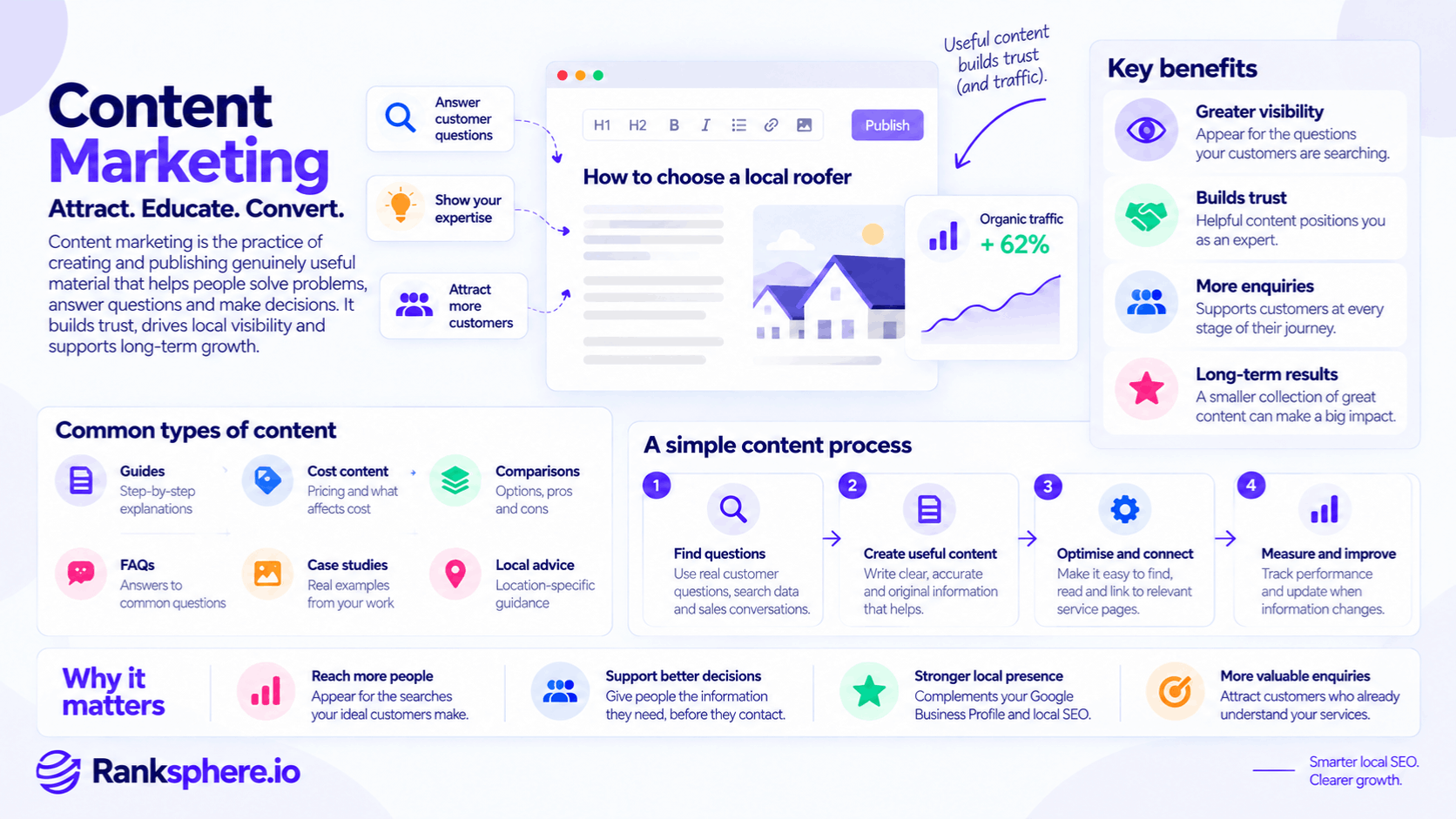
Content marketing uses useful information to build familiarity, trust and demand before someone is ready to buy.
That content might include:
- Guides
- Service explanations
- Cost information
- Comparisons
- FAQs
- Case studies
- Local advice
- Original research
- Videos
The format matters less than the usefulness.
For a roofing company, a detailed page explaining when a flat roof needs replacing may be more valuable than twenty generic blog posts.
For a dentist, a clear explanation of:
how much dental implants cost
may answer a question that stands between a potential patient and an appointment.
Content marketing works best when it solves a real information problem.
Content marketing and SEO
Content marketing and SEO overlap heavily, but they are not identical.
SEO helps make useful content:
- Discoverable
- Crawlable
- Relevant to searches
- Connected to the rest of the website
Content marketing focuses more broadly on providing useful information that can:
- Attract an audience
- Build trust
- Support buying decisions
- Earn attention and mentions
The strongest approach combines both.
Do not write only for search engines.
Do not publish useful content and then make it impossible for search engines to find or understand.
Why content marketing works
Good content can support several stages of the customer journey.
Someone may not be ready to buy today.
They might first want to know:
- What is wrong?
- What does it cost?
- Can it be repaired?
- Which option should I choose?
- How long will it take?
A business that answers those questions well can become familiar before the customer reaches the buying stage.
That does not guarantee the eventual enquiry.
It simply gives the business another opportunity to become part of the decision.
Content can capture earlier-stage demand
Commercial service pages usually target people who already know what they want.
For example:
boiler repair Bristol
suggests fairly immediate intent.
But someone may start with:
why does my boiler keep losing pressure?
That person may not be ready to call an engineer yet.
A useful explanation can reach them earlier.
If the problem later requires professional help, the company that provided the useful information may already be familiar.
That is one of the main roles of content marketing.
Content supports commercial pages
Informational content should not sit in isolation.
Use internal links where they genuinely help the reader move to the next relevant page.
For example:
An article about:
signs your roof needs replacing
might link naturally to:
roof replacement services
if someone decides professional help is needed.
Internal links also help search engines understand relationships between pages.
They should guide people logically rather than being inserted mechanically for SEO.
Content can earn links and mentions
Useful resources can sometimes attract backlinks or mentions more naturally than standard service pages.
Examples include:
- Original local research
- Useful statistics
- Detailed guides
- Industry resources
- Practical tools
A page titled:
Emergency Plumbing Services
is unlikely to attract many editorial links simply because it exists.
A genuinely useful resource based on original experience or data has a stronger reason to be referenced.
Links are not guaranteed.
The content still needs to be worth citing.
Content and topical authority
Publishing consistently useful information around a defined subject can help create a clearer and more coherent body of content.
This is often described in SEO as topical authority.
However, topical authority should not be treated as a public Google score that increases whenever another article is published.
The practical benefits are more straightforward.
Good topic coverage can help a site:
- Answer more relevant search intents
- Build stronger internal relationships between pages
- Demonstrate genuine subject knowledge
- Create more useful resources for customers
Quality and coherence matter more than page count.
Content and AI search
Clear, original and useful content may also be discovered or referenced by AI-powered search systems.
But there is no reliable formula saying:
write concise answers and AI systems will cite you.
Generative search systems can retrieve and synthesise information from many sources.
Content that provides:
- Original information
- First-hand experience
- Clear explanations
- Reliable facts
may be more useful to both traditional search and AI-powered discovery.
Treat AI visibility as another possible benefit of strong content, not as a guaranteed outcome.
Where content marketing fits in local SEO
For many local businesses, content is not the first problem that needs solving.
Before building a large publishing programme, make sure the fundamentals are in reasonable shape.
That may include:
- Google Business Profile
- Reviews
- Core service pages
- Location information
- Citations
- Technical SEO
- Conversion tracking
But there is no universal rule saying content must always come last.
Priority depends on the business.
If a site already has a strong profile but almost no useful service information, website content may deserve immediate attention.
If an important service page is missing entirely, that content may be more urgent than another round of profile polishing.
The right question is:
What is currently limiting performance most?
Content and the local pack
Transactional local searches often feature the local pack, where Google Business Profile information and local-search signals are particularly important.
However, it is too simplistic to say website content has nothing to do with local visibility.
A relevant, well-structured website can provide additional context about:
- Services
- Locations
- Business expertise
Content cannot manufacture proximity.
It cannot turn a distant business into the nearest option.
But the website remains part of the wider local-search ecosystem.
Do not blog just because you are doing local SEO
A local SEO strategy does not automatically require a blog.
Sometimes the better content investment is:
- Better service pages
- Better location pages
- Pricing information
- Case studies
- FAQs
before a traditional blog is considered.
A business with ten weak service pages does not necessarily need:
50 new articles.
It may need:
ten better commercial pages.
Start with customer questions
One of the best content-research sources is already inside the business.
Ask:
What do customers keep asking us?
Examples might include:
- How much does this cost?
- How long does it take?
- Do I need to replace it?
- Is this covered by insurance?
- Can this be repaired?
- What happens during the appointment?
These are real questions from real customers.
If the same question appears repeatedly during:
- Calls
- Sales conversations
- Emails
- Appointments
it may deserve an answer on the website.
Cost content
Pricing questions are often valuable because they appear close to commercial decision-making.
Someone searching:
how much does a new roof cost
may still be researching.
But they are clearly thinking about the financial implications of the service.
Useful cost content can explain:
- Typical pricing structure
- What affects price
- What's included
- Why estimates vary
Do not invent a fixed figure simply because:
“price content ranks.”
If pricing varies substantially, explain the variables honestly.
“How to choose” content
Comparison and selection content can help customers make a decision.
Examples include:
- How to choose a roofer
- How to choose a dental implant provider
- Questions to ask a driveway contractor
The content should genuinely help the reader evaluate options.
Do not simply design the criteria so that only your own business can qualify.
Useful comparison content earns trust by being fair.
Problem-based content
Many searches begin with a problem rather than a service name.
For example:
boiler keeps losing pressure
instead of:
boiler repair company
or:
tooth hurts when biting
instead of:
dentist near me
Problem-focused content can reach customers before they know what service they need.
Explain:
- Possible causes
- What they can safely check
- When professional help may be necessary
Avoid turning every problem into:
Call us immediately.
The content should help first.
Local content
Local knowledge can differentiate a business when it is genuine.
For example, a roofing company operating in a coastal area may have first-hand experience with:
- Weather exposure
- Common materials
- Typical housing stock
A landscaper may understand:
- Local soil
- Drainage issues
- Planning conditions
That is more useful than artificially inserting a town name into generic advice.
Avoid fake localisation
Changing:
How much does a new driveway cost?
into:
How much does a new driveway cost in Bristol?
does not automatically make the article genuinely local.
If the content contains nothing specifically relevant to Bristol, the location modifier adds little value.
Local content should contain information that actually changes because of the location.
Case studies
Case studies are one of the strongest ways local businesses can create distinctive content.
A useful case study might explain:
- The customer's problem
- The starting condition
- The work completed
- Why that approach was chosen
- The result
Where appropriate, include:
- Original photos
- Timelines
- Materials
- Costs
- Challenges
This is information competitors cannot simply reproduce from the same generic research sources.
Before-and-after content
For visual industries, before-and-after examples can be especially useful.
Examples include:
- Roofing
- Landscaping
- Driveways
- Decorating
- Cleaning
- Renovation
Explain what changed rather than publishing only two photographs.
For example:
The patio had sunk along the rear edge because drainage was directing water beneath the base. We lifted the affected section, rebuilt the sub-base and adjusted the fall before relaying the slabs.
That gives the images meaning.
Use first-hand experience
First-hand experience is one of the easiest ways for a real business to make its content less generic.
A company can include:
- Things customers commonly misunderstand
- Problems staff regularly encounter
- Examples from real work
- Original photographs
- Lessons learned
This also aligns naturally with the broader E-E-A-T concept of demonstrating genuine experience.
Do not manufacture experience.
Use what the business actually knows.
Content should match search intent
Before creating a page, understand what people searching that topic appear to want.
For example:
roof replacement cost
probably needs pricing information.
roof replacement company Bristol
probably needs a commercial service page.
These are different intents.
Do not force every keyword into a blog post.
Sometimes the correct content is:
- Service page
- Guide
- Category page
- Location page
The format should follow the need.
Service pages are content marketing too
Content marketing is often reduced to:
blogging.
That is a mistake.
A strong service page can educate customers while still being commercial.
It can explain:
- What the service involves
- Who needs it
- What affects price
- What happens next
- Common questions
That is useful content.
The fact that it also sells a service does not make it less valuable.
Topic clusters
A topic cluster groups related pages around a broader subject.
For example:
Main topic
Dental implants
Supporting content
- Dental implant costs
- Recovery after implants
- Who can have implants
- Implant maintenance
Internal links connect the related pages where appropriate.
This can create a more coherent resource for users.
There is no ideal cluster size
Do not force every topic into:
five to eight pages.
Some subjects may need:
- Two pages
Others may justify:
- Ten or more
The number depends on:
- Search intent
- Complexity
- Genuine customer questions
Create another page when there is a distinct reason for it.
Stop when there is not.
Avoid splitting one intent into too many pages
Suppose people search:
- cost of roof replacement
- roof replacement prices
- how much does reroofing cost
These may all represent essentially the same intent.
You probably do not need three pages.
One strong page can cover them naturally.
Creating a separate article for every keyword variation can lead to repetitive content and unnecessary keyword cannibalisation.
Publishing frequency
There is no ideal content-marketing cadence.
You do not need:
- One post per week
- Four posts per month
- Fifty posts per year
Publish when you have something useful worth publishing.
A business producing:
six excellent resources in a year
may get more value than one producing:
52 forgettable articles.
Consistency can help operationally.
Quality matters more than arbitrary frequency.
Content volume is not the goal
Do not use:
articles published
as the main performance metric.
That measures output.
It does not tell you whether the content:
- Ranks
- Gets read
- Generates enquiries
- Supports commercial pages
- Earns links
A content team can become very efficient at publishing pages nobody needs.
How much content does a local business need?
There is no universal number.
A small specialist company may need relatively few pages.
A multi-service business operating across several locations may legitimately need much more.
Content volume should follow:
- Services
- Locations
- Customer questions
- Search opportunities
rather than a quota.
Complete useful topics before expanding randomly
Although there is no fixed cluster size, it is usually sensible to build depth around commercially relevant topics rather than jumping constantly between unrelated subjects.
For example, a roofing company might first improve its coverage around:
flat roofing
before suddenly writing unrelated articles about:
- Guttering
- Loft insulation
- Solar panels
Focus makes planning and internal linking easier.
Content refreshes
Content refresh means updating existing content when there is a reason to improve it.
Good reasons include:
- Pricing changed
- Regulations changed
- Services changed
- Information became outdated
- Better first-hand examples are now available
There is no rule requiring every page to be refreshed annually.
A stable article may remain useful for years.
Another page may need updating after three months.
Refresh based on need rather than calendar.
Do not fake freshness
Changing:
Updated January 2026
to:
Updated September 2026
without materially improving the page does not make it fresher in a meaningful sense.
Update dates when substantive information has actually changed.
Users should be able to trust them.
Content audits
A content audit can help identify which existing pages should be:
- Kept
- Improved
- Consolidated
- Removed
Low traffic alone is not a reason to delete something.
A page may still serve:
- Existing customers
- Sales conversations
- Important niche searches
Evaluate the page's purpose before deciding what to do with it.
Consolidate overlapping content
Years of blogging often create several pages that answer almost the same question.
For example:
- How long does a roof last?
- Roof lifespan explained
- When should I replace my roof?
Sometimes these deserve different pages.
Sometimes they should become one stronger resource.
Consolidation can make the site easier to maintain and easier for users to navigate.
Internal linking
Every new page should have a logical place within the site.
Use internal links to connect:
- Supporting guides
- Commercial pages
- Related information
For example:
How much do dental implants cost?
might link to:
Dental implant treatment
when the reader wants to learn about the service itself.
Do not add links simply to hit a numeric target.
Calls to action
Informational content still needs a sensible next step.
That does not mean every paragraph needs:
CALL NOW!
A useful call to action might be:
If you're unsure whether the damage can be repaired, send us photographs and we'll explain whether an inspection is worthwhile.
The CTA should match where the reader is in the buying journey.
Measure content by purpose
Different pages have different jobs.
A commercial service page may be judged partly on:
- Enquiries
- Calls
- Bookings
An informational guide might be judged on:
- Qualified organic traffic
- Assisted journeys
- Links
- Search visibility
Do not demand the same conversion rate from every type of content.
Content and attribution
Content often contributes earlier in the customer journey.
Someone might:
- Read a guide.
- Leave.
- Return later through branded search.
- Convert.
Last-click attribution may give the guide no credit.
That does not prove the guide caused the enquiry.
It simply illustrates why content value cannot always be reduced to last-click conversions.
Look at several signals.
Content and branded search
Useful content may contribute to brand awareness.
But if branded searches increase, do not automatically claim:
our articles caused this.
Branded demand can also come from:
- Referrals
- Advertising
- PR
- Offline activity
Treat branded search growth as supporting context.
Links are not guaranteed
Publishing an excellent article does not automatically earn backlinks.
There needs to be a reason for another site to reference it.
Content with stronger link potential often contains:
- Original research
- Unique data
- Expert insight
- Useful tools
- First-hand findings
Generic rewrites of existing articles have far less reason to attract citations.
Content quality is not word count
Do not decide:
competitor wrote 2,500 words, so we need 3,000.
A page is not useful because it is long.
Sometimes the strongest answer is 700 words.
Sometimes a complex topic genuinely needs 3,000.
Write enough to satisfy the user's need.
Then stop.
AI-generated content
AI tools can help with:
- Research organisation
- Outlines
- Editing
- Idea generation
But the final content still needs:
- Accuracy
- Original insight
- Business-specific knowledge
- Human review
Publishing dozens of generic AI-written pages because it makes production cheap recreates the same volume problem in a faster form.
The goal is useful content, not inexpensive word count.
Ranksphere and content prioritisation
Ranksphere's smart tasks prioritise the work that will move visibility first, helping businesses decide when content should be a priority and when another local SEO issue deserves attention first.
That matters because content should compete for resources like every other part of SEO.
It should not automatically go to the top of the queue because:
“we need to publish this month.”
Common content marketing mistakes
- Publishing on a fixed schedule without a clear reason.
- Assuming every local business needs a large blog.
- Treating content as completely separate from local SEO.
- Claiming blogging has no relationship whatsoever with local visibility.
- Creating generic articles that repeat information already available everywhere.
- Writing from keyword lists instead of customer needs.
- Avoiding useful pricing information when the business can provide it responsibly.
- Creating a separate page for every keyword variation.
- Using arbitrary topic-cluster page counts.
- Refreshing content annually simply because a year has passed.
- Publishing without useful internal links.
- Measuring success by article count.
- Assuming every article should generate direct leads.
- Claiming content automatically earns backlinks.
- Claiming clear content automatically gets cited by AI systems.
- Writing about experience the business does not actually have.
Content marketing best practices
- Start with the problems and questions real customers have.
- Prioritise content according to business needs rather than a publishing calendar.
- Strengthen core service pages before creating unnecessary supporting articles.
- Use first-hand experience, original photos and genuine examples wherever possible.
- Answer cost questions clearly when reliable information is available.
- Create separate pages for distinct search intents, not every keyword variation.
- Use topic clusters where they help organise related information naturally.
- Connect useful informational content to relevant commercial pages with internal links.
- Use calls to action appropriate to the reader's stage of the journey.
- Maintain and refresh content when the information genuinely needs updating.
- Audit and consolidate overlapping pages rather than endlessly adding more.
- Judge each page according to the job it was created to do.
- Focus on usefulness and differentiation rather than output volume.
Example
“Thornley Roofing has published steadily for several years.
The blog contains dozens of articles covering:
- Roofing materials
- Repairs
- Maintenance
- Flat roofs
- Leaks
The content is technically competent.
But much of it could have been published by almost any roofing company in the country.
A content audit finds substantial overlap between pages and very little evidence of first-hand experience.
Instead of increasing the publishing schedule, the company changes direction.
It identifies six questions customers repeatedly ask during surveys and phone calls:
- How much does a flat roof replacement cost?
- When is repair no longer worth it?
- What does the guarantee actually cover?
- Why do flat roofs fail?
- How long will replacement take?
- Which material is suitable for different properties?
The team also documents two real projects.
Those case studies include:
- Original photographs
- The condition before work began
- Why the original roof failed
- The repair options considered
- The work completed
The new pages are connected to the relevant roofing service pages.
Older overlapping posts are reviewed and consolidated where appropriate rather than simply left to compete with one another.
The company then monitors:
- Search visibility
- Qualified traffic
- Enquiries
- Assisted customer journeys
without assuming that every improvement was caused by one article.
The content library becomes smaller, but more useful.
That is the point of content marketing for a local business:
not to publish constantly, but to create information worth finding — information that answers real customer questions, demonstrates genuine experience and helps people move from researching a problem to making an informed decision.”
See also
- Topic cluster — organising related content around a subject
- Topical authority — the SEO concept of building strong coverage around relevant topics
- Content audit — deciding what existing content should be kept, improved, consolidated or removed
- Content brief — defining what an individual page needs to accomplish
- E-E-A-T — demonstrating genuine experience, expertise and credibility
- Local SEO — the wider strategy that determines where content fits in the priority order