Social signals are engagement metrics from social media platforms, including likes, shares, comments, reactions, and follower counts.
In SEO, the term usually refers to the idea that activity on platforms such as Facebook, Instagram, LinkedIn, or TikTok might influence a website's Google rankings.
Google representatives have repeatedly said that social engagement metrics aren't used as direct ranking factors in ordinary organic search.
For example, a roofing company doesn't automatically rank higher because its Facebook post receives 500 likes.
However, social media can still support SEO indirectly by helping people discover a business, share its content, and search for its name.
The distinction is between social engagement itself and the opportunities that engagement creates.
Buying likes or followers doesn't produce the same benefits as genuine recommendations from customers and local communities.
Are Social Signals a Google Ranking Factor?
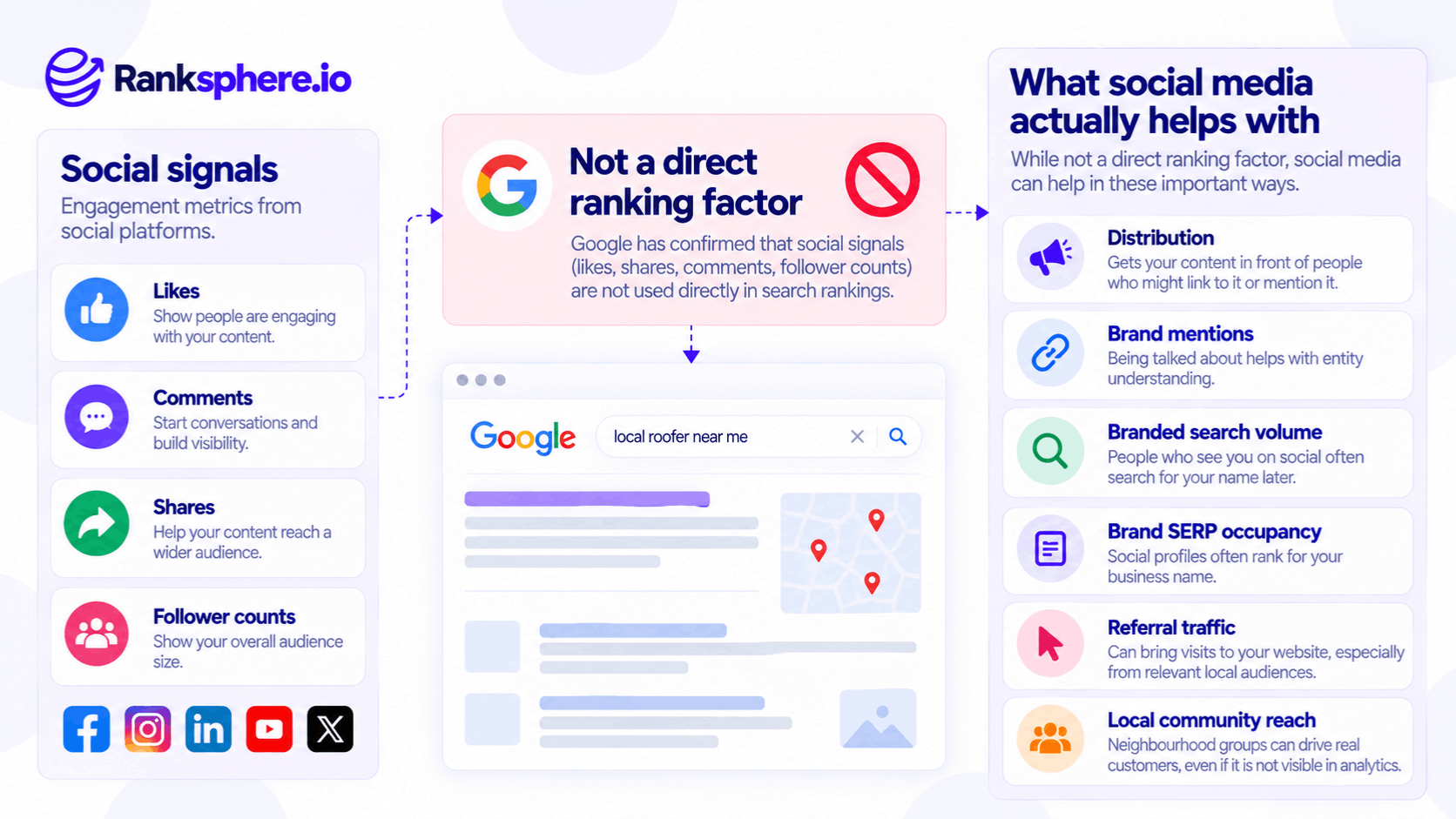
Google hasn't identified social media likes, shares, or follower counts as direct organic ranking signals.
Historically, Google representatives have explained that social platform information can be difficult to access consistently, changes frequently, and may be manipulated.
For example, a business could purchase thousands of followers without attracting a single genuine customer.
Using follower counts as a direct measure of website quality would therefore be unreliable.
That doesn't mean Google ignores social media websites.
Public social profiles and posts can appear in Google Search results, and ordinary crawlable links may help Google discover content.
But these are different from counting social engagement as ranking credit.
Why Do Popular Pages Often Rank Well?
Content that performs well on social media may also attract backlinks, press coverage, and other attention.
For example, a useful guide shared by a local charity might be discovered by a journalist who later references it in an article.
The resulting editorial link is separate from the original social media share.
Google documents links as one of the signals its ranking systems use to understand pages.
This is why social activity and search performance can correlate without likes or shares being the direct cause of higher rankings.
How Social Media Can Support SEO
Social media can contribute to a business's broader online visibility, even when engagement metrics don't directly affect rankings.
1. Content Distribution
Publishing an article doesn't guarantee that anyone will discover it.
Sharing useful content through relevant social channels can introduce it to people who might otherwise never encounter the website.
For example, a landscaping company might share a seasonal garden maintenance guide in a community group where such contributions are welcome.
Some readers may visit the guide, share it privately, or recommend it to others.
The value comes from reaching a relevant audience, not accumulating reactions.
2. Brand Mentions
Social activity can encourage people to discuss a company online.
These brand mentions may appear in posts, articles, community discussions, or other public content.
Mentions can help people discover and recognise a business.
Public information may also provide context about an entity, such as a company or organisation.
However, Google hasn't confirmed that simply accumulating social mentions provides a direct ranking boost or guarantees visibility in AI-generated answers.
3. Branded Searches
Someone who discovers a business on social media may search for its name later.
For example, a homeowner might see a roofing company's completed project on Facebook and search for the company on Google a week later.
That could contribute to branded keyword searches.
Monitoring branded search demand can provide useful context, but an increase doesn't prove that social media caused it.
Referrals, advertising, offline recommendations, and press coverage can all influence branded searches.
4. Brand Search Results
Social media profiles often appear when someone searches for a company by name.
For example, a business's Instagram or Facebook profile may appear alongside its website and other listings.
Maintaining accurate social profiles can therefore support its brand SERP.
This gives potential customers additional places to check business information, photographs, and recent activity.
However, businesses cannot fully control which social profiles Google displays or their positions.
5. Referral Traffic
People who click a social media link and visit a website may appear as referral traffic or in a dedicated organic social channel in analytics, depending on the source and configuration.
For example, a veterinary practice may receive website visits after sharing an article about pet care.
These visits are valuable if they lead to meaningful engagement or enquiries.
However, not every social interaction leads to a website visit.
6. Local Community Recommendations
For local businesses, recommendations in neighbourhood groups can be particularly valuable.
Someone asking for a reliable plumber may receive several recommendations from local residents.
They might search the recommended company's name, call directly, or share its details through WhatsApp.
Some of those interactions won't be attributed accurately to social media in website analytics.
For example, visits from private messaging apps may sometimes be classified as direct traffic when referral information is unavailable.
This is why referral traffic alone doesn't capture the full value of community recommendations.
How Local Businesses Should Approach Social Signals
Most local businesses don't need to maintain accounts on every social platform.
A roofing company might benefit more from participating in one active local Facebook group than from publishing generic content across five poorly maintained profiles.
The practical priorities are straightforward.
Complete Your Important Social Profiles
Make sure customers can identify the business.
Use accurate names, contact information, website links, and appropriate photographs.
Prioritise the platforms customers actually use.
Participate in Local Conversations
Community engagement works best when contributions are relevant and helpful.
For example, a plumbing company might answer questions about preventing frozen pipes without turning every response into an advertisement.
Follow each group's rules and avoid unsolicited promotions.
Make Shared Links Look Professional
Open Graph tags help supported social platforms and messaging applications generate previews when someone shares a webpage.
A properly configured link may display a relevant image, title, and description.
For example, a roofing company's project page could show a photograph of the completed roof rather than a generic website image.
Not every platform uses Open Graph metadata in exactly the same way, so important URLs should be tested.
Avoid Buying Engagement
Purchasing likes, followers, or shares doesn't guarantee customers, backlinks, or higher Google rankings.
Artificial engagement may also violate the relevant platform's policies.
For local businesses, genuine recommendations are worth more than inflated social metrics.
How to Measure Social Media's SEO Value
Social media should be evaluated against realistic business objectives.
Useful measurements include:
| Metric | What it can help show |
|---|---|
| Social referral visits | Traffic reaching the website from identifiable social sources |
| Branded search clicks | Changes in searches associated with the business |
| Enquiries and bookings | Business outcomes from visitors or customers |
| Social profile visibility | How supported social content appears in Google Search |
| Customer referral feedback | Whether customers mention social posts or community recommendations |
Google expanded Search Console reporting for supported social and video platform content in 2026, making it possible to examine certain Search and Discover performance for those channels.
However, those reports measure visibility and interactions. They don't establish that social engagement metrics are ranking factors.
Businesses can also ask new customers how they heard about them.
This is particularly helpful when recommendations happen privately and cannot be reliably attributed through web analytics.
Common Social Signals Mistakes
- Buying likes or followers for SEO. Artificial engagement isn't a reliable way to improve organic rankings.
- Treating correlation as causation. Popular content may earn both social engagement and backlinks.
- Using follower count as the main business metric. Followers don't necessarily become customers.
- Maintaining too many inactive profiles. A smaller number of useful accounts is often more manageable.
- Posting promotional content in community groups without permission. This can damage relationships.
- Ignoring Open Graph tags. Poor link previews can make useful content less appealing to share.
- Measuring only social referral traffic. Private recommendations and later branded searches may be missed.
- Assuming social mentions guarantee AI visibility. No such guarantee has been established.
Social Signals Best Practices
- Focus on platforms your customers actually use.
- Keep important business profiles accurate and complete.
- Share content that answers real questions.
- Participate in local communities genuinely.
- Configure Open Graph tags on important webpages.
- Monitor branded search and relevant social referral traffic.
- Ask customers how they discovered your business.
- Avoid purchasing social engagement.
- Measure enquiries and customer relationships rather than likes alone.
The objective isn't to generate social signals for Google's ranking systems.
It's to make the business easier to discover, recommend, and trust.
Example of Social Signals for a Local Roofing Company
Consider a hypothetical business called Kingsdown Roofing.
Over several months, the company notices an increase in branded searches and website visits categorised as direct traffic.
Its owner initially assumes the changes are caused by an analytics issue.
However, conversations with customers suggest another explanation.
What the Business Discovers
Kingsdown Roofing has been mentioned in local news coverage and recommended by residents in a community Facebook group.
Some homeowners visit the company's website through links in posts.
Others search for the business by name after seeing a recommendation.
A few receive the website address through private messages.
These activities don't all appear under the same acquisition channel in analytics.
What the Company Does
Instead of buying followers or publishing more promotional posts, the owner continues answering relevant community questions.
The company also improves its website's social sharing previews and keeps its social profiles accurate.
It adds a simple question to its enquiry process asking customers how they heard about the business.
Example
“The company benefits from social media through recommendations, awareness, and customer enquiries.
Its success doesn't depend on accumulating likes or proving that social engagement improves Google rankings.
The most useful activity is helping people who may later recommend the business to someone else.
Social signals aren't a shortcut to higher Google rankings, but social media can still play an important role in how customers discover and choose a local business.”
See Also
- Brand Mention — How references to a business support online awareness.
- Brand SERP — The search results people see when looking for a business by name.
- Open Graph Tags — Controlling how website links are previewed on supported platforms.
- Direct Traffic — Website visits without a clearly identified referral source.
- Branded Keywords — Searches containing a business or brand name.
- Entity — How search systems identify people, businesses, and organisations.