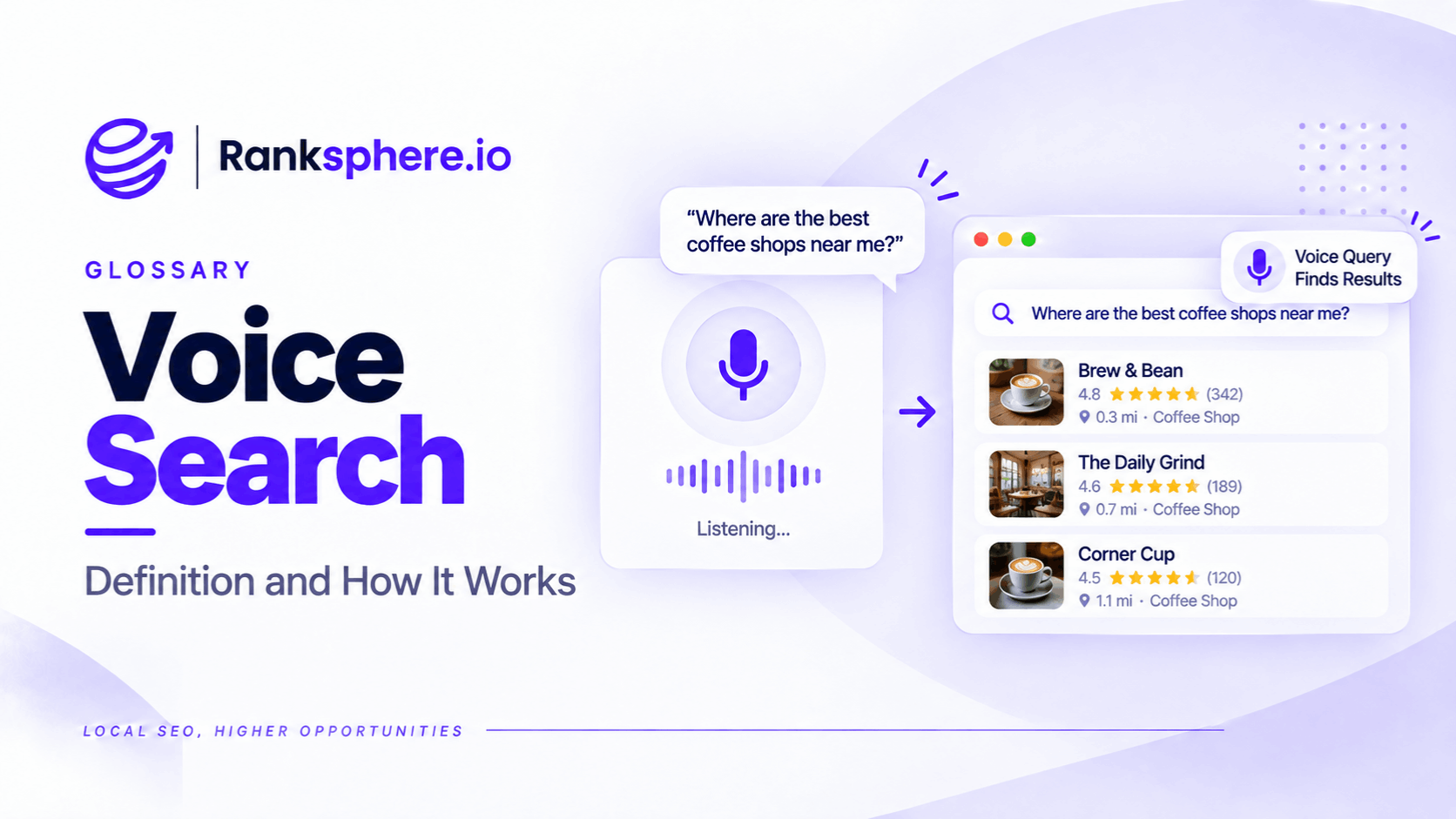
Voice search is the process of searching for information by speaking instead of typing. It uses voice recognition and language-processing technology to interpret spoken questions and return relevant results.
For example, someone might ask their phone, "Where's the nearest pharmacy that's open now?" rather than typing "pharmacy near me."
Voice searches can be made through smartphones, smart speakers, vehicles, and other voice-enabled devices. Depending on the device and assistant, the response may be spoken aloud, displayed on a screen, or presented as a list of options.
For local businesses, voice search matters because customers often use it to find nearby services, check opening hours, request directions, or contact a business.
However, voice search doesn't require a completely separate SEO strategy.
Most of the work that helps a business appear in voice-assisted results is already part of good local SEO: accurate business information, relevant website content, and a clear explanation of the services offered.
How Does Voice Search Work?
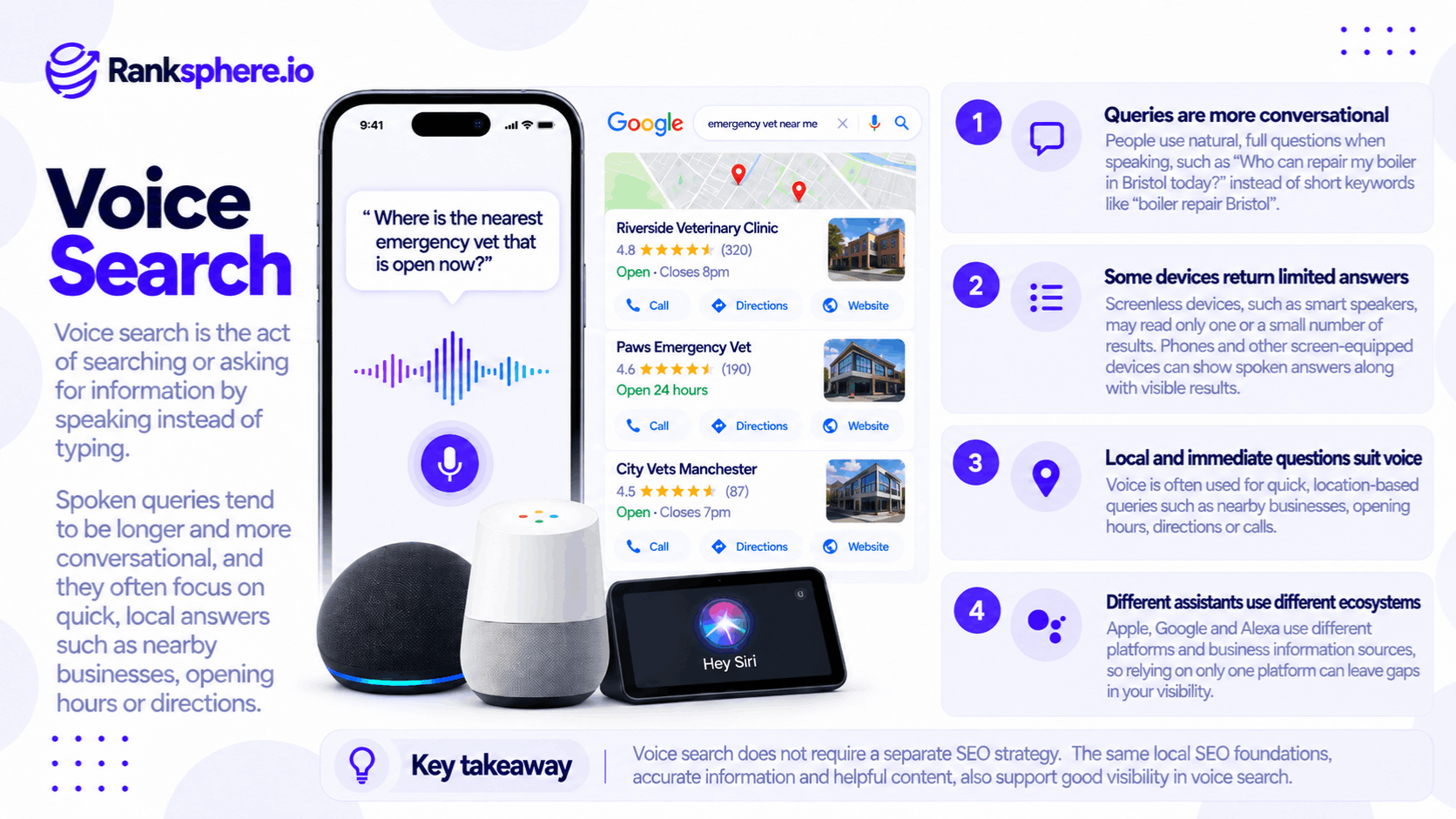
When someone makes a voice search, the system first converts their speech into something it can process.
It then interprets the question and identifies relevant information.
For example, consider this spoken query:
"Is there a dentist near me that's open on Saturday?"
The assistant needs to understand several things:
- The person is looking for a dental practice.
- They want a nearby location.
- Saturday availability matters.
- They may be looking for a business they can contact or visit.
Depending on the assistant, this information may come from business listings, mapping services, search results, or other connected sources.
The assistant then presents an answer.
On a smartphone, that might include several local businesses.
On a speaker without a screen, the assistant may provide a shorter spoken response.
This difference is important because voice search doesn't always produce the same experience as a traditional Google results page.
How Is Voice Search Different From Text Search?
Voice and text searches often serve the same purposes, but there are a few practical differences.
1. Voice Queries Can Be More Conversational
People may speak in complete questions rather than short keyword phrases.
For example:
Typed search: Emergency plumber Bristol
Spoken search: Can you find an emergency plumber in Bristol who's available now?
Both searches express a similar need.
Modern search systems can interpret conversational language without requiring businesses to repeat every possible variation on their websites.
That means a plumbing company doesn't need a separate page for "find me an emergency plumber" and another for "emergency plumber near me."
The priority is a useful service page that accurately explains what the business offers.
2. Spoken Answers May Be Shorter
A conventional Google search can display several websites, advertisements, maps, and other results.
A voice-only device has less room to present that information.
It may respond with one answer, a short summary, or a small number of recommendations.
However, it's inaccurate to assume every voice search produces exactly one result.
The response depends on the assistant, device, query, and available information.
3. Many Voice Queries Involve Immediate Needs
Voice search is convenient for questions such as:
- What time does the pharmacy close?
- Where's the nearest petrol station?
- Call the dental practice.
- Find a restaurant that's open now.
- How do I get to the nearest supermarket?
These are useful examples of local voice search.
However, there isn't a reliable universal percentage showing how many voice searches have local intent.
Businesses should focus on the questions relevant to their customers rather than unsupported voice search statistics.
4. Different Assistants Use Different Sources
This is particularly important for local businesses.
Google, Apple, and Amazon don't necessarily rely on the same business information sources.
A business may have accurate information in Google Search but outdated details in Apple Maps.
For example, an iPhone user asking Siri for a local plumber may encounter Apple Maps business information.
That is why maintaining accurate listings across relevant platforms matters.
Voice Search and Google Business Profile
A complete, accurate Google Business Profile is an important part of maintaining visibility across Google's local search experiences.
For example, a person may ask a Google-powered assistant whether a nearby shop is open.
If the business's opening hours are outdated, the information available to the assistant may also be wrong.
Important profile details include:
- Business name
- Address or service area
- Telephone number
- Primary and relevant additional categories
- Opening hours
- Special hours
- Services
- Website
These details help Google understand what the business does and provide useful information to customers.
However, completing every field doesn't guarantee that Google or Gemini will recommend the business in response to a particular spoken query.
Ranksphere's Google Business Profile Management helps businesses manage and monitor profile information across locations.
This supports accurate local business information, whether customers search by typing or speaking.
Why Apple Maps Matters for Voice Search
Google isn't the only platform businesses need to consider.
People using Siri may discover businesses through Apple's mapping and business information services.
For example, someone might ask:
"Siri, find a vet near me."
If the veterinary practice has an outdated telephone number or incorrect location information in Apple Maps, customers may have trouble contacting it.
Apple's business management tools allow businesses to claim and maintain their location information.
The platform previously known as Apple Business Connect has evolved into Apple's broader Apple Business experience.
For more information, see Apple Business Connect.
Businesses should check that important information is accurate, including:
- Business name
- Location
- Contact details
- Opening hours
- Website
- Appropriate business category
Maintaining these details doesn't guarantee that Siri will recommend the business.
However, it helps ensure that customers receive accurate information when the listing is used.
What Actually Matters for Voice Search SEO?
Most useful voice search improvements are ordinary SEO and business information management tasks.
Keep Business Information Accurate
A business should use accurate contact details across important listings and platforms.
This includes checking NAP, meaning name, address, and phone number.
For example, if a veterinary clinic changes its telephone number, the updated information should appear on its website and relevant business listings.
Consistency helps customers find the correct business.
However, identical formatting across every directory isn't a documented requirement for voice search rankings.
Keep Opening Hours Up to Date
One practical reason customers use voice assistants is to ask whether a business is open.
For example:
"Is the pharmacy open on Sunday?"
Businesses should maintain accurate regular and special business hours.
This is particularly important during public holidays, temporary closures, and seasonal changes.
Incorrect opening hours can lead to missed enquiries or customers arriving when the business is closed.
Answer Common Questions Clearly
Voice searches can involve conversational questions.
For example:
"How much does a dental implant cost?"
A dental practice could answer this question through a useful treatment pricing guide.
The page should explain the information patients need, such as costs, treatment stages, and factors affecting the final price.
Clear answers can help readers and make content easier for search systems to understand.
However, writing in a conversational style doesn't guarantee that an assistant will select the page.
Use Clear Page Structure
Descriptive headings and logically organised sections make content easier to navigate.
For example:
How Long Does a Roof Repair Take?
This is more informative than a heading such as "Additional Information."
A well-structured page can help users locate answers and may also be suitable for search features such as featured snippets.
However, featured snippet inclusion and spoken answers aren't the same thing.
Winning a featured snippet doesn't guarantee selection by a voice assistant.
Maintain Genuine Customer Reviews
Customer reviews can help people evaluate local businesses.
Google also confirms that more reviews and positive ratings can help local ranking.
However, the role reviews play in an individual voice assistant's recommendations varies.
Businesses should focus on collecting genuine customer feedback and maintaining accurate listings rather than assuming a specific rating guarantees voice search visibility.
Voice Search SEO Myths
Voice search has attracted a great deal of marketing advice.
Some of it reflects useful SEO principles, while other claims exaggerate what businesses need to do.
Myth 1 — Half of All Searches Are Voice Searches
A widely repeated prediction claimed that voice would account for 50% of all searches by 2020.
The claim became a common justification for selling voice search optimisation services.
However, it was not established by reliable evidence showing that half of all searches actually became voice searches.
Businesses should be cautious about statistics that don't identify the device, market, time period, and method of measurement.
Myth 2 — You Need Separate Voice Search Keywords
Spoken queries may be conversational, but businesses don't generally need a completely separate keyword strategy.
For example, "dentist near me" and "where can I find a dentist nearby?" may express the same intent.
A useful local service page can address both.
Keyword research should still identify how customers describe their needs.
However, creating separate pages for every spoken variation can lead to unnecessary duplication.
Myth 3 — Speakable Schema Is Essential
Google documents speakable structured data for a limited beta use case involving audio playback of news content.
It isn't a general requirement for local business websites.
A plumber, dentist, or roofing contractor doesn't need to add speakable markup to every service page to become eligible for ordinary local voice search.
Myth 4 — Position Zero Guarantees Voice Search Visibility
Some older SEO advice suggested that winning a featured snippet would automatically make a website the source of a spoken answer.
There isn't one universal rule linking featured snippets to voice assistant responses.
Assistants may use different information sources, retrieval methods, and response formats.
A featured snippet can be useful search visibility, but it doesn't guarantee a spoken recommendation.
Myth 5 — Voice Search Optimisation Is Always a Separate Service
Some agencies offer voice search optimisation packages.
There may be legitimate work involved, such as correcting business listings, researching customer questions, and improving website content.
However, most local businesses don't need a completely separate programme built around speculative voice ranking factors.
The important question is what work the agency will actually perform.
How Voice Search Relates to AI Search
Voice search and AI search increasingly overlap.
For example, Google's transition from the classic Google Assistant to Gemini on mobile devices reflects the wider shift toward conversational AI experiences.
A user may now ask a spoken question, receive an AI-generated explanation, and continue with follow-up questions.
This resembles aspects of AI Overviews and Google AI Mode.
However, these aren't identical systems.
AI Overviews, AI Mode, Gemini, Siri, and other assistants can use different sources and methods to produce responses.
A business shouldn't assume that appearing in one automatically guarantees visibility in the others.
Google's own guidance confirms that established SEO best practices remain relevant to AI Overviews and AI Mode.
For local businesses, that means prioritising accurate information, useful content, accessible pages, and genuine business details.
Those fundamentals also support many common voice search tasks.
Common Voice Search SEO Mistakes
- Buying a voice search package without understanding the work. Ask what will actually be improved.
- Optimising only for Google. Apple Maps and other relevant platforms also deserve attention.
- Ignoring special opening hours. Customers frequently need accurate availability information.
- Creating separate pages for every conversational phrase. Related queries often share the same intent.
- Assuming featured snippets guarantee spoken answers. Selection varies by assistant and query.
- Adding speakable schema everywhere. It isn't a general local business requirement.
- Quoting unsupported voice search statistics. Predictions aren't evidence of actual search behaviour.
- Expecting immediate visibility after correcting listings. Updated information doesn't guarantee selection by an assistant.
Voice Search Best Practices
For local businesses, a practical approach is to:
- Keep Google Business Profile information accurate.
- Claim and maintain relevant Apple business listings.
- Review business names, addresses, and telephone numbers.
- Update regular and special opening hours.
- Use appropriate business categories and service descriptions.
- Answer genuine customer questions on the website.
- Keep important pages accessible and easy to navigate.
- Maintain a process for collecting genuine customer reviews.
- Check how the business appears across relevant search and mapping platforms.
- Avoid purchasing services based on unverified ranking claims.
The goal isn't to optimise for a particular voice command.
It's to make accurate information available when customers search for the business, its services, or its location.
Example of Voice Search for a Veterinary Practice
Consider a hypothetical veterinary practice offering emergency appointments.
The practice is approached by an agency selling a voice search optimisation package.
The proposal includes conversational keyword research, speakable schema, and a promise to improve voice assistant visibility.
Before agreeing, the practice manager decides to check the existing business information.
What the Practice Discovers
The manager searches for the clinic using Siri and a Google-powered search experience.
The results reveal two issues.
First, the practice's Apple Maps listing contains an outdated telephone number.
Second, the Google Business Profile doesn't reflect the clinic's actual holiday opening hours.
Neither issue requires specialist voice search keyword research to identify.
They are ordinary business information problems.
What the Practice Changes
The practice reviews the relevant listings.
It updates the telephone number in Apple's business management platform and completes any required verification.
It also corrects the Google Business Profile opening hours.
The team then checks the clinic's website to make sure emergency contact information and appointment availability are explained clearly.
How the Practice Checks the Results
After the updates have been processed, the manager tests the information again.
The clinic checks whether its current telephone number, location, and opening hours are displayed correctly.
However, the practice doesn't assume that correcting these details guarantees its inclusion in every voice assistant response.
Recommendations can vary depending on location, device, query, and the assistant being used.
Example Shows
“The practice didn't need a separate voice search campaign to fix the problems.
It needed accurate business information across the platforms its customers might use.
The same corrections would also help people searching through Google Maps, Apple Maps, or conventional search results.
Voice search changes how people ask questions, but it doesn't remove the need for accurate listings, relevant content, and reliable business information.
For local businesses, those fundamentals are a more useful investment than trying to optimise for unverified voice-specific ranking factors.”
See Also
- Apple Business Connect — Managing business information across Apple's services.
- Google Business Profile — Maintaining business information for Google's local search experiences.
- Business Hours — Keeping regular and special opening hours accurate.
- Featured Snippet — Understanding highlighted answers in Google Search.
- Google AI Mode — Google's conversational AI search experience.
- Near Me Search — Understanding searches for nearby businesses and services.