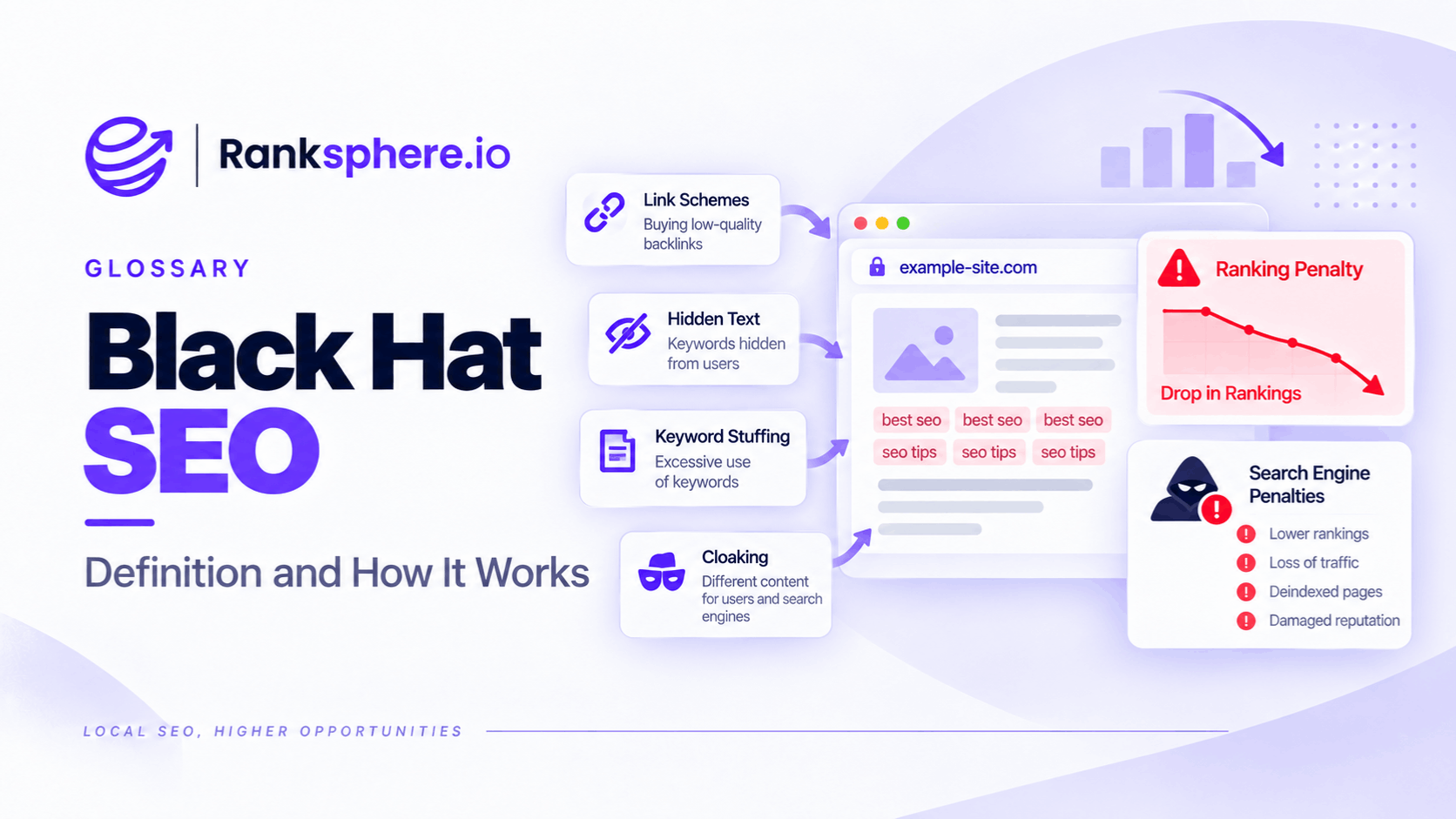
Black hat SEO refers to practices that violate search engine policies in an attempt to manipulate rankings or search visibility.
Examples include buying links to influence rankings, hiding keywords on webpages, creating misleading location pages, and generating large amounts of low-value content primarily for search engines.
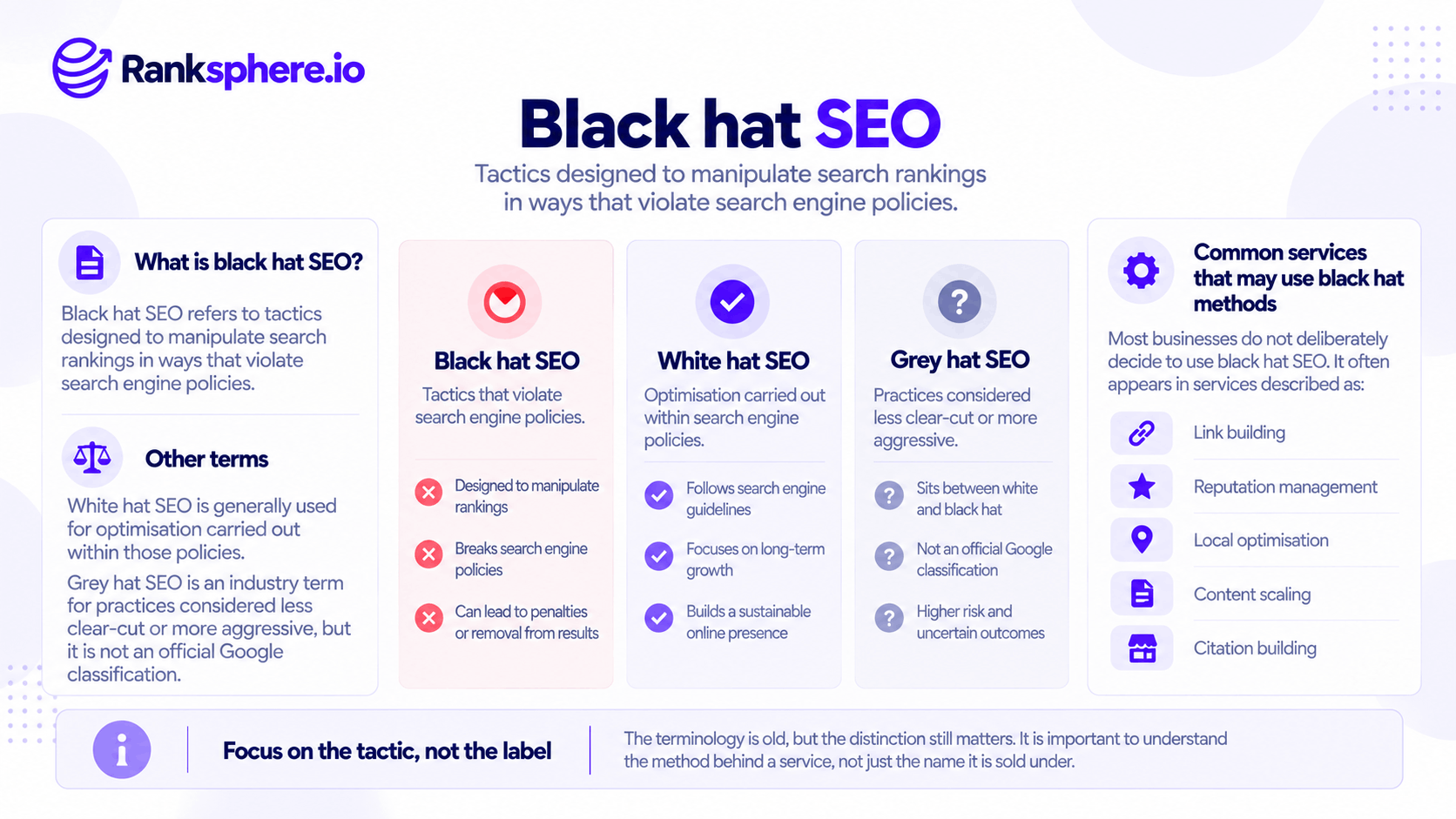
The opposite is commonly called white hat SEO, which follows search engine guidelines. Grey hat SEO describes practices where the boundaries are less clear.
These terms aren't official Google classifications, but the distinction is useful.
The biggest risk for local businesses is often buying black hat SEO services without realising how the work is being done.
An agency might describe its service as link building, reputation management, or local SEO optimisation. Those activities can be legitimate, but the methods used to deliver them matter.
What Counts as Black Hat SEO?
Google defines prohibited practices through its spam policies, which form part of Google Search Essentials.
Common examples include:
Cloaking
Cloaking involves presenting different content to search engines and users with the intention of manipulating rankings or misleading visitors.
For example, a website might show Googlebot a page about dental treatments while directing human visitors to unrelated commercial content.
Not every difference between what Googlebot and a visitor sees is cloaking. The intent and implementation matter.
Doorway Pages
Doorway pages are created primarily to rank for similar searches and direct users towards another destination.
For example, a plumbing company might publish dozens of nearly identical pages targeting neighbouring towns, even though those pages provide no meaningful local information.
Creating genuine location pages isn't inherently a violation. The problem is producing pages primarily to manipulate search visibility without adding value.
Keyword Stuffing
Keyword stuffing involves repeating search terms unnaturally to influence rankings.
For example:
"Need a Bristol plumber? Our Bristol plumbers provide Bristol plumbing services for customers looking for plumbers in Bristol."
The problem isn't mentioning Bristol or plumbing.
It's forcing the same phrase into content repeatedly instead of writing for readers.
Link Spam
Google prohibits creating links primarily to manipulate search rankings.
Examples can include buying ranking-credit-passing links, excessive link exchanges, and low-quality guest post campaigns using optimised anchor text.
See link building.
However, legitimate advertising and sponsorship links aren't automatically prohibited.
Paid links should be appropriately qualified, commonly using rel="sponsored" or rel="nofollow".
Scaled Content Abuse
Scaled content abuse involves producing large amounts of content primarily to manipulate rankings rather than help users.
For example, an agency might generate hundreds of nearly identical service pages using automated templates.
Google's policy applies regardless of whether content is produced using AI, automation, or human writers.
See AI-generated content.
Using AI to help research, structure, or draft useful content isn't automatically black hat SEO.
Other Prohibited Practices
Google's spam policies also cover hidden text and link abuse, sneaky redirects, expired domain abuse, site reputation abuse, and other deceptive techniques.
Certain structured data violations can also lead to eligibility restrictions or manual actions affecting search features.
Black Hat SEO in Local Search
Local businesses face additional risks because Google Business Profile has its own policies.
Violations may result in profile restrictions, rejected edits, or Google Business Profile suspension.
Keyword Stuffing in Business Names
A common problem is adding unnecessary service keywords or locations to a Google Business Profile name.
For example, a law firm officially known as "Aurora Family Law" shouldn't change its profile name to:
"Aurora Family Law – Best Divorce Lawyers Aurora Colorado"
unless the additional wording genuinely forms part of its established real-world name, consistent with Google's naming requirements.
Google expects the profile name to reflect how the business is represented in the real world.
Fake Business Locations
Creating listings for locations where a business doesn't genuinely operate can violate Google's eligibility rules.
For example, a roofing company cannot create multiple profiles using rented mailboxes to appear established in additional towns.
Google also places restrictions on virtual offices and co-working addresses.
Fake Reviews and Review Gating
Buying positive reviews, creating fake customer accounts, and selectively soliciting only positive feedback violate Google's review policies.
Review gating is particularly relevant to local businesses.
For example, a business shouldn't direct satisfied customers to Google while deliberately preventing dissatisfied customers from receiving the same review invitation.
Businesses should request genuine feedback without incentives or pressure.
Fraudulent Business Reports
Google provides reporting processes for misleading business information, including business redressal.
These mechanisms are intended to help correct policy violations.
Submitting knowingly false reports against legitimate competitors is an abusive practice, not a local SEO strategy.
Black Hat vs White Hat vs Grey Hat SEO
The terminology can make some practices sound more ambiguous than they are.
| Approach | Meaning | Example |
|---|---|---|
| White hat SEO | Work that complies with search engine policies | Improving helpful content and earning genuine editorial links |
| Grey hat SEO | An informal label for tactics whose compliance may depend on context | Aggressive but truthful outreach, depending on its execution |
| Black hat SEO | Practices that violate search engine policies | Cloaking, manipulative link schemes, fake reviews |
Calling something grey hat doesn't make it acceptable.
For example, paying for links that pass ranking credit is a documented link spam risk.
Likewise, selectively requesting positive Google reviews isn't a grey area under Google's review policies.
The useful question is whether the activity complies with the applicable rules, not what an agency chooses to call it.
What Happens if Google Detects Black Hat SEO?
Google uses automated systems and human reviewers to identify policy violations.
Consequences depend on the activity.
For websites, enforcement may involve lower rankings, removal from search results, or a manual action.
For Google Business Profiles, enforcement may include content removal, editing restrictions, or suspension.
These processes aren't identical.
A website manual action is reported through Google Search Console. Business Profile restrictions are managed through separate Google processes.
Recovery also depends on the issue.
For example, a website affected by a manual action may need to correct the violation and submit a reconsideration request.
A suspended Business Profile may require an appeal supported by appropriate business evidence.
Neither process has a guaranteed recovery timeframe.
How Businesses Accidentally Buy Black Hat SEO
Some risky practices are sold under ordinary marketing terminology.
A business might purchase a package promising hundreds of backlinks, guaranteed five-star reviews, or rapid publication of hundreds of location pages.
The service descriptions may sound professional.
The problem becomes clear only when the business asks how the results will be achieved.
Before hiring a supplier, ask whether backlinks are paid placements, where reviews come from, how content is reviewed, and whether Business Profile changes comply with Google's guidelines.
During client onboarding, agencies should also review work completed by previous providers.
Inherited violations can remain unnoticed for years.
Common Black Hat SEO Mistakes
- Assuming every agency follows Google's policies. Ask how the work is delivered.
- Treating paid ranking links as harmless. Link spam policies still apply.
- Calling clearly prohibited practices grey hat. An informal label doesn't change the rules.
- Adding unnecessary keywords to Business Profile names. Real-world naming requirements apply.
- Buying or selectively requesting positive reviews. Both create policy risks.
- Publishing large amounts of unreviewed content. Scale doesn't compensate for a lack of value.
- Ignoring inherited violations. Previous agency work should be checked.
- Assuming all penalties are permanent. Recovery may be possible, but isn't guaranteed.
Black Hat SEO Best Practices
Check Google's current spam and Business Profile policies before approving SEO work.
Ask agencies to explain how links, reviews, content and business listings will be created or managed.
Use the business's genuine real-world name and accurate location information.
Request authentic reviews without incentives or selective solicitation.
Qualify paid links appropriately and produce content for users rather than ranking manipulation.
If you inherit questionable SEO work, investigate the evidence before making changes or submitting reconsideration requests.
Example of Black Hat SEO for a Law Firm
Consider a hypothetical law firm called Aurora Family Law.
A previous agency created its Google Business Profile using the name:
"Aurora Family Law – Divorce Attorney Aurora CO"
The additional keywords were intended to improve visibility for local divorce-related searches.
However, the firm's actual name, signage and website branding use only "Aurora Family Law."
What the New Agency Finds
During an audit, the new agency identifies the mismatch.
Google's naming guidelines require Business Profile names to reflect the business's real-world identity.
The agency explains that the additional keywords create an avoidable policy risk.
What the Firm Does
The firm confirms its genuine business name and corrects the profile.
It also reviews other profile fields and previous SEO work for potential issues.
The team monitors the profile after the correction because significant edits can sometimes trigger additional verification or review.
Example
“The law firm hadn't deliberately set out to violate Google's guidelines.
It had followed a recommendation from a supplier.
Correcting the name addressed a compliance issue, but didn't guarantee better rankings or eliminate every suspension risk.
The lesson is that businesses remain exposed to the consequences of the methods used on their behalf.
Black hat SEO isn't defined by whether a tactic works. It's defined by whether it violates the rules of the search platform being manipulated.
For local businesses, understanding those rules is one of the most useful ways to evaluate an SEO proposal and protect the visibility they've already earned.”
See Also
- Google Search Essentials — Google's official technical requirements and spam policies.
- Manual Action — Human-reviewed enforcement of Google Search policies.
- Google Business Profile Suspension — Restrictions affecting business listings.
- Link Building — Legitimate link acquisition and manipulative link schemes.
- Review Gating — Selectively soliciting positive customer reviews.
- Keyword Stuffing — Unnatural keyword repetition intended to manipulate rankings.