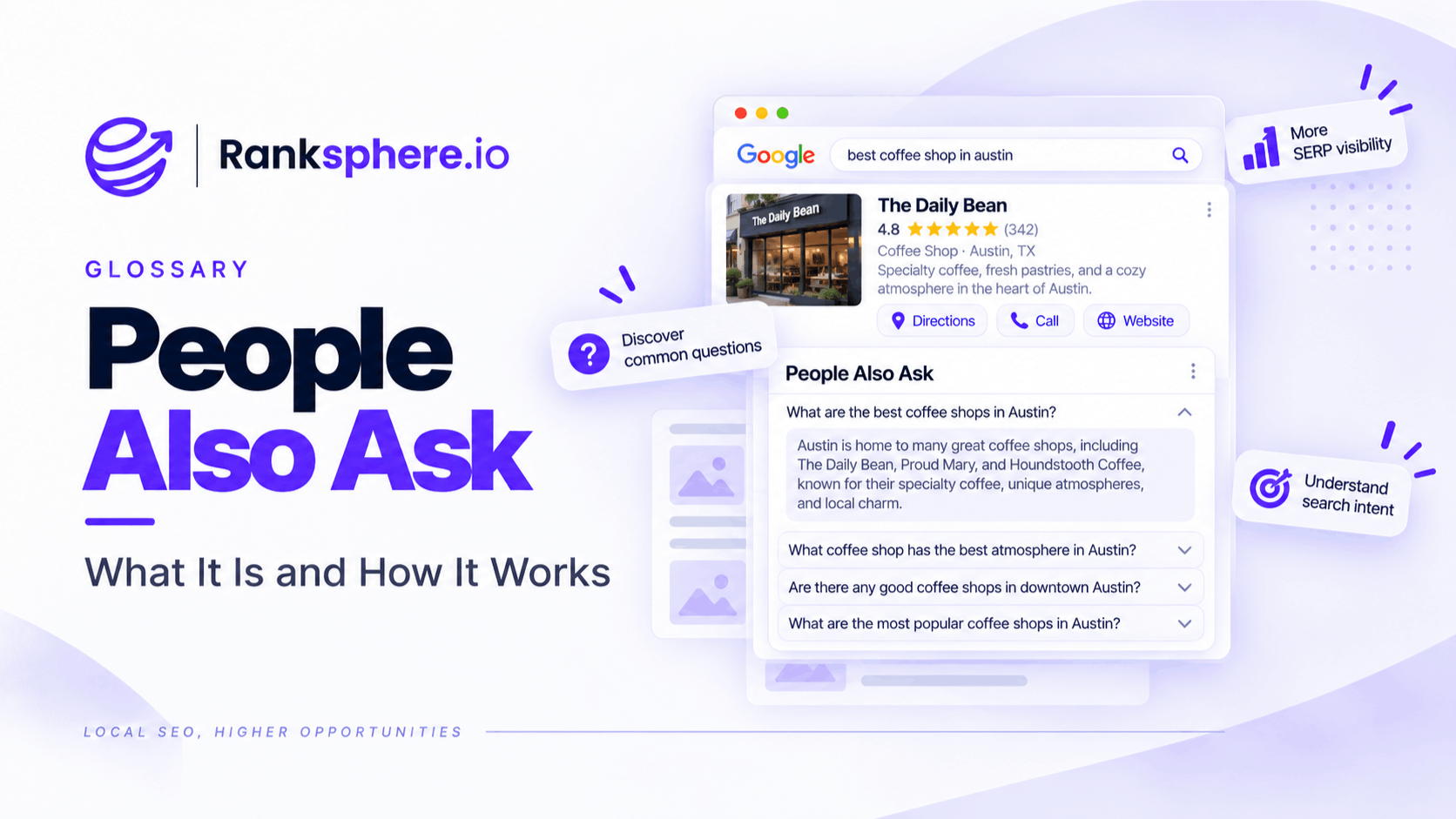
People Also Ask, usually shortened to PAA, is a Google Search feature that displays questions related to a user's original query.
Each question can be expanded to reveal a short answer taken from a webpage, usually with a link to the source.
Google may also load additional related questions as users interact with the feature, allowing them to explore a topic without starting a completely new search.
For SEO and content planning, People Also Ask can be useful because it shows how Google connects one search with related questions and subtopics.
That makes it a valuable research source.
But it should not be mistaken for:
- Exact search-volume data
- A complete list of questions people ask
- A guaranteed content roadmap
- A direct export of individual user searches
Think of PAA as evidence of related search intent, not a perfect demand dataset.
How does People Also Ask work?
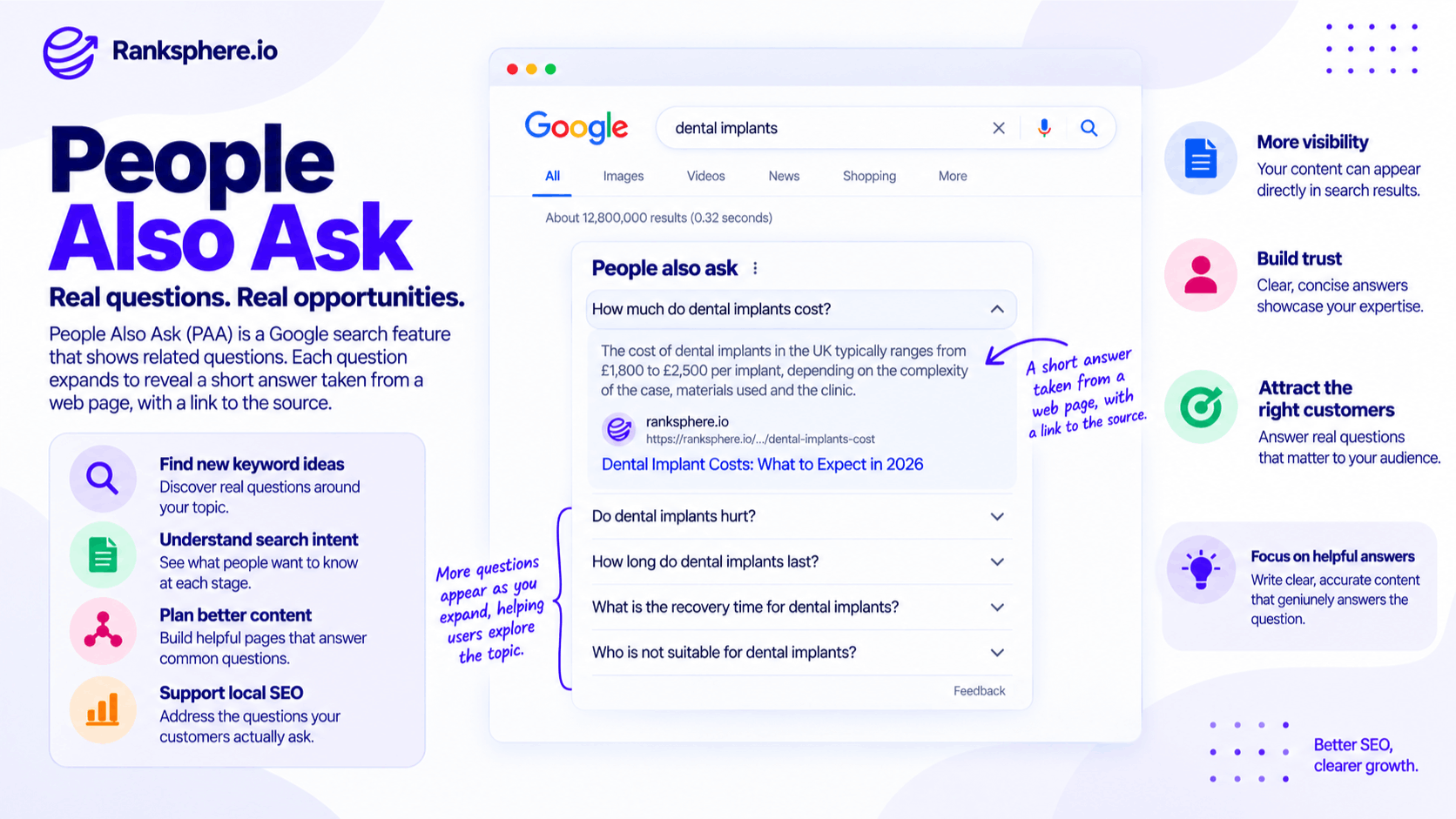
A People Also Ask result usually begins with several related questions.
When a user expands one, Google can show an answer in formats such as:
- A paragraph
- A list
- A table
- An image
- A video
The answer is attributed to a webpage that users can visit for more detail.
Google's own Search documentation explains that featured snippets can appear within the People Also Ask section, which is why the two features often look similar.
People Also Ask vs featured snippets
People Also Ask and featured snippets are closely related, but they appear differently.
Featured snippet
A featured snippet presents an extracted answer prominently within the search results for the main query.
People Also Ask
PAA presents several expandable related questions.
Each may contain an answer extracted from a webpage.
So while the answer format can be similar, the user journey is different.
A featured snippet attempts to answer the current query directly.
People Also Ask encourages the searcher to explore related questions.
Where do PAA questions come from?
Google does not publish a complete formula for generating People Also Ask questions.
They are algorithmically selected based on relationships Google identifies around the search.
This may include:
- Related search behaviour
- Query relationships
- Topic relevance
- Search intent
- Other signals within Google's systems
Third-party SEO tools often describe them as questions related searchers commonly ask, but you should not treat every PAA question as verified search-volume evidence.
A question appearing in PAA tells you:
Google believes it is relevant enough to the topic to surface.
It does not tell you:
Exactly how many people searched for it.
Are PAA questions real searches?
They can reflect genuine search behaviour, but that does not mean every displayed question is a verbatim query copied directly from a user's search history.
That distinction matters when doing keyword research.
People Also Ask is useful for discovering:
- Questions
- Concerns
- Subtopics
- Search journeys
For actual first-party query data about your own website, Google Search Console is more direct.
The strongest research process uses both.
Why People Also Ask is useful for keyword research
PAA can reveal questions that traditional keyword research might miss.
Suppose you search:
dental implants
Google may surface questions around:
- Cost
- Pain
- Recovery
- Longevity
- Suitability
- Gum disease
That gives you clues about what people may want to understand before making a decision.
You can then investigate those topics further rather than automatically creating content for every question.
PAA and search intent
People Also Ask is particularly useful for understanding the questions surrounding a broader search intent.
Someone searching:
dental implants
might eventually want treatment.
But before choosing a dentist, they may ask:
- Do implants hurt?
- How long do they last?
- How long does recovery take?
- Who is unsuitable for implants?
Those questions reveal the informational journey around the commercial decision.
That is often more useful than simply finding additional keyword variations of:
dental implants
PAA and topic clusters
People Also Ask can help identify possible supporting subjects for topic clusters.
For example:
Main topic
Dental implants
Related questions
- How long do dental implants last?
- How painful are dental implants?
- What affects implant cost?
- Can you get implants with gum disease?
- How long does recovery take?
The next step is to decide which questions belong:
- On the main page
- On a supporting guide
- On a treatment page
- In an FAQ section
Do not assume every PAA question deserves its own URL.
One question does not always need one page
A common content mistake is creating one article for every People Also Ask question.
For example:
/do-dental-implants-hurt/
/are-dental-implants-painful/
/is-getting-dental-implants-painful/
These may all represent essentially the same intent.
Creating separate pages can result in:
- Repetitive content
- Thin pages
- Internal competition
- Poor site structure
One strong page can often answer several closely related questions naturally.
How to research People Also Ask
Start with a relevant topic rather than an extremely narrow keyword.
For example:
roof replacement
Then review the questions Google displays.
Expand useful ones and note how the topic branches.
You might discover questions around:
- Costs
- Timescales
- Materials
- Planning
- Repair vs replacement
- Weather
You can then group them by intent.
Do not blindly copy everything into a content brief.
Ask:
Does this question genuinely matter to the audience for this page?
Combine PAA with Search Console
People Also Ask becomes more useful when combined with Search Console.
Search Console can show queries for which your own site already receives impressions.
For example, your roof replacement page might already appear for:
how long does roof replacement take
even though that question is barely addressed.
If the same topic also appears in PAA, that is a stronger reason to improve that section.
You now have:
Google's related-question signal + your own first-party impression data.
That is better than relying on either source alone.
Combine PAA with autocomplete
Google autocomplete can provide another perspective.
Autocomplete suggests possible completions as someone types.
PAA surfaces related questions around a search.
Search Console shows actual queries connected to your own website.
Used together, they can help identify:
- Language customers use
- Follow-up questions
- Related intents
- Content gaps
None should be treated as a complete market-demand dataset by itself.
Should you use every PAA question as a heading?
No.
A People Also Ask question can make a useful heading when the wording matches something readers genuinely want answered.
For example:
How long do dental implants last?
is a perfectly natural heading.
But there is no requirement to copy PAA wording exactly.
You could also write:
How long can dental implants last?
if that reads better on your page.
Write for the reader first.
How to optimise content for People Also Ask
There is no special PAA schema or guaranteed optimisation formula.
The strongest approach is to make the relevant answer clear.
For an important question:
- Use a descriptive heading.
- Answer the question early.
- Give enough context to make the answer accurate.
- Expand underneath where useful.
- Keep the information current.
For example:
How long does a flat roof last?
A well-installed flat roof can last for many years, but lifespan depends heavily on the roofing material, workmanship, drainage, maintenance and exposure to weather.
You can then explain how the answer differs for:
- EPDM
- GRP
- Felt
The short answer gives immediate value.
The rest of the section gives the reader the detail they actually need.
Is there an ideal PAA answer length?
No official word count exists.
Older SEO studies have found that short answers are common.
For example, a Semrush study found an average of roughly 41 words for paragraph-style PAA answers in its dataset.
That does not mean you should write every answer to exactly 40–60 words.
A definition may need one sentence.
A medical or financial answer may require more context to avoid being misleading.
A list may be more appropriate than a paragraph.
The correct length is:
as short as possible while still answering accurately.
Direct answers matter more than arbitrary word counts
A common problem is burying the answer.
For example:
Weak structure
How long does boiler installation take?
There are many factors homeowners should consider before replacing their boiler. Heating systems have changed considerably over recent years...
The actual answer appears three paragraphs later.
Better structure
How long does boiler installation take?
A straightforward boiler replacement can often be completed within a day, while more complex installations may take longer depending on pipework, boiler type and changes to the heating system.
Then explain the variables.
This is better for:
- Readers
- Featured snippets
- PAA extraction
- General content clarity
But it is not an invitation to oversimplify complicated topics.
You do not need exact-match wording
Google's search systems can understand variations in wording.
A page answering:
What does roof replacement cost?
can still be relevant to:
How much does a new roof cost?
Do not awkwardly reproduce every PAA question word for word.
The underlying meaning matters more.
Does the page need to rank first?
There is no published requirement saying a page must rank number one—or even in a particular fixed position—to appear in People Also Ask.
Google says featured snippets are selected from webpages based on how well they answer the question and how helpful Google considers them. PAA can contain these snippet-style answers.
Third-party research has also found PAA sources outside the top few traditional organic results, so avoid treating a particular ranking threshold as a rule.
Organic relevance still matters.
A completely unrelated page is unlikely to become useful simply because one paragraph is formatted as a question and answer.
Is PAA easier to win than a featured snippet?
There is no reliable universal rule saying it is easier.
PAA offers several possible question surfaces rather than one headline featured snippet, which can create more opportunities.
But difficulty depends on:
- Query
- Topic
- Existing sources
- Content quality
- Search-result layout
Treat it as another search feature, not an easy-ranking shortcut.
Can one page appear for several PAA questions?
Yes, a strong page can potentially be selected for more than one related question.
That is another reason not to create eight thin pages when one comprehensive resource serves the same search intent.
For example, one useful dental implant guide might answer:
- Are implants painful?
- How long do implants last?
- How long does recovery take?
if those subjects naturally belong together.
PAA answers can use different formats
Paragraphs are common, but they are not the only option.
People Also Ask answers may include:
- Paragraphs
- Numbered lists
- Bulleted lists
- Tables
- Images
- Videos
Ahrefs and Semrush have both documented multiple answer formats in PAA results.
Use the format that best answers the question.
If someone asks:
What are the stages of dental implant treatment?
a numbered list may be more useful than forcing the answer into a paragraph.
PAA for local SEO
People Also Ask can be valuable for local businesses because many customers research before making contact.
A plumber may discover questions around:
- Emergency call-out fees
- Burst pipes
- Boiler pressure
- Repair times
A dentist may find questions around:
- Pain
- Cost
- Recovery
- Treatment suitability
A roofing company may find questions around:
- Repair vs replacement
- Lifespan
- Materials
- Pricing
These topics can help create content that answers genuine customer concerns.
The goal is not to “rank for PAA”.
The goal is to become more useful during the research stage of the customer journey.
Local modifiers are not always necessary
Do not force the city name into every PAA-style heading.
For example:
How painful are dental implants in Bristol?
is awkward because pain is not meaningfully different in Bristol.
Use:
How painful are dental implants?
Then provide local information elsewhere where geography genuinely matters.
Semantic relevance is more important than mechanically inserting locations.
People Also Ask and long-tail keywords
Many PAA questions resemble long-tail keywords because they express specific information needs.
For example:
Can I get dental implants if I have gum disease?
is more specific than:
dental implants
That specificity can make PAA useful when researching the wider search journey.
But not every PAA question necessarily has high search volume.
Specificity and demand are different things.
PAA and AI search
Question-led content can also be useful in AI-powered search because clear answers are easier for both people and retrieval systems to understand.
But do not assume:
PAA optimisation = AI Overview optimisation.
Google's generative Search systems work differently and may retrieve information through several related queries.
The overlap comes from the quality of the content:
- Clear questions
- Accurate answers
- Logical structure
- Useful detail
Those are broadly good publishing practices.
Does PAA drive traffic?
Sometimes.
But People Also Ask can also satisfy the user's immediate question directly within Google.
That creates the same zero-click search trade-off seen across other SERP features.
A user may:
- Expand the question.
- Read the answer.
- Never visit the source.
Or they may click because they need:
- More detail
- Context
- A service
- A quote
- An appointment
So PAA visibility should not automatically be valued only by direct clicks.
PAA visibility and brand exposure
A source appearing inside People Also Ask can place its page prominently within the user's research journey.
That may have brand value.
But do not automatically assume every PAA impression creates:
- Awareness
- Recall
- Leads
Those effects are difficult to attribute directly.
Measure what you can.
How to track People Also Ask visibility
There is no dedicated first-party PAA performance report in Search Console.
You can still monitor:
- Impressions for related queries
- Page-level organic performance
- Keyword rankings
- SERP features through appropriate SEO tools
Ranksphere's rank tracker follows a set of related terms across your service area, helping show whether a question-led page is becoming visible across a wider cluster rather than judging it by one exact phrase.
Remember that PAA results can change.
A source appearing today is not guaranteed to remain there indefinitely.
People Also Ask changes over time
The questions Google displays can change as:
- Search behaviour changes
- Topics evolve
- Google changes its systems
- Fresh information becomes relevant
That makes PAA useful to revisit periodically.
However, you do not need to rewrite an article every time one question changes.
Look for meaningful shifts in what customers want to know.
Common People Also Ask mistakes
- Treating PAA questions as exact first-party search-volume data. They are related questions, not a volume report.
- Calling every PAA question a verbatim real-user query.
- Creating a separate page for every question. Group questions when they share the same intent.
- Following a strict 40–60 word rule. There is no official requirement.
- Copying every question verbatim into headings. Natural wording is fine.
- Burying the actual answer beneath a long introduction.
- Assuming PAA is always easier to win than a featured snippet.
- Believing a page must rank in a specific organic position first.
- Adding questions simply because Google displays them. They still need to be relevant to your audience.
- Expecting large amounts of traffic from every appearance.
- Treating the PAA set as permanent.
- Using PAA instead of Search Console or broader keyword research.
People Also Ask best practices
- Use PAA as one content-research source, not your entire strategy.
- Combine it with Search Console, autocomplete and keyword research.
- Group questions by search intent.
- Answer useful questions clearly and early.
- Use question-shaped headings where they improve the page.
- Choose the answer format that best suits the question.
- Avoid arbitrary answer-length targets.
- Cover several closely related questions on one page when appropriate.
- Create separate pages when the underlying intent genuinely differs.
- Keep factual answers current.
- Revisit PAA periodically as topics change.
- Measure visibility alongside traffic and conversions rather than assuming the SERP feature itself is the outcome.
Example
“Hartwell Dental is planning new content around dental implants.
Instead of starting by creating separate articles for every keyword variation, the practice reviews the People Also Ask questions appearing around the topic.
Several themes keep appearing:
- Pain
- Cost
- Recovery
- Longevity
- Suitability
The practice then checks its Search Console data.
Some of those themes already generate impressions for its existing dental implant page, even though the page barely answers them.
Rather than creating five thin new articles, Hartwell improves the existing page.
It adds clear sections explaining:
- What patients may experience during and after treatment
- The factors affecting cost
- Typical stages of recovery
- Factors affecting implant lifespan
- Circumstances that may affect suitability
Each section answers the main question first, then provides additional context.
Where a subject deserves substantially more depth, the practice creates a dedicated supporting page and links it back to the main treatment page.
If outdated or overlapping URLs are later consolidated, appropriate 301 redirects are used rather than leaving duplicate pages competing unnecessarily.
The value of the PAA research was not that Google handed the practice a guaranteed ranking formula.
It revealed how the topic branches into the questions potential patients may want answered before they make a decision.
That is the best way to use People Also Ask: as a source of search-intent insight, not as a mechanical list of keywords to turn into pages.”
See also
- Featured snippet — an extracted answer that can also appear within People Also Ask
- Keyword research — where PAA can provide useful supporting ideas
- Long-tail keyword — specific searches and questions around broader topics
- Topic cluster — organising related questions and supporting content
- Zero-click search — when an answer is consumed without a website visit
- Heading tags — structuring question-led content clearly