Word count is the number of words in a piece of content or on a webpage. In SEO, it is commonly used to measure the length of blog posts, service pages and articles.
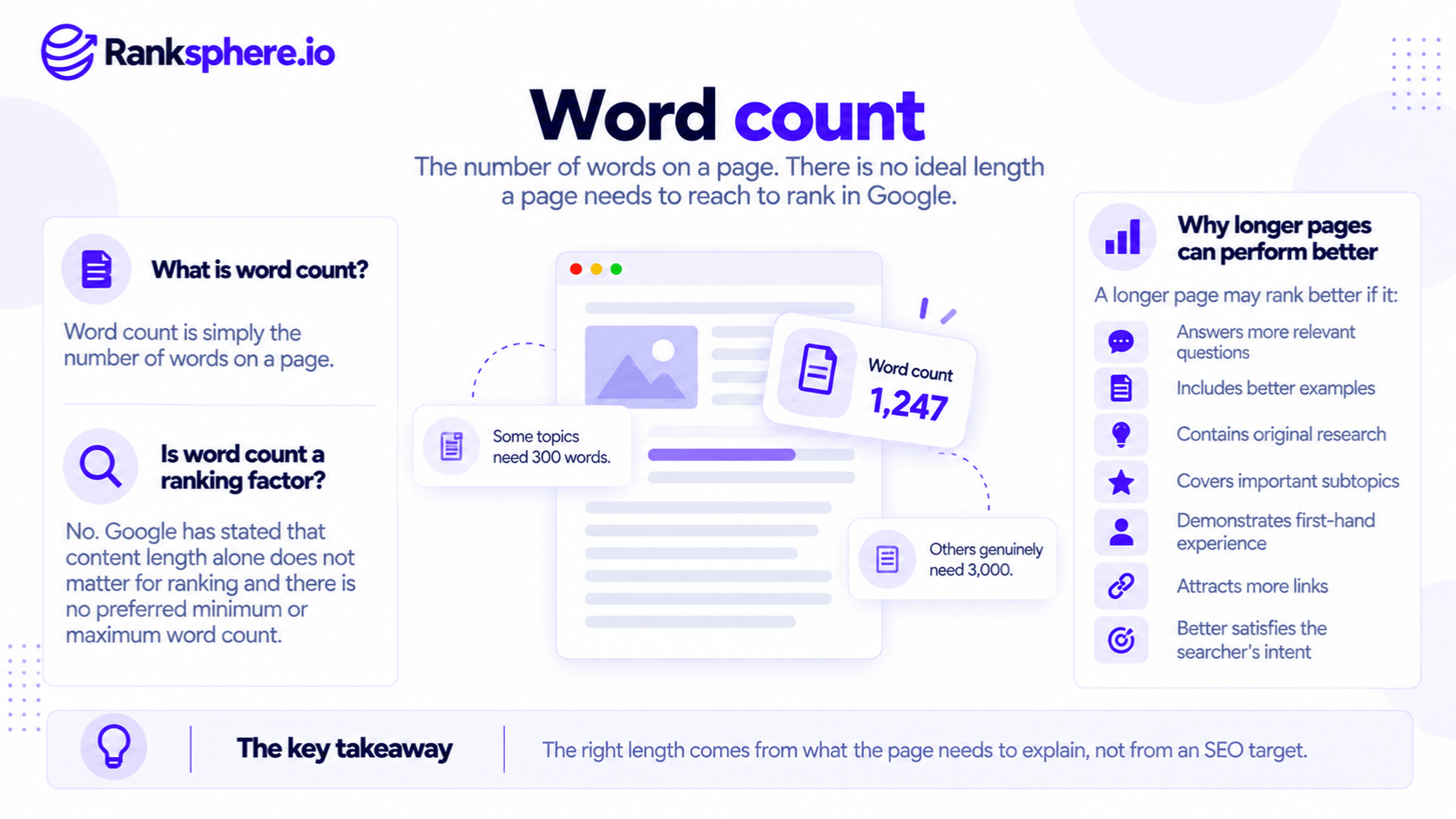
Google does not require a minimum word count, and content length alone is not a ranking factor.
A 500-word article can rank well if it answers the searcher's question. A 3,000-word guide can struggle if it adds little value or fails to address what people are searching for.
Yet word count remains one of the most common requirements in SEO content briefs.
The problem is that longer content isn't automatically better content.
The right question isn't how many words a page should contain. It's whether the page provides enough useful information to satisfy the reader.
Is Word Count a Google Ranking Factor?
No.
Google's SEO Starter Guide explicitly states that content length alone doesn't matter for ranking purposes. There is no preferred minimum or maximum word count.
Google also advises against writing to a particular length simply because someone claims it is better for SEO.
That doesn't mean a page's depth or content is irrelevant.
A comprehensive guide may answer more questions, cover related concepts and attract relevant links. It may also be longer because the subject requires more explanation.
But Google isn't rewarding the extra words simply for being there.
Adding several paragraphs of generic information to reach 2,000 words doesn't make an article more useful.
Why Do Longer Articles Often Rank Well?
The belief that longer content ranks better largely comes from SEO correlation studies.
Some studies have found that high-ranking pages tend to contain more words than lower-ranking pages.
However, correlation doesn't establish why those pages rank.
A detailed article may perform well because it answers important questions, contains original research or provides examples that competing pages lack.
Its length may be a consequence of that work rather than the reason for its rankings.
The reverse also applies.
A short page can be useful when someone wants a direct answer.
For example, a visitor searching for a business's opening hours doesn't need a 2,000-word explanation.
Word count should follow the information a page needs to provide, not determine what gets written.
How Long Should a Blog Post Be for SEO?
There is no universal ideal blog post length.
A useful starting point is to understand search intent: what the reader wants to know or accomplish.
Then review the current search engine results page (SERP).
Look at the types of pages appearing for the query, the questions they answer and the amount of detail the subject genuinely requires.
For example, a search for "what is a canonical tag" may be satisfied by a concise definition with a practical example.
A search for "how to migrate a website without losing SEO traffic" usually requires more explanation, including redirects, technical checks and post-launch monitoring.
The existing results offer useful context, but they aren't a word count target. A shorter, more specific page may serve readers better than a lengthy competitor.
A good content brief should therefore specify the questions the article must answer, not just an arbitrary number of words.
When Is Short-Form Content Better?
Shorter content is often appropriate when the reader needs a clear, specific answer.
Examples include definitions, straightforward troubleshooting instructions and focused service pages.
A local plumber's drain unblocking page might explain the service, common problems, pricing considerations, service area and how to book.
If those details can be covered thoroughly in 700 words, adding another 1,500 words of general plumbing advice may make the page less useful.
A concise explanation can also work well for questions that may appear in a featured snippet.
However, a short featured snippet doesn't mean the entire source page must be short.
The aim is to provide a clear answer in the appropriate place.
When Does Longer Content Make Sense?
Some subjects genuinely require more detail.
A guide to improving local search rankings, for example, may need to explain Google Business Profile optimisation, reviews, proximity, citations, website content and reporting.
Longer content can also make sense for detailed tutorials, research, comparisons and topic cluster pillar pages.
The difference is whether the additional sections contribute something useful.
If readers need the detail, include it.
If a paragraph exists only to meet a word count, remove it.
Why Specificity Matters More for Local Businesses
For local businesses, first-hand information can be more useful than a long general article.
Consider two roofing websites.
The first publishes a 2,500-word guide covering common roofing problems. It provides general advice but little information about the company's actual work.
The second publishes a shorter guide explaining typical repair costs in its service area, with photographs of completed jobs and details about the problems its team regularly encounters.
The second page may offer more practical value to prospective customers because its information is specific.
That doesn't guarantee better rankings. Competition, relevance, links and other signals still matter.
However, original examples and first-hand experience can make the content more useful and credible.
This connects with Google's guidance on E-E-A-T, particularly the value of genuine experience and trustworthy information.
Common Word Count Mistakes
- Setting an arbitrary minimum. Google doesn't require 1,000 or 2,000 words to rank.
- Adding filler to reach a target. More text doesn't necessarily make a page more useful.
- Treating correlation as causation. Longer high-ranking pages don't prove that length caused the ranking.
- Copying a tool's recommended word count. These figures are estimates, not Google requirements.
- Assuming longer means more comprehensive. An article can be lengthy while missing essential questions.
- Removing useful detail to keep content short. Brevity shouldn't come at the expense of completeness.
- Ignoring search intent. The right level of detail depends on what readers need.
Word Count Best Practices
Use word count as an editorial planning estimate rather than an SEO target.
Before writing, identify the primary question, supporting questions and information required to answer them.
Review competing pages to understand search intent, but don't automatically copy their length.
Prioritise original information, practical examples and clear explanations.
Once the article answers the necessary questions, stop.
Example of Word Count in an SEO Content Brief
Consider a hypothetical dental practice hiring an agency to write a page about dental implants.
The original brief requires 1,500 words and a specific number of keyword mentions.
The writer delivers a lengthy overview describing the treatment, but the article contains little information specific to the practice.
It doesn't explain the practice's pricing, treatment process or who provides the service.
What the Agency Changes
The agency rewrites the brief around questions prospective patients actually ask.
These include treatment costs, recovery time, suitability, possible complications and what happens during a consultation.
The practice provides accurate pricing information, details verified by its clinicians and relevant photographs it has permission to use.
The revised page is shorter, but contains more useful information.
Example
“The original page met its word count target.
The revised page addressed the questions patients needed answered before booking an appointment.
That makes it a stronger resource for readers, although improved search rankings or enquiries aren't guaranteed.
The purpose of SEO content isn't to reach a word count. It's to answer the right questions with enough useful detail and no unnecessary padding.”
See Also
- Thin Content — Content that provides insufficient value, regardless of length.
- Search Intent — Understanding what readers expect from a page.
- Content Brief — Planning the questions and information content should cover.
- Skyscraper Technique — A content strategy sometimes misunderstood as making articles longer than competitors.
- Ranking Factors — Understanding what Google confirms about search rankings.
- Readability — Making content easier to understand, regardless of word count.