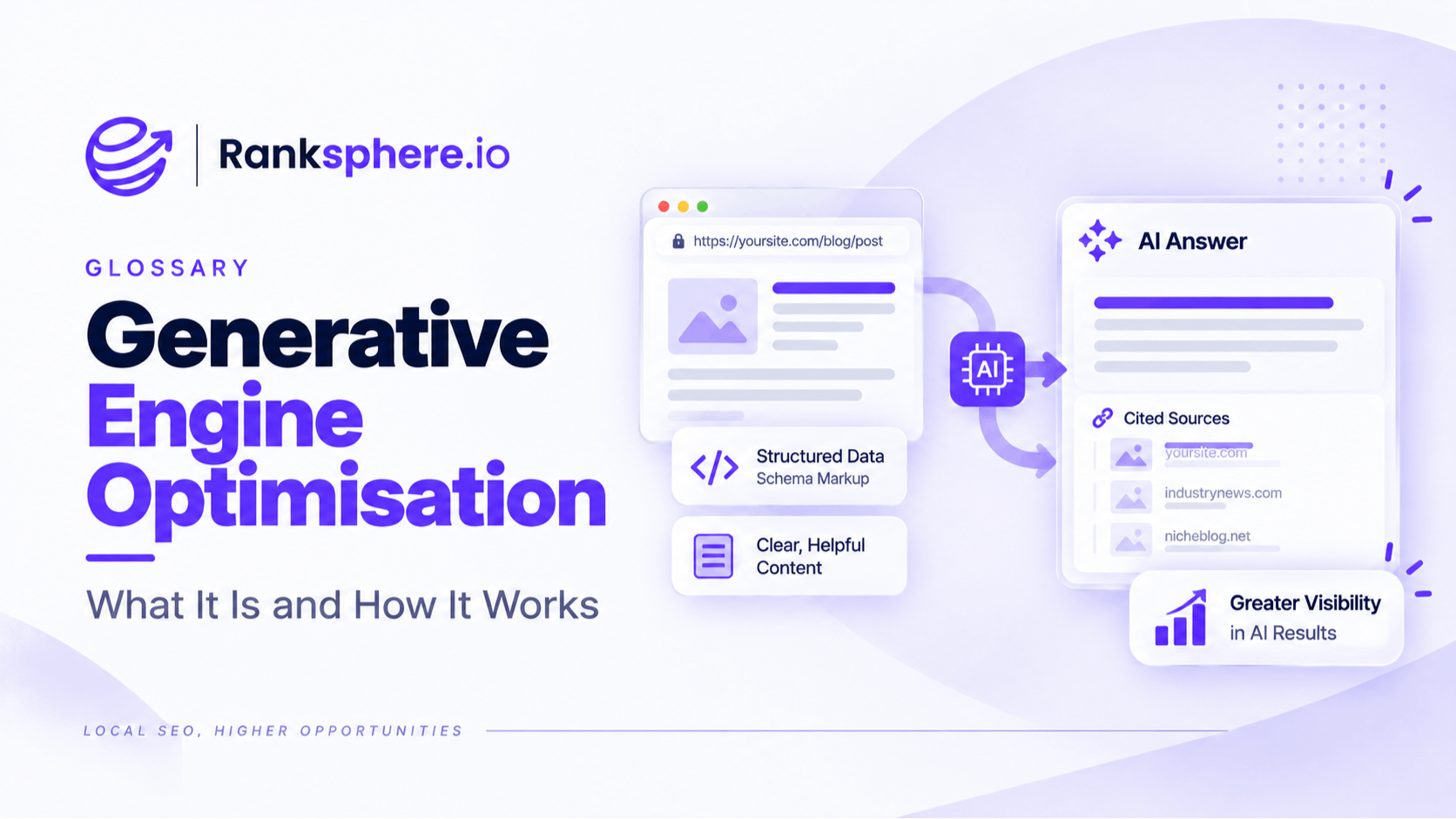
Generative Engine Optimisation, usually shortened to GEO, is the practice of improving how easily a brand, website or piece of content can be discovered, understood, referenced and cited by generative AI search and answer systems.
These systems include experiences such as:
- Google AI Overviews
- Google AI Mode
- ChatGPT Search
- Perplexity
Traditional SEO focuses heavily on visibility within search results.
GEO looks at an additional question:
Can an AI-powered system find, understand and use your information when generating an answer?
The distinction matters, but it should not be exaggerated.
Much of effective GEO is built on familiar foundations:
- Useful content
- Technical accessibility
- Clear site structure
- Accurate information
- Strong brand and entity signals
- Original expertise
- External recognition
For Google specifically, the overlap is especially strong. Google says its generative AI Search features remain grounded in its core Search ranking and quality systems, and there are no separate technical requirements for appearing in AI Overviews or AI Mode.
GEO is therefore best understood as an extension of search optimisation into generative interfaces rather than a replacement for SEO.
What does GEO mean?
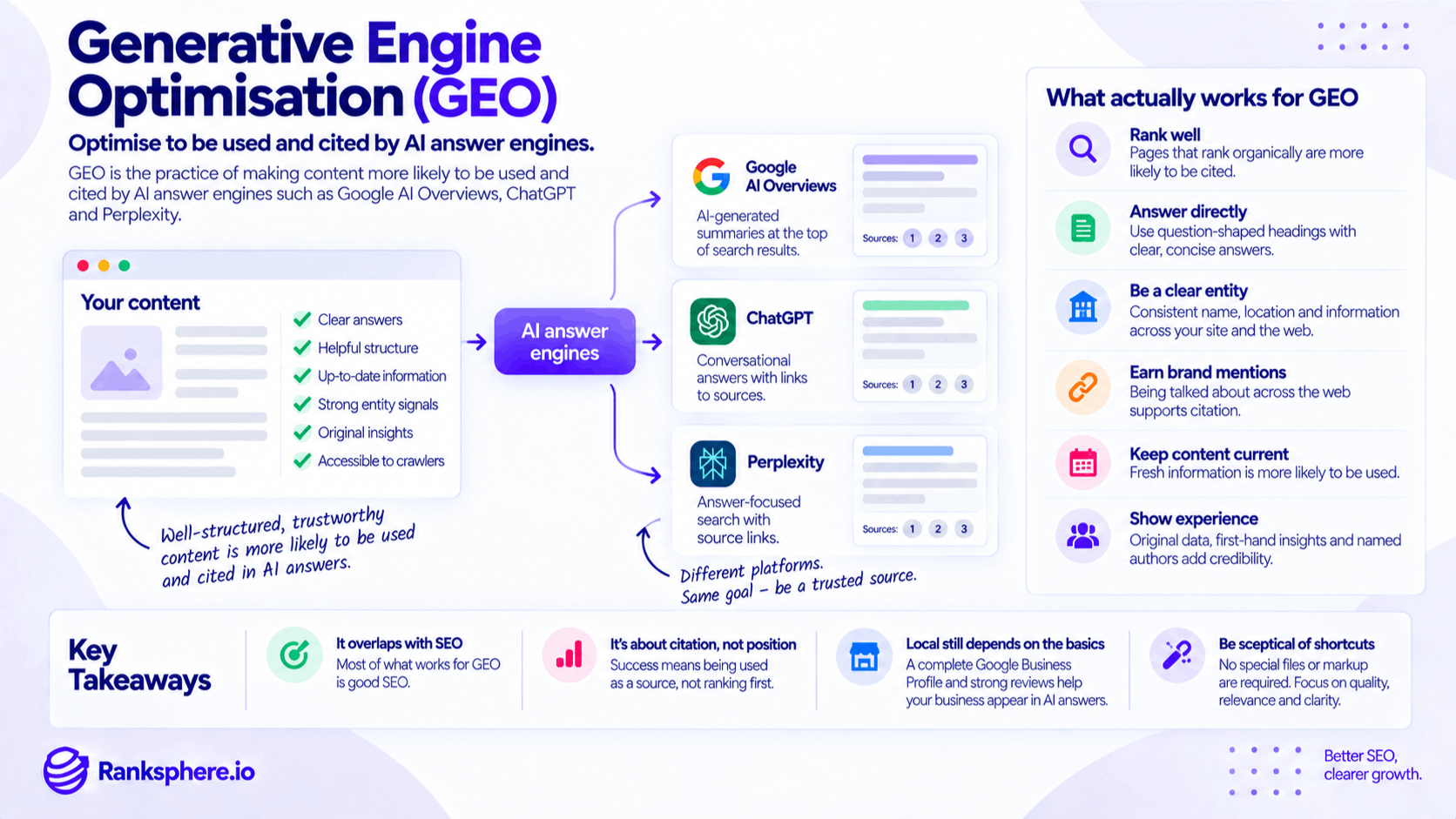
Generative search systems do more than return a ranked list of webpages.
They can:
- Search for relevant information
- Retrieve several sources
- Compare information
- Generate an answer
- Cite or link to supporting webpages
That changes the type of visibility a website can receive.
In traditional search, you might measure:
Position 1
Position 4
Position 10
In a generative answer, your website may instead appear as:
- A cited source
- A supporting link
- A referenced brand
- A recommended business
- A source within one section of a longer answer
That is the environment GEO attempts to address.
GEO vs SEO
SEO and GEO overlap heavily, but they are not identical.
SEO
Search Engine Optimisation focuses on improving visibility within search engines.
That includes areas such as:
- Crawling
- Indexing
- Search intent
- Content
- Internal linking
- Backlinks
- Technical SEO
- Local SEO
Success is often measured through:
- Rankings
- Search impressions
- Clicks
- Organic traffic
- Conversions
GEO
Generative Engine Optimisation focuses on visibility within AI-generated answers.
Possible outcomes include:
- Being cited
- Being linked as a source
- Having your information incorporated into an answer
- Having your business surfaced as a relevant option
The challenge is that there is no universal GEO ranking system.
Google, ChatGPT and Perplexity have different:
- Search indexes
- Retrieval systems
- Crawlers
- Models
- Interfaces
- Citation behaviour
So there is no single optimisation formula that works identically across every generative platform.
Is GEO different from AEO?
Answer Engine Optimisation, or AEO, and GEO are closely related but are not necessarily the same thing.
AEO is the broader term.
It can include optimisation for direct-answer experiences such as:
- Featured snippets
- Voice answers
- Search-result answers
- AI-generated answers
GEO is generally used more specifically for generative AI systems that synthesise information into newly generated responses.
In practice, marketers often use the terms interchangeably.
That is understandable, because much of the work overlaps.
But technically:
AEO is about being the answer.
GEO is about being a useful source within a generated answer.
Neither requires abandoning SEO.
Does GEO replace SEO?
No.
For Google Search, this is particularly clear.
Google's 2026 guidance says its generative AI features rely on the same foundational Search systems and that established SEO practices remain relevant.
If Google cannot properly:
- Crawl the page
- Index it
- Understand it
- Determine its relevance
then creating special “AI-optimised” wording is unlikely to solve the underlying problem.
The practical order is usually:
Technical accessibility → useful content → strong SEO → generative visibility
rather than:
SEO or GEO
They work together.
GEO and Google AI Overviews
AI Overviews generate answers within Google Search and can link to several supporting webpages.
Google says the pages surfaced in its generative features must meet the normal technical requirements for Search and be eligible to appear with a snippet.
You do not need:
- AI Overview schema
- Special GEO markup
- An AI sitemap
- A separate AI version of the page
The same Search foundation still applies.
GEO and Google AI Mode
Google AI Mode extends this further through longer, conversational and multi-part searches.
A major difference is query fan-out.
A question such as:
What should I consider before installing a heat pump in a Victorian terrace with poor insulation?
may cause Google's systems to explore several related searches around:
- Heat pump sizing
- Victorian properties
- Insulation
- Installation requirements
- Running costs
That means a webpage does not necessarily need to rank for the exact wording of the original query to be relevant to part of the generated response.
This is one reason the old model of:
“Rank number one for this exact keyword and you will get cited.”
is too simplistic.
GEO and ChatGPT Search
ChatGPT Search can search the web and provide citations and links to sources.
For publishers, OpenAI provides a specific crawler for this purpose:
OAI-SearchBot
OpenAI says sites that want their content to be discoverable and included in ChatGPT Search summaries and snippets should make sure they are not blocking OAI-SearchBot.
This is different from:
GPTBot
GPTBot is associated with content that may be used for model development or training.
That distinction is important.
Blocking GPTBot does not mean the same thing as blocking ChatGPT Search.
GEO and Perplexity
Perplexity operates as an AI-powered answer and search engine that retrieves web information and cites sources in its responses.
Its search crawler is:
PerplexityBot
Perplexity says the crawler follows robots.txt rules and is used as part of its search infrastructure.
Again, this shows why GEO cannot be reduced to one Google optimisation checklist.
Different platforms access and retrieve web content differently.
How generative engines choose sources
There is no public universal formula.
Anyone promising:
“Follow these seven steps and you will be cited by every AI engine”
is overselling what is known.
Different systems may consider different signals.
For Google's generative Search experiences, Google has confirmed that its normal Search ranking and quality systems play an important role in retrieving relevant web content.
For other AI search platforms, their own indexes, search providers, retrieval systems and crawlers may be involved.
The safest strategy is therefore to make the source itself strong rather than attempting to reverse-engineer one citation algorithm.
What actually helps with GEO?
There is no guaranteed formula, but several principles make content more useful to both people and retrieval systems.
Create original, useful content
Generic information is easy to reproduce.
If a page says nothing beyond what appears on hundreds of other websites, an AI system can often summarise the same material without needing anything distinctive from your page.
More valuable sources may contain:
- Original research
- First-hand experience
- Unique data
- Expert analysis
- Case studies
- Original photographs
- Practical examples
- Proprietary tools
Google's current generative Search guidance specifically encourages valuable, unique and non-commodity content.
That principle extends naturally beyond Google.
Give the web something worth referencing.
Answer the actual question
Useful content should answer the question it promises to answer.
If the heading is:
How long does a heat pump installation take?
the reader should not need to work through six paragraphs before reaching an answer.
Give the useful answer first.
Then explain:
- Variables
- Exceptions
- Practical considerations
- Examples
This improves the page for people and makes the information easier to understand.
But do not mistake this for an AI-specific formatting rule.
Clear writing was useful before generative search existed.
Use clear headings
Well-structured heading tags help organise complex information.
For example:
How much does treatment cost?
How long does recovery take?
Who is suitable for treatment?
may provide a clearer structure than one continuous wall of text.
Use question-shaped headings when they naturally match what the reader wants to know.
Do not convert every H2 into a question simply because someone claims AI systems require it.
Avoid artificial “content chunking”
One common GEO recommendation is to break every answer into small, supposedly “AI-readable chunks”.
Google specifically addressed this type of advice in its 2026 generative AI optimisation guidance.
Its position is that no special content chunking is required for Google Search's generative features.
Good structure still matters.
Artificially rewriting a natural article into dozens of tiny fragments because an AI checklist says so does not.
Optimise for clarity.
Not for an imaginary extraction formula.
Add first-hand experience
First-hand information can make a page considerably harder to replace with a generic summary.
Examples include:
- Work you completed
- Results you observed
- Original photographs
- Real customer questions
- Tests you conducted
- Professional commentary
- Lessons learned
This also aligns naturally with E-E-A-T.
For example, a landscaper could publish:
How We Improved Drainage in a Clay-Soil Garden in Maidstone
with:
- Before-and-after photographs
- The original problem
- What was installed
- Why that approach was chosen
That offers more original value than another generic article titled:
10 Garden Drainage Tips
Use named experts where appropriate
If a page deals with specialist information, readers should be able to understand who produced or reviewed it.
That might include:
- Author name
- Relevant qualifications
- Professional role
- Review date
This is particularly important for subjects where expertise matters, such as:
- Health
- Finance
- Legal information
- Safety
Do not invent credentials or create author profiles solely as an SEO tactic.
The aim is transparency.
Keep information current
Generative systems need accurate information.
Pages containing:
- Old prices
- Closed programmes
- Expired regulations
- Obsolete product names
- Outdated statistics
become poorer sources as the information changes.
A regular content refresh is therefore relevant to GEO for the same reason it is relevant to SEO:
Accuracy matters.
Do not change dates merely to make a page appear fresh.
Update the substance.
Make your entity clear
An entity is a distinct person, organisation, place or concept that search systems can identify.
For a business, basic clarity matters.
Make it easy to establish:
- Business name
- What the company does
- Where it operates
- Who works there
- Which website is official
That information should be accurate across important properties.
But avoid treating “entity optimisation” as a mystical GEO score.
There is no public entity-strength metric that guarantees AI citations.
Use schema where it genuinely applies
Schema markup can help search engines understand structured information about a page or entity.
Useful types might include:
- Organization
- LocalBusiness
- Product
- Article
- Person
depending on the content.
But there is no special:
GEO schema
or:
AI citation schema
that tells generative engines to use your content.
Schema describes information.
It does not guarantee citation.
Earn genuine recognition across the web
Being referenced by reputable websites can strengthen a brand's wider web presence.
That might come through:
- Press coverage
- Industry publications
- Associations
- Reviews
- Partnerships
- Citations
- Backlinks
Do not reduce this to:
“More brand mentions = more AI citations.”
There is no published universal formula proving that.
The stronger principle is that a real organisation with a clear and independently verifiable web presence is easier to understand than one that exists only on its own website.
GEO and backlinks
Backlinks remain useful.
For Google, links continue to be part of the broader Search ecosystem underlying generative results.
For other platforms, backlinks can also contribute indirectly through:
- Discoverability
- Publisher recognition
- Referral traffic
- Wider brand exposure
But do not build links solely to increase an invented “AI authority score”.
There is no standard GEO backlink metric.
GEO and brand mentions
Brand mentions deserve attention, but this area is often overstated.
Third-party studies may identify correlations between brands frequently mentioned online and brands appearing in AI-generated answers.
That does not prove that unlinked mentions are a direct citation-ranking factor across every platform.
Treat mentions as part of broader reputation and discoverability.
Earn them because the business is worth discussing.
Not because someone promises each mention produces an AI signal.
GEO and llms.txt
llms.txt is a proposed file format intended to help AI systems find useful website information.
It has received considerable attention in GEO discussions.
For Google Search, the situation is clear.
In June 2026, Google explicitly stated that llms.txt is not required and has no positive or negative impact on Google Search visibility or rankings.
That means adding an llms.txt file is not a Google AI Overview or AI Mode optimisation tactic.
However, it is too broad to say the file can never serve any purpose.
Other tools or services may choose to use it.
If you maintain one for another legitimate reason, that is fine.
Just do not treat it as a ranking shortcut.
Do you need Markdown versions of every page?
No.
There is no requirement to create parallel Markdown copies of your website for Google AI Search.
Markdown may be useful for:
- Documentation
- Developer workflows
- APIs
- Particular tools
But there is no evidence that creating a Markdown duplicate of every normal webpage is a general-purpose GEO requirement.
Do not duplicate your entire site because a vendor tells you AI engines cannot understand HTML.
Modern search and retrieval systems are built to process web pages.
Do you need special AI markup?
No general-purpose AI citation markup exists.
There is no schema property that says:
“Please cite this page in ChatGPT.”
or:
“Use this paragraph in AI Overviews.”
Use structured data when it accurately describes the content and is appropriate for the platform.
Do not invent markup solely for GEO.
Can AI-written content rank or be cited?
The issue is not whether AI touched the copy.
The issue is the quality of the finished content.
Generic mass-produced material that simply rewrites information already available elsewhere provides little reason to:
- Rank it
- Reference it
- Cite it
- Visit it
AI can be useful for:
- Research assistance
- Outlining
- Editing
- Brainstorming
- Drafting
But the final content should still be:
- Accurate
- Useful
- Original where possible
- Properly reviewed
- Appropriate to the subject
The weak strategy is not:
AI was used.
It is:
Nothing distinctive was added.
AI crawler access
Crawler management is one area where GEO genuinely introduces some new technical decisions.
Different AI companies use different crawlers for different purposes.
Do not assume all AI bots perform the same job.
OpenAI
For ChatGPT Search visibility, OpenAI says publishers should allow:
OAI-SearchBot
if they want their content available for discovery, summaries and citations.
OpenAI separately uses:
GPTBot
in relation to potential model-training use.
You can therefore make different choices about:
- Search discovery
- Training access
Do not tell a publisher to allow GPTBot simply because they want to appear in ChatGPT Search.
Anthropic
Anthropic also distinguishes between crawler purposes.
Its documentation identifies:
ClaudeBot for model-development crawling
and separate user-directed retrieval behaviour when Claude users request web information.
Again, training access and live retrieval should not be treated as the same decision.
Perplexity
Perplexity uses:
PerplexityBot
as part of its search crawling infrastructure and says it respects robots.txt controls.
Because crawler names and policies can change, check each provider's current documentation before changing robots.txt.
Should you allow AI crawlers?
There is no universal answer.
It is a publisher decision.
Consider separately:
- Search visibility
- User-directed retrieval
- Model training
- Copyright considerations
- Server load
- Commercial strategy
Do not simply add:
User-agent: *
Allow: /
because someone says it improves GEO.
Understand which crawler you are allowing and what it does.
GEO for local businesses
For most local businesses, GEO is less exotic than the marketing around it suggests.
The fundamentals remain:
- Accurate business information
- Strong local pages
- Genuine reviews
- Useful service information
- Clear expertise
- Real-world evidence
For Google's generative Search features, Google specifically recommends maintaining accurate business information through Google Business Profile. Its generative AI guidance includes Business Profile as part of making local products and services available across Google Search experiences.
That does not mean a complete profile guarantees an AI recommendation.
It means the underlying local data needs to be accurate.
Google Business Profile and GEO
For a local business, maintain:
- Correct business name
- Appropriate categories
- Address or service area
- Opening hours
- Services
- Contact information
- Photos
Keep the information accurate rather than trying to “AI optimise” it.
A Google Business Profile remains part of ordinary local SEO as well as Google's wider search ecosystem.
Reviews and generative search
Reviews can provide useful information about:
- Customer experience
- Services
- Reputation
- Common themes
They remain important for local businesses.
But avoid claims such as:
“Review text is a major AI citation factor.”
Google has not published a weighting showing that.
Build genuine reviews because they help customers and local visibility.
Do not ask customers to insert target phrases for AI systems.
NAP and GEO
Keep your NAP information accurate.
That means your:
Name
Address
Phone number
should represent the real business consistently enough that users and platforms are not receiving conflicting information.
It does not have to be character-for-character identical everywhere.
Harmless formatting differences are normal.
The problem is conflicting underlying information.
LocalBusiness schema and GEO
LocalBusiness schema can help describe a genuine local business entity.
Use accurate information such as:
- Business name
- Address
- Telephone
- Opening hours
- Relevant business type
sameAs can be useful for linking authoritative profiles where appropriate.
But do not treat sameAs as an AI citation switch.
Schema helps describe the entity.
It does not guarantee that a generative engine will recommend it.
Local content still matters
Local businesses should also answer the questions their customers actually ask.
For example, a roofing company might publish:
How much does a roof replacement cost in Kent?
Can a leaking flat roof be repaired or does it need replacing?
How long does a tiled roof replacement take?
The strongest versions will add information the business genuinely knows:
- Local project examples
- Original photographs
- Pricing considerations
- Common property types
- Real customer questions
That is valuable for:
- Traditional organic search
- AI Search
- Potential customers
The work does not need a different label to be useful.
Ranksphere's smart tasks prioritise profile, review and content gaps by impact, helping identify the underlying work that supports visibility across traditional and generative search experiences.
Measuring GEO
Measurement is one of the areas where GEO differs most from traditional rank tracking.
There is no universal:
AI position 1
across every generative platform.
Instead, you may need to monitor several things.
Google introduced dedicated Generative AI performance reporting in Search Console in 2026, covering visibility in experiences such as AI Overviews and AI Mode. Google says the reports rolled out worldwide by 31 August 2026.
That gives site owners a first-party way to monitor Google generative visibility.
ChatGPT
OpenAI says referral links from ChatGPT Search automatically include:
utm_source=chatgpt.com
which makes traffic from ChatGPT easier to identify in analytics.
You can therefore monitor:
- Referral sessions
- Landing pages
- Conversions
alongside any separate citation monitoring you perform.
Other platforms
Measurement capabilities vary.
For platforms without first-party publisher reporting, businesses may need to combine:
- Referral analytics
- Manual visibility checks
- Third-party monitoring
- Brand-search trends
- Enquiry data
Do not claim perfect attribution where none exists.
What should a GEO baseline include?
Before starting GEO work, record what is happening now.
Depending on the platform, that might include:
- Current AI citations or mentions
- Google generative AI impressions
- ChatGPT referral traffic
- Perplexity referral traffic
- Organic visibility
- Branded search
- Conversions from AI referrals
Then compare changes over time.
Without a baseline, a vendor can claim:
“Your AI visibility improved.”
without showing what actually changed.
How to judge a GEO agency or consultant
The term GEO is new enough that vague services are common.
Ask practical questions.
What exactly will you change?
If the answer is:
- Improve content
- Fix technical SEO
- Add original research
- Improve business information
that may be useful work.
You should still know what you are paying for.
Which platforms are you targeting?
Google AI Overviews, ChatGPT Search and Perplexity are not one system.
How will you measure success?
Ask for:
- Baseline
- Platforms
- Visibility methodology
- Traffic measurement
- Conversion measurement
Which recommendation is genuinely AI-specific?
This question is particularly useful.
Sometimes the answer reveals that a supposed GEO package is simply good SEO under a new name.
That does not make the work bad.
It does affect how it should be priced and explained.
GEO tactics to be cautious about
Be sceptical of services based primarily on:
- Guaranteed AI citations
- AI-specific keyword density
- Mandatory llms.txt
- Special citation schema
- Duplicate Markdown versions of every page
- Artificial content chunking
- Hundreds of pages targeting individual prompts
- Exact citation formulas
- Fixed “AI authority” scores
None provides a documented universal shortcut into generative answers.
Common GEO mistakes
- Treating GEO as completely separate from SEO. The overlap is substantial, particularly within Google Search.
- Assuming GEO and AEO have one universally agreed definition.
- Believing a top organic ranking guarantees an AI citation.
- Publishing a page for every conversational query.
- Artificially chunking content solely for AI extraction.
- Treating llms.txt as a Google ranking or citation factor.
- Creating special AI schema that search engines have not documented.
- Blocking the wrong crawler. GPTBot and OAI-SearchBot serve different purposes.
- Treating every AI crawler as a training bot.
- Assuming more brand mentions automatically produce citations.
- Creating generic AI content at scale.
- Measuring impressions or citations without business outcomes.
- Paying for GEO work without establishing a baseline first.
GEO best practices
- Get the SEO foundation right first.
- Make important content crawlable and indexable.
- Create original information worth referencing.
- Answer real questions clearly and directly.
- Use logical headings without artificial AI formatting.
- Add first-hand expertise, data and examples where available.
- Keep time-sensitive information accurate.
- Make business and author information easy to understand.
- Use structured data accurately rather than as an AI shortcut.
- Earn legitimate recognition across the web.
- Understand each AI crawler before allowing or blocking it.
- Measure visibility separately across Google, ChatGPT and other platforms.
- Track traffic, enquiries and conversions alongside citations.
Example
“Millbrook Accountants receives a proposal for £1,800 per month of GEO optimisation.
The package includes:
- An llms.txt file
- Markdown copies of every webpage
- “AI-optimised” rewrites
- Entity optimisation
- AI citation tracking
Rather than accepting the terminology at face value, the firm asks what each item actually does.
Google has explicitly said llms.txt is not required for Google Search and does not improve or reduce Google visibility.
There is no general Google requirement to create Markdown duplicates of normal webpages either.
The genuinely useful parts of the proposal are more familiar.
Several articles contain outdated figures.
Some important questions are buried beneath long introductions.
The firm's partners are not clearly identified on specialist articles.
Business information is inconsistent across several pages.
The website contains little first-hand material showing the firm's actual expertise.
So the company focuses on those problems instead.
It updates the outdated pages.
Qualified partners review specialist content.
Common customer questions receive clearer answers.
Useful internal links are added.
Business details are corrected.
Real examples from the firm's work are incorporated where confidentiality permits.
The team also checks crawler policies deliberately, allowing the search crawlers it wants without assuming that search discovery and model training are the same thing.
Finally, it establishes a baseline using Search Console's generative AI reporting, referral analytics and existing organic performance.
That is a more useful way to approach GEO.
Do not optimise for the acronym. Optimise so that people and retrieval systems can find clear, accurate, distinctive information worth referencing — then measure whether that visibility produces something useful for the business.”
See also
- AI Overviews — Google's generated answers within Search
- Google AI Mode — Google's conversational generative Search experience
- LLM visibility — measuring appearances across generative platforms
- llms.txt — a proposed file format that is not required for Google Search
- Entity — a person, business, place or concept understood by search systems
- E-E-A-T — experience, expertise, authoritativeness and trustworthiness