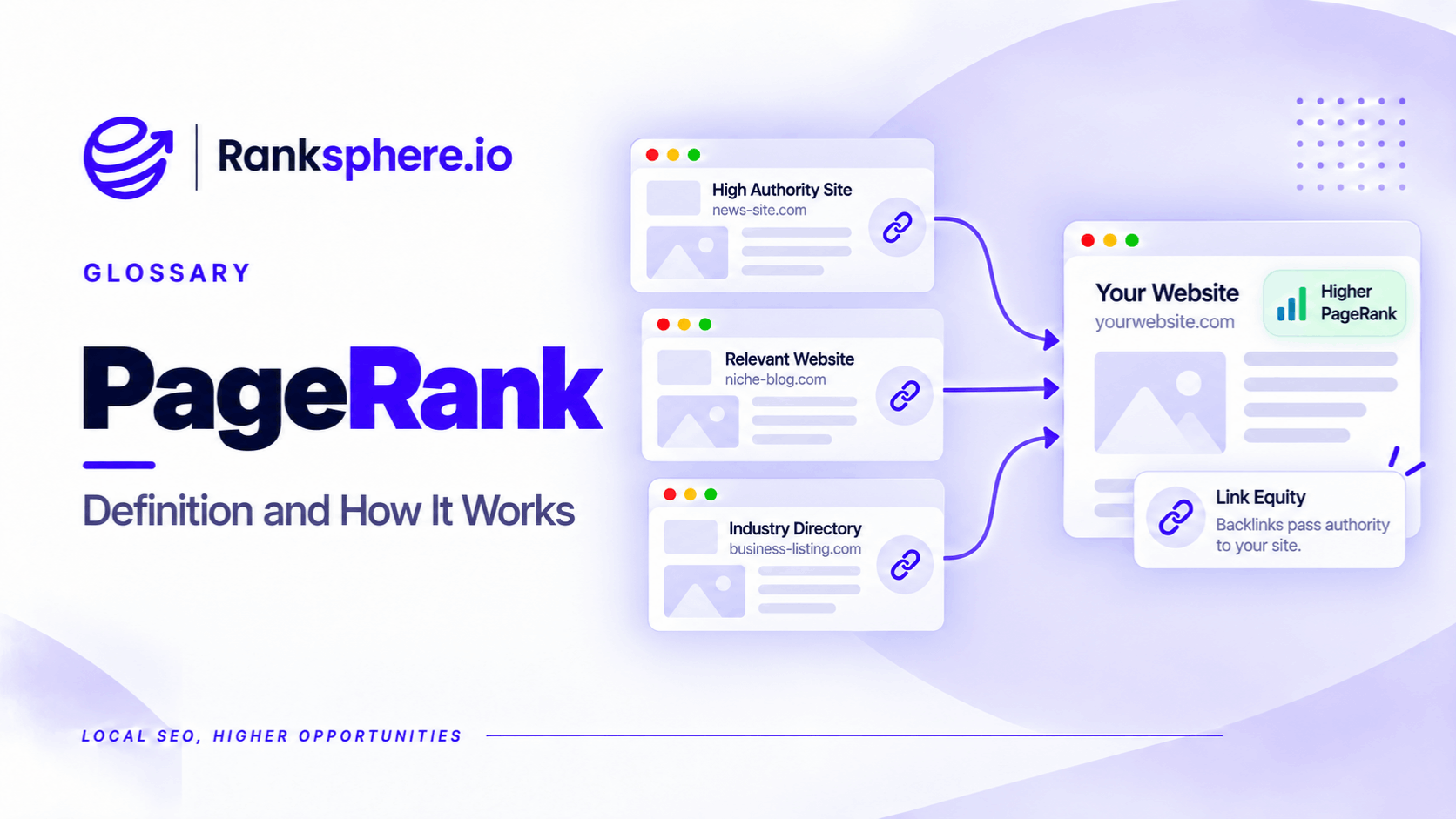
PageRank is Google's original link analysis algorithm, developed to evaluate the importance of webpages based on the links pointing to them.
The idea was simple: a link from one page to another could act as a vote of importance, and links from already important pages should carry more weight.
This helped distinguish Google from earlier search engines that relied heavily on keywords appearing within webpages.
Google once displayed a public PageRank score from 0 to 10, but retired that metric in 2016.
PageRank itself hasn't disappeared. Google confirms that an evolved version remains part of its core ranking systems.
Understanding PageRank is useful because it explains the origins of concepts such as link equity, backlinks, and internal linking.
However, modern Google rankings cannot be explained by PageRank alone.
How Does PageRank Work?
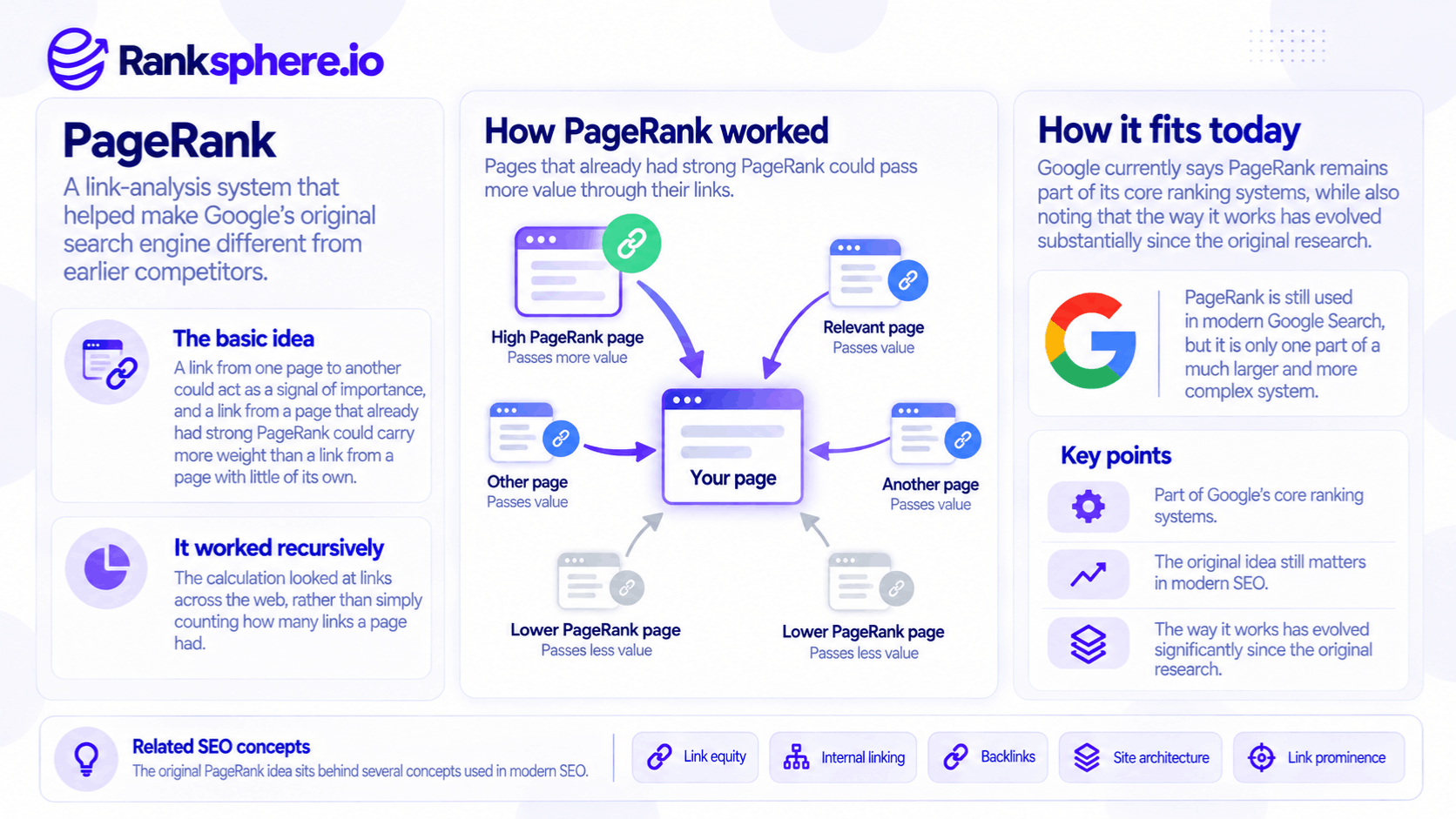
The original PageRank algorithm evaluated links between webpages.
A page receiving links from important pages could gain more importance itself.
That importance could then be distributed through links pointing to other pages.
For example, imagine a legal publication links to a solicitor's guide about employment law.
The publication may have accumulated considerable link-based importance through references from other websites.
Its link to the solicitor's guide could therefore carry more weight within the original PageRank model than a link from a little-known page with few incoming links.
The important distinction is that PageRank evaluates pages, not simply entire websites.
Does Every Link Pass the Same Value?
No.
Under the original model, the value passed through a page's links depended partly on that page's own PageRank and how many links it contained.
For example, a page linking to five destinations would distribute its available link-based value differently from one linking to fifty.
However, this mathematical explanation shouldn't be treated as a reliable calculation for modern Google rankings.
Google's current link analysis systems have evolved substantially.
Relevance, link context, spam detection, and other ranking systems can affect how links are interpreted.
A contextual editorial link may be useful, but there's no public formula for calculating exactly how much ranking value it passes.
What Happened to Google's Public PageRank Score?
Google previously displayed a PageRank score through its browser toolbar.
The score ran from 0 to 10.
For years, SEO professionals used it to compare websites and evaluate backlinks.
However, the public score had significant limitations.
It was updated infrequently, simplified Google's underlying calculations, and encouraged people to focus excessively on a single number.
Some businesses even bought links based on the PageRank scores of the pages selling them.
Google stopped updating the public toolbar data around 2013 and removed the toolbar PageRank metric in 2016.
That didn't mean the underlying algorithm was abandoned.
Google's current ranking systems documentation explicitly confirms that PageRank continues to contribute to its core ranking systems.
Is Domain Authority the New PageRank?
No.
Domain Authority is a third-party metric developed by Moz.
Other SEO platforms provide their own authority and link-related scores.
These metrics can be useful for comparative research, but they aren't Google's internal PageRank scores.
A website doesn't need to reach a particular Domain Authority threshold to rank.
Nor should an agency claim that a third-party authority score reveals the exact value Google assigns to a webpage.
PageRank and Internal Linking
One of PageRank's most useful lessons for modern SEO concerns how pages connect within a website.
External backlinks aren't the only links that matter.
Internal links help Google discover content and understand relationships between pages.
For example, a law firm's employment tribunal guide may attract links from relevant legal publications.
If that guide also links naturally to the firm's employment law service page, it helps visitors move from learning about a legal issue to understanding the firm's services.
The link also helps Google discover and understand the destination page.
Link From Relevant Pages
A strong internal link should make sense in context.
For example, a guide explaining redundancy rights could naturally link to a related employment law service page.
There's no need to insert several links to the same destination simply to manipulate PageRank.
Use descriptive anchor text so visitors understand where the link leads.
Keep Important Pages Accessible
A logical site architecture makes important pages easier to find.
For example, a dental practice shouldn't bury its dental implant service page behind numerous unrelated navigation steps.
However, Google doesn't impose a universal maximum click depth.
The goal is to create a structure that supports crawling and helps visitors navigate the website.
Find Orphan Pages
Orphan pages have no incoming internal links.
They may be difficult for visitors and search engines to discover through normal website navigation.
However, an orphan page can still receive external backlinks or be discovered through other sources, such as a sitemap.
It is therefore inaccurate to say that orphan pages automatically have zero PageRank.
Important pages should generally have relevant internal links pointing to them.
PageRank Tactics That No Longer Make Sense
Several older SEO tactics are still discussed as though Google's original PageRank model remains unchanged.
PageRank Sculpting With Nofollow
PageRank sculpting involved adding nofollow to selected internal links in an attempt to concentrate ranking value on other pages.
Google changed its handling of this tactic in 2009.
The original approach of using nofollow to redistribute PageRank is no longer a reliable strategy.
Google also changed its treatment of nofollow attributes in 2019, using them as hints in certain situations.
See nofollow.
For ordinary internal links, focus on clear navigation and useful connections between pages.
Counting Backlinks Without Considering Their Sources
A website with hundreds of backlinks isn't automatically stronger than one with fewer links.
The links may come from unrelated, low-quality, or repetitive sources.
Reviewing referring domains can provide useful context about the diversity of websites linking to a page.
However, fifty links from one website aren't necessarily equivalent to one link.
Google doesn't publish a rule that limits each referring domain to a single counted relationship.
Both link quality and context matter.
Buying Links Based on Authority Scores
Purchasing links primarily to manipulate rankings can violate Google's spam policies.
See link building.
A high third-party authority score doesn't make a paid link safe, relevant, or valuable.
Treating PageRank as the Entire Ranking Algorithm
Google considers many signals when ranking webpages.
A page with strong backlinks may still struggle if it doesn't satisfy the searcher's needs.
Similarly, a useful page with fewer backlinks may rank well for relevant queries.
PageRank is part of Google's ranking systems, not a complete explanation of them.
Common PageRank Mistakes
- Looking for a current public PageRank score. Google no longer provides one.
- Confusing Domain Authority with PageRank. They are different metrics.
- Using nofollow to sculpt internal link value. The original tactic is obsolete.
- Assuming every link passes equal value. Modern link analysis is more complex.
- Counting referring domains as if each can pass only one link. Google hasn't published such a rule.
- Adding unnecessary links solely to distribute PageRank. Internal links should help visitors.
- Assuming orphan pages have no link value. They may have external backlinks.
- Expecting an internal link to guarantee higher rankings. Google evaluates many factors.
PageRank Best Practices
For practical SEO, PageRank's most useful lesson is to build clear, relevant connections between webpages.
Make important pages accessible through internal links. Use descriptive anchor text and link from related content where the connection helps readers.
Evaluate external backlinks based on relevance and context, not only third-party scores.
Avoid buying links to manipulate rankings or attempting to control PageRank through outdated nofollow tactics.
Most importantly, don't report PageRank as though Google still publishes a measurable score for your website.
Example of PageRank and Internal Linking
Consider a hypothetical law firm called Larkfield Legal.
Its guide to employment tribunal deadlines attracts regular organic traffic and has earned backlinks from relevant legal publications.
However, the firm's employment law service page receives relatively little organic traffic.
The guide mentions services the firm provides but doesn't link to the relevant service page.
What the Agency Finds
The agency reviews the website's internal linking structure.
It discovers that visitors reading the tribunal guide have no obvious way to find the firm's related legal services.
The employment service page is accessible through navigation, but few relevant content pages link to it.
What the Agency Changes
The agency adds a contextual link from the guide to the employment law service page.
It also reviews other relevant articles for natural linking opportunities.
Each link uses descriptive text explaining the destination.
The team avoids inserting repeated links merely to increase their number.
What Happens Next?
The service page becomes easier for visitors to discover.
Google can also use the new internal links to better understand its relationship to the firm's employment law content.
The agency monitors Search Console to see whether impressions, rankings, and organic clicks change.
However, adding internal links doesn't guarantee that the service page will move from a particular ranking position to another.
Example
“The firm already had useful content and relevant external links.
Improving internal navigation helped connect that content to an important commercial page.
This reflects a principle inherited from PageRank: the relationships between pages matter.
PageRank remains part of Google's ranking systems, but modern SEO is not about calculating or manipulating a public link score.
Its practical value is understanding why relevant links, sensible website structure, and useful internal connections deserve attention.”
See Also
- Link Equity — The concept of ranking value associated with links.
- Internal Linking — Connecting pages within the same website.
- Domain Authority — A third-party metric often confused with PageRank.
- Backlink — A link from another website to your page.
- Nofollow — A link attribute whose treatment has changed over time.
- Site Architecture — How website pages are organised and connected.