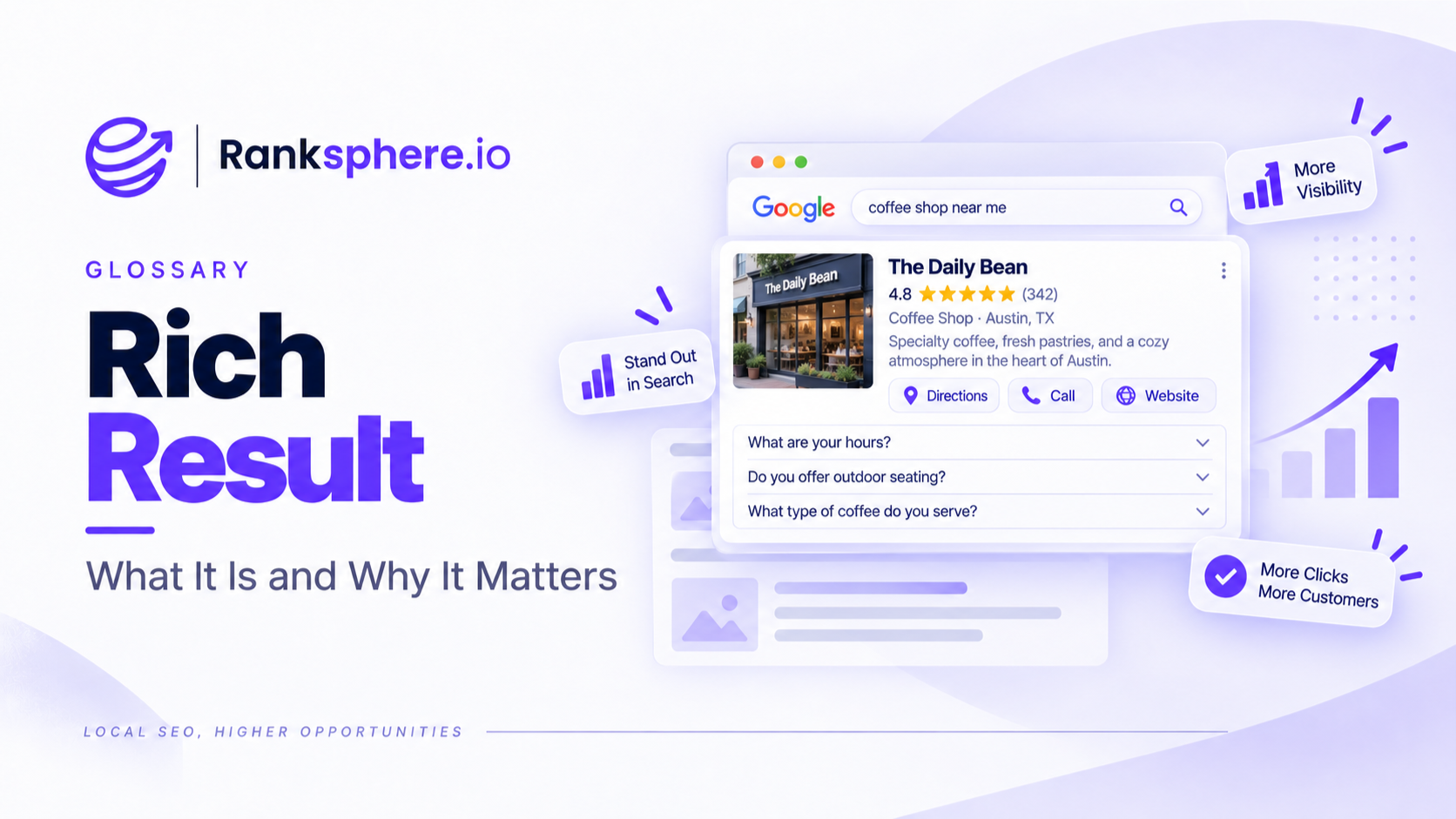
A rich result is an enhanced Google Search result that can display additional information beyond the standard title, URL and description.
Depending on the type of content, a rich result might include:
- Ratings
- Prices
- Availability
- Event dates
- Images
- Video information
- Breadcrumbs
- Other structured details
Rich results are usually powered by schema markup that helps Google understand specific information on a webpage.
The important distinction is this:
Valid structured data can make a page eligible for a rich result. It does not guarantee that Google will display one.
Google decides which search features to show based on the page, query, device, location and its own Search systems. Google explicitly states that valid structured data does not guarantee a rich result will appear.
What is a rich result?
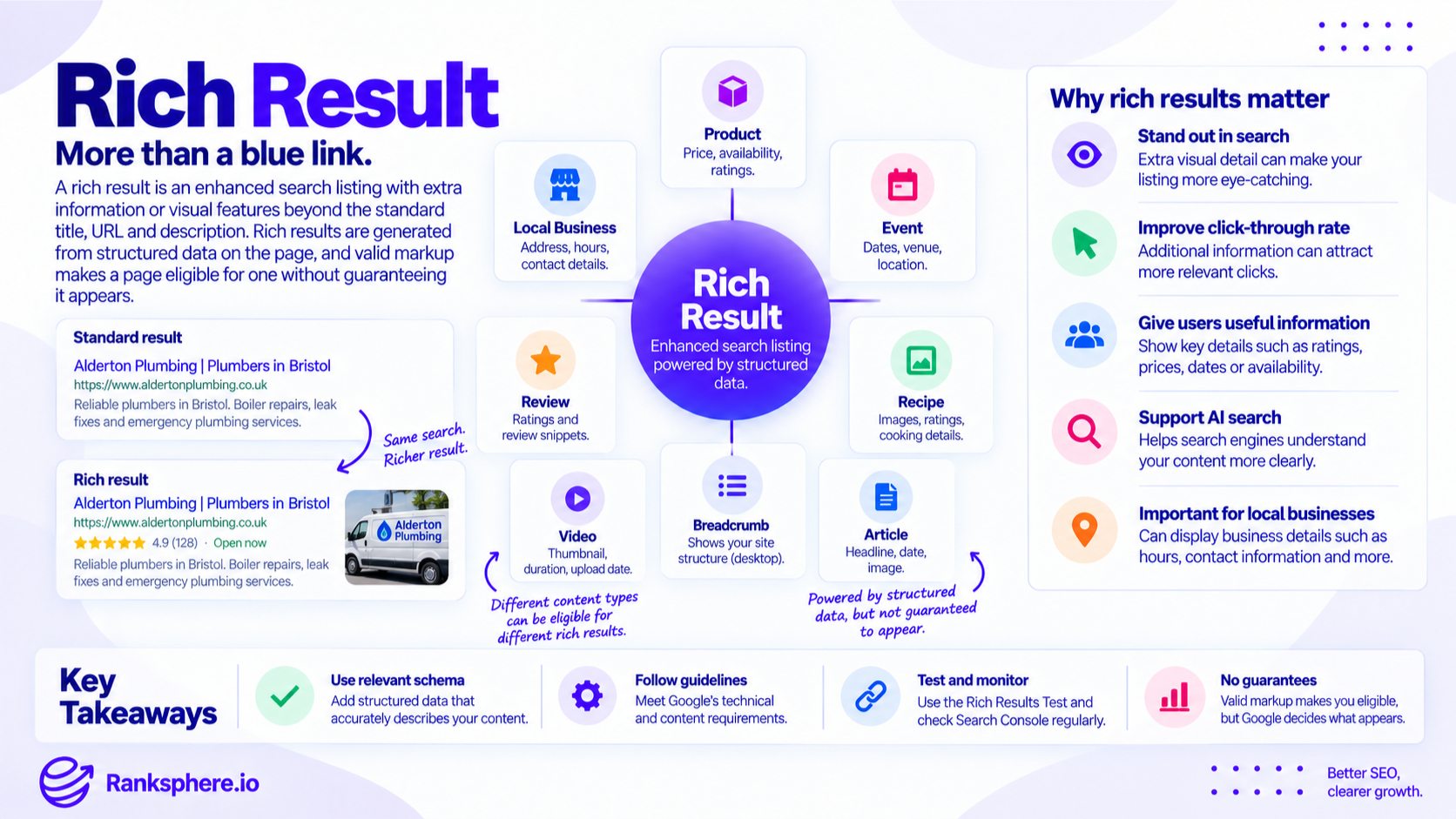
A normal organic search result typically contains:
- Title
- Displayed URL
- Description or snippet
A rich result may add more information.
For example, an ecommerce product result might show:
- Price
- Availability
- Rating
An event result might show:
- Date
- Venue
- Location
A recipe could show:
- Image
- Rating
- Cooking information
Google supports different structured data features for different content types, and that list changes over time. Its current Search appearance documentation includes features such as LocalBusiness, Event, Product, Recipe, Review snippet, Video and Breadcrumb structured data.
Rich results and structured data
Structured data gives search engines explicit machine-readable information about a page.
For example, a product page might identify:
- Product name
- Price
- Availability
in structured data.
A local business page might identify:
- Business name
- Address
- Telephone
- Opening hours
through LocalBusiness markup.
That information can help Google understand the page and, where supported, make it eligible for richer Search features.
But structured data should describe what is genuinely on the page.
It is not a way to invent information simply because you want a richer search listing.
Eligibility does not mean display
This is the most important thing to understand about rich results.
There are several separate stages:
1. The markup must be valid.
The code needs to meet Google's technical requirements.
2. The content must meet the feature guidelines.
Correct syntax alone is not enough.
3. The page must be eligible for Search.
Google still needs to crawl and index it appropriately.
4. Google decides whether to display the enhanced result.
Even if everything is technically correct, the rich result may not appear.
Google makes this clear throughout its structured data documentation.
So:
Valid ≠ guaranteed rich result.
What does the Rich Results Test tell you?
Google's Rich Results Test checks whether supported structured data is technically eligible for the rich-result features known to the tool.
It can identify problems such as:
- Missing required properties
- Invalid values
- Syntax problems
That makes it useful during implementation.
But the test does not tell you:
- Whether Google will actually display the rich result
- How often it will appear
- Whether it will improve CTR
- Whether Google considers the page high quality
- Whether every non-technical guideline issue has been detected
Google notes that some structured data problems may relate to spam or content rather than syntax, which means the Rich Results Test cannot identify every reason a rich result may fail to appear.
Which rich results does Google currently support?
Google maintains a changing list of structured-data features.
Current supported features include areas such as:
- Article
- Breadcrumb
- Event
- Local business
- Product
- Recipe
- Review snippet
- Video
- Job posting
- Profile page
- Discussion forum
- Course list
- Software application
The exact list can change, so Google's search gallery documentation should be treated as the current reference rather than an old SEO checklist.
Rich results for local businesses
For a typical local service business, not every structured-data feature is relevant.
The practical opportunities are usually narrower.
LocalBusiness structured data
LocalBusiness schema helps Google understand information about a physical local business.
Depending on the business, it can describe details such as:
- Name
- Address
- Phone number
- Opening hours
- Business type
Google says LocalBusiness structured data can help provide information used in business-related Search and Maps experiences.
Use the most specific accurate subtype available where appropriate.
For example:
Dentist
may be more informative than the generic:
LocalBusiness
for a dental practice.
Breadcrumbs
Breadcrumbs can help Google understand the position of a page within a site's hierarchy.
For example:
Home → Services → Roof Repair
Google still supports BreadcrumbList structured data, but there is an important current limitation:
Google stopped displaying breadcrumbs in mobile search results in January 2025.
They continue to appear in desktop results.
So breadcrumbs remain useful for:
- Site structure
- Navigation
- Desktop Search presentation
but should no longer be described as a universal mobile rich result.
Product rich results
Retailers and businesses selling products can use Product structured data.
Eligible results may display details such as:
- Price
- Availability
- Rating information
Google currently supports both product snippets and merchant-related product features.
For a plumber, solicitor or dentist, this is unlikely to matter.
For a local retailer or ecommerce business, it can be much more relevant.
Event rich results
Businesses that genuinely host events can use Event structured data where the page meets Google's requirements.
Examples might include:
- Workshops
- Classes
- Public events
- Seminars
The markup should describe a real event represented on the page.
Do not create fake “events” merely to gain additional search visibility.
Video structured data
Google also supports Video structured data.
If video is an important part of the content, structured information can help Google understand details about it.
Again, eligibility does not guarantee a particular video treatment in Search.
FAQ rich results
This is one of the biggest areas where older SEO advice is now wrong.
FAQ rich results used to be available much more widely.
In August 2023, Google sharply restricted them.
Google says FAQ rich results are now generally shown only for well-known, authoritative government and health websites. For other websites, the feature is no longer displayed regularly.
That means an ordinary local business should not add FAQPage markup expecting expandable FAQ questions beneath its organic result.
You can still have useful FAQs on the page.
The content itself may help users.
But the old promise:
“Add FAQ schema and get a bigger Google listing”
is no longer a realistic strategy for most businesses.
Should local businesses still publish FAQs?
Yes, where they genuinely help.
For example, a roofing service page may answer:
How much does roof repair cost?
How quickly can you attend a leak?
Can a damaged roof be repaired instead of replaced?
Those questions can improve the page.
They simply should not be published because you expect an FAQ rich result.
Content value and rich-result eligibility are separate issues.
How-to rich results
How-to rich results are no longer a current Google Search opportunity.
Google stopped showing How-to rich results on mobile in 2023 and then removed them from desktop as well.
By September 2023, Google described the feature as deprecated and subsequently removed its Search Console and Rich Results Test support.
You can still publish useful step-by-step content.
There is simply no reason to implement HowTo schema expecting Google to show the former How-to rich result.
Sitelinks search box
The sitelinks search box is another outdated rich-result recommendation.
Google removed the feature globally starting on 21 November 2024 because usage had declined.
Google also removed its associated Search Console reporting and Rich Results Test support.
Normal sitelinks can still appear.
The dedicated search box within a branded result no longer does.
Review stars for local businesses
This is another common source of confusion.
A business cannot normally add reviews of itself to its own website using LocalBusiness or Organization markup and expect Google to show review stars beneath that page.
Google restricts self-serving review snippets for these entity types.
Its current guidance says LocalBusiness review snippets are supported when a site captures reviews about other local businesses rather than displaying self-controlled ratings for itself.
See review schema for the full distinction.
Where do local business review stars come from?
Local businesses may still show star ratings within Google surfaces such as:
- Google Business Profile
- Local pack
- Google Maps
- Business information or knowledge panel experiences
Those ratings come from Google's local review system.
They are not generated because the business added AggregateRating markup to its own service page.
These are separate systems.
Structured data must match the page
Structured data should accurately represent the page users can see.
Do not add markup for:
- Services you do not provide
- Prices that are not real
- Ratings that do not exist
- Events that are not happening
- Reviews you invented
- Content absent from the page
Google's structured-data guidelines can result in markup being ignored, and serious manipulation can lead to manual action against structured-data features.
The rule is simple:
Describe reality. Do not use schema to create a different version of reality for search engines.
Does valid schema guarantee eligibility?
Validation and eligibility are related, but they are not identical.
A page can contain syntactically valid schema while still failing a feature's content or policy requirements.
For example:
An AggregateRating object might be technically valid JSON-LD.
But if it represents self-serving reviews on a local business's own page, that does not make those stars eligible for the review rich result.
Always check the guidelines for the specific feature.
Why rich results do not always show
A valid eligible page may still receive an ordinary result.
Possible reasons include:
- Google deciding the feature is not useful for that query
- Device differences
- Search-result layout
- Content eligibility
- Structured-data quality
- Search-feature changes
- Google's own systems choosing another presentation
This is normal.
Do not assume missing visual enhancement means the markup is broken.
Check:
- The structured data
- Feature guidelines
- Indexing
- Search Console
Then accept that display itself remains Google's decision.
Rich results can change or disappear
Search features are not permanent.
Google regularly changes which structured-data displays it supports.
Recent examples make this especially clear:
- How-to rich results were retired in 2023.
- Sitelinks search box was removed in 2024.
- Breadcrumbs stopped displaying on mobile in 2025.
- Google continued phasing out lesser-used structured-data Search features during 2025 and 2026.
That is why a schema implementation should not depend entirely on one visual Search feature remaining unchanged forever.
Do rich results improve click-through rate?
They can change how visible a result is.
A result containing useful information such as:
- Price
- Availability
- Rating
- Event date
may attract attention differently from a standard result.
But do not state that rich results always improve click-through rate.
CTR depends on:
- Ranking position
- Search intent
- Competitors
- SERP features
- Brand
- Device
- The specific enhancement
In some cases, additional information may even answer the user's question before a click is necessary.
Measure the effect instead of assuming it.
Rich results and entity understanding
Structured data can help Google understand what information on a page represents.
For example:
LocalBusiness
can identify a business.
Organization
can describe an organisation.
Product
can describe a product.
This can support clearer machine understanding of the page and its entity information.
But structured data is not a universal “entity authority” signal.
It should accurately reinforce information that exists on the site.
Rich results and AI search
Structured data remains useful because it gives search engines explicit information about content.
However, do not say:
“Adding schema gets your content into AI answers.”
Google does not require special structured data for AI Overviews or AI Mode, and there is no markup that guarantees citation in generated answers.
Structured data should be implemented because it accurately describes the page and can support the Search features that Google documents.
AI visibility is not guaranteed by schema.
Does every local business need schema?
Most local businesses can benefit from having accurate business structured data on relevant pages.
Useful foundational markup may include:
- LocalBusiness
- Organization
- BreadcrumbList
depending on the site.
Other types should be added only when the content genuinely qualifies.
Do not implement:
- Product
- Event
- Review
- Recipe
simply because those rich results look attractive.
Use the schema type that represents the content you actually have.
LocalBusiness schema first
For a local company, LocalBusiness schema is often the logical starting point.
Google's current documentation supports LocalBusiness structured data for describing information such as:
- Business details
- Opening hours
- Departments
- Other relevant properties
and recommends using the most specific appropriate subtype.
For example:
A restaurant should generally use:
Restaurant
rather than stopping at:
LocalBusiness.
Accuracy is more useful than adding more markup.
Breadcrumb schema second
For a site with clear hierarchy, BreadcrumbList markup is another sensible foundation.
For example:
Home → Services → Commercial Roofing
This can help describe where the page belongs within the website.
Remember that Google's breadcrumb Search presentation is currently desktop-only.
The breadcrumb navigation itself can still be valuable on mobile for users even though Google no longer displays it in mobile search results.
Use JSON-LD where practical
JSON-LD is often the easiest structured-data format to implement and maintain.
For example:
<script type="application/ld+json">
{
"@context": "https://schema.org",
"@type": "Plumber",
"name": "Alderton Plumbing",
"url": "https://example.com/"
}
</script>
The exact properties required depend on the schema type and Google's current documentation.
Do not copy a generic template without checking whether the values are accurate.
Test after implementation
After adding supported structured data:
- Run the page through Google's Rich Results Test.
- Fix critical errors.
- Check how Google sees the URL through Search Console.
- Monitor the relevant structured-data reports where available.
- Recheck after major template or website changes.
Google specifically recommends validating structured data after implementation and monitoring it through Search Console.
Ranksphere's schema generator produces valid markup without hand-writing JSON-LD, helping remove much of the implementation guesswork.
Recheck schema after redesigns
Structured data can break when:
- Templates change
- Plugins are replaced
- CMS themes are updated
- Content fields move
- JavaScript implementations change
A schema implementation that worked two years ago should not be assumed to still work.
Include structured-data testing in post-launch and migration checks.
Common rich result mistakes
- Treating valid markup as a display guarantee. Google decides whether the feature appears.
- Adding FAQ schema to local service pages expecting expandable FAQs. FAQ rich results are now heavily restricted.
- Implementing HowTo schema expecting a How-to rich result. That Search feature has been deprecated.
- Optimising for the sitelinks search box. Google removed it in 2024.
- Expecting breadcrumbs on mobile Search. They now display on desktop only.
- Adding self-serving AggregateRating markup to get stars for your own local business. Those reviews are not eligible for the ordinary review snippet.
- Marking up information that users cannot find on the page where the feature requires visible content.
- Inventing ratings, prices or other structured data.
- Adding every schema type available instead of the ones that accurately describe the page.
- Assuming rich results always increase CTR.
- Promising rich results to clients as a guaranteed deliverable.
- Failing to test structured data after a website redesign.
Rich result best practices
- Start with structured data that accurately represents the business and content.
- Use the most specific valid schema type where appropriate.
- Treat rich-result display as a possibility, not a guarantee.
- Check Google's current Search Gallery before implementing a feature.
- Use LocalBusiness structured data accurately for genuine local businesses.
- Use BreadcrumbList where the website has a meaningful hierarchy.
- Add Product or Event markup only when those content types genuinely exist.
- Do not expect ordinary local businesses to receive FAQ rich results.
- Do not use self-serving review markup to manufacture stars.
- Validate supported markup using the Rich Results Test.
- Monitor Search Console after implementation.
- Retest after templates, migrations and major site changes.
- Measure actual Search performance rather than assuming a visual enhancement improves CTR.
Example
“Alderton Plumbing pays an agency to add FAQ schema to fourteen service pages.
The work is sold on the promise that each page will gain expandable questions beneath its Google result.
That expectation is outdated.
Google restricted FAQ rich results in 2023, and ordinary local service websites are no longer generally eligible for that treatment.
The FAQ content itself may still be useful.
Questions such as:
How quickly can you attend an emergency leak?
How much does a boiler repair cost?
Do you charge a call-out fee?
help prospective customers understand the service.
But adding FAQPage markup does not turn those questions into a guaranteed rich result.
A better implementation focuses on structured data that is actually relevant to the business:
- Accurate LocalBusiness markup
- Clear breadcrumb structure
- Genuine visible business information
- Supported schema for any other qualifying content
The pages are then tested properly rather than judged by whether Google produces one specific visual effect.
That is the right way to approach rich results:
structured data should help describe the page accurately and make it eligible for supported Search features. The enhancement itself belongs to Google, and no agency, plugin or schema generator can guarantee that it will appear.”
See also
- Schema markup — structured information that can make pages eligible for richer Search features
- Review schema — where self-serving review restrictions matter
- Breadcrumb navigation — site hierarchy that can appear in desktop Search results
- Featured snippet — an enhanced Search result that works differently from structured-data rich results
- Click-through rate — one metric to measure rather than assume
- LocalBusiness schema — foundational structured data for genuine local businesses