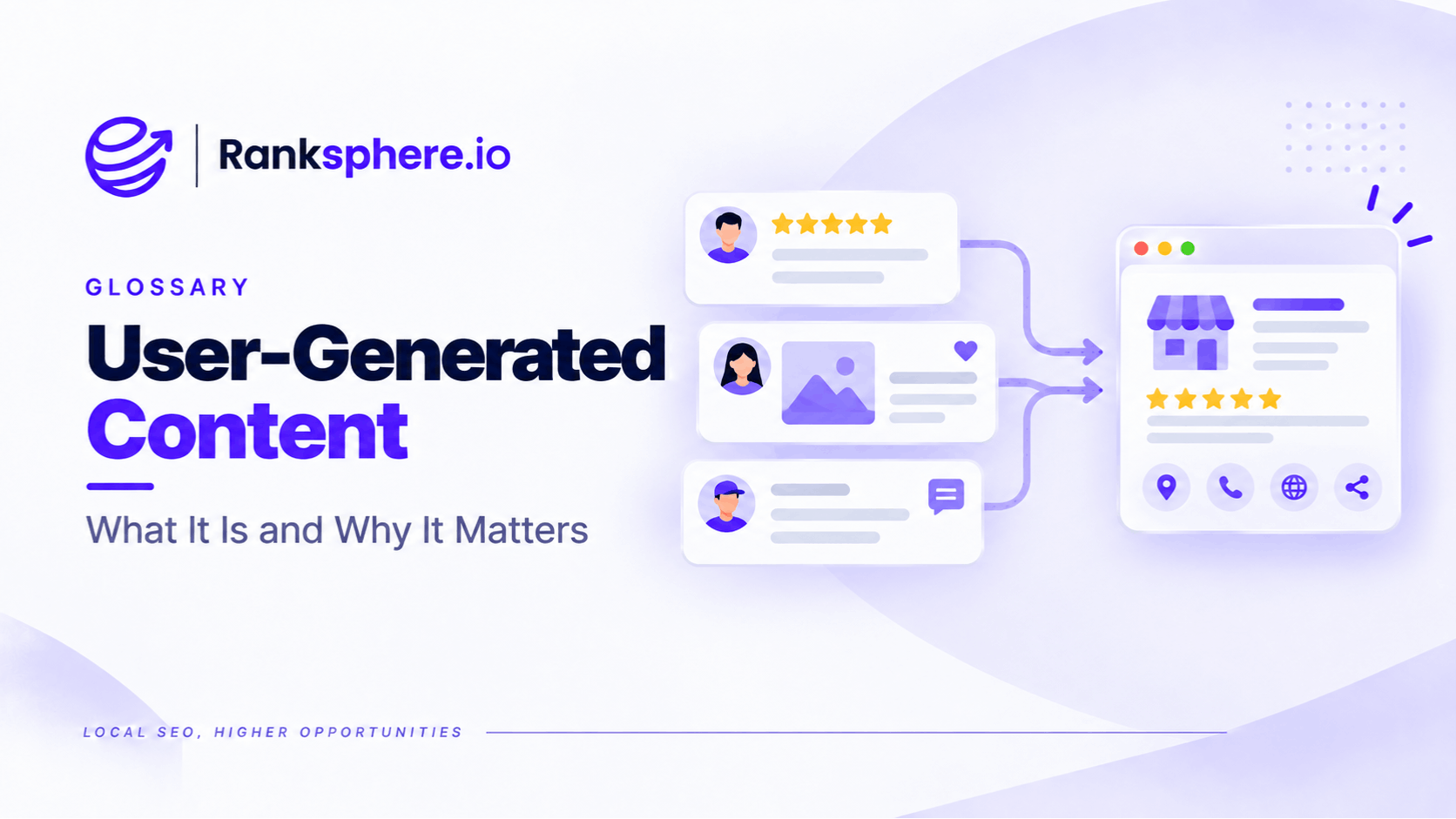
User-generated content, usually shortened to UGC, is content created by users rather than by the business or publisher itself.
For a local business, UGC can include:
- Customer reviews
- Customer photos and videos
- Social media posts
- Tags and mentions
- Forum discussions
- Community recommendations
- Comments
- Questions and answers
On Google Maps, users can publicly contribute reviews, ratings, photos and videos about places they have visited. Google can combine those contributions with information supplied by the business and information from other sources when presenting a Business Profile.
For many local businesses, the most visible forms are:
reviews and customer-uploaded photos.
They matter because they show the business from a perspective the company does not fully control.
That can make UGC particularly useful for customers trying to answer questions such as:
- What is this place actually like?
- What does the finished work look like?
- What do recent customers say?
- Are there recurring complaints?
- Does the experience match the business's own marketing?
UGC should not automatically be treated as more trustworthy than professionally produced content.
But it provides a different kind of evidence.
What counts as user-generated content?
The important distinction is who created it.
Business-created content
Examples include:
- Website copy
- Professional photography commissioned by the business
- Business Profile Posts
- Promotional videos
- Email campaigns
User-generated content
Examples include:
- A customer's Google review
- A visitor's restaurant photograph
- A TikTok showing a purchased product
- A forum discussion about a local tradesperson
- A customer comment underneath an article
The user does not necessarily need to be a paying customer in every case.
They may be:
- A visitor
- A member of a community
- A forum participant
- Someone interacting with the business publicly
So:
user-generated content
is broader than:
customer-generated content.
UGC on Google Maps
Google Maps has a large user-contribution ecosystem.
Google says its community now includes more than 500 million contributors, whose photos, reviews and videos help people understand places and decide where to go.
Users can contribute:
- Reviews
- Ratings
- Photos
- Videos
- Place information
- Suggested edits
Google can then use Maps contributions across its services. Its Maps UGC policy says submitted content may appear across Google services including Maps, Search and YouTube, and may also appear through third-party products that use Google Maps Platform or embeddable Google features.
That makes UGC much broader than something sitting quietly underneath a Business Profile.
Reviews
Online reviews are one of the most important forms of UGC for a local business.
They provide:
- A star rating
- Written customer experiences
- Recurring themes
- Service mentions
- Customer language
Google explicitly says reviews can help businesses stand out and give prospective customers useful information. It also says more reviews and positive ratings can help local ranking as part of prominence.
But avoid turning that into:
“more UGC always means better rankings.”
Google's local ranking system considers:
- Relevance
- Distance
- Prominence
together.
There is no published UGC score.
Review text and AI-powered local discovery
Written review content now has uses beyond somebody manually scrolling through reviews.
Google's Ask Maps experience can analyse information from more than 300 million places, including reviews from its community of over 500 million contributors.
This means review content can contribute to answers about questions such as:
- What is the atmosphere like?
- Is a place suitable for a particular situation?
- What do visitors commonly mention?
That does not mean every review becomes an AI answer.
Nor does it mean businesses should attempt to put target keywords into customer reviews.
The useful principle is:
genuine customer experiences create information Google may be able to analyse and surface in different Maps experiences.
Local justifications and review snippets
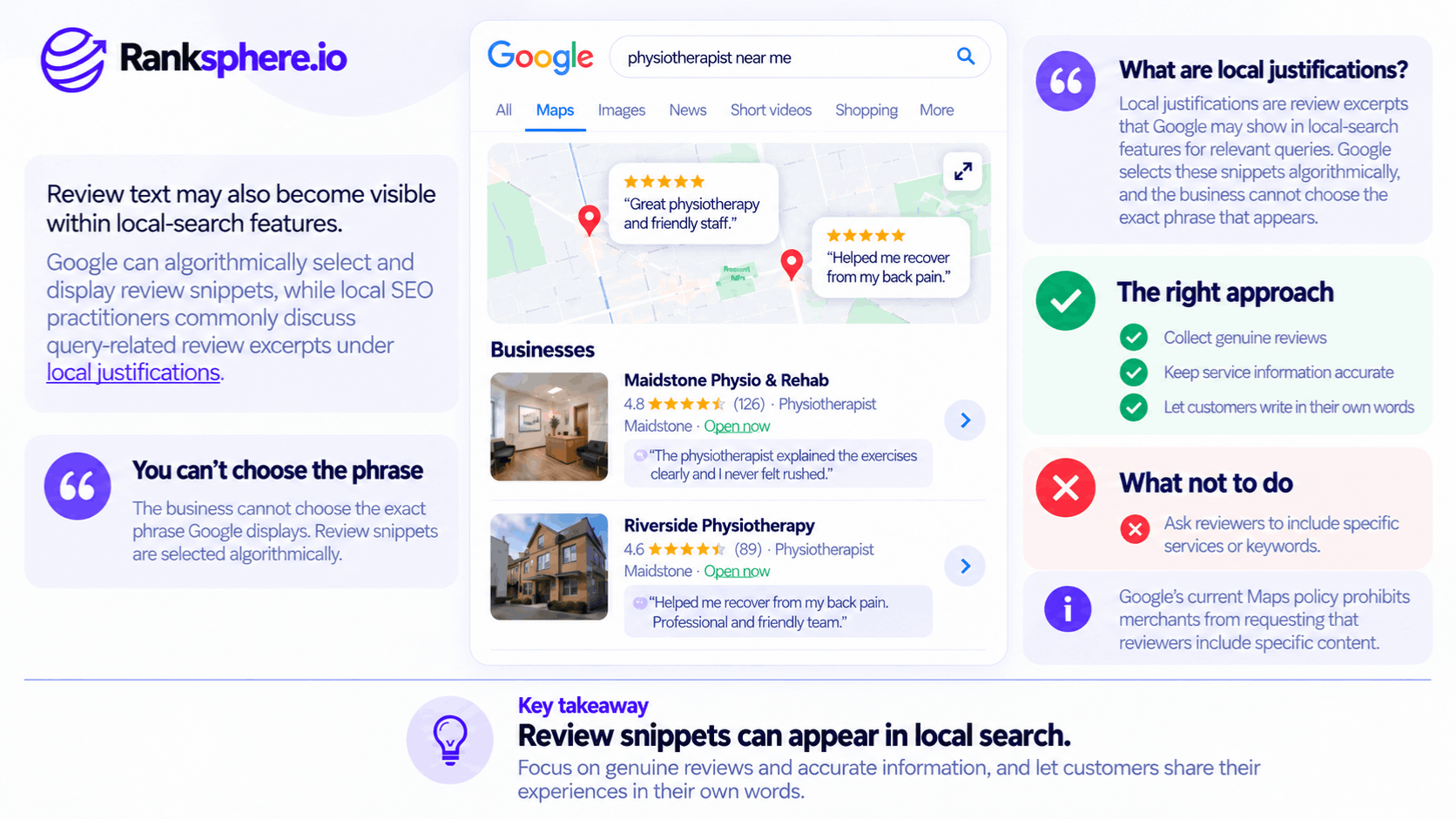
Review text may also become visible within local-search features.
Google can algorithmically select and display review snippets, while local SEO practitioners commonly discuss query-related review excerpts under local justifications.
The business cannot choose the phrase Google displays.
That makes the correct approach:
- Collect genuine reviews
- Keep service information accurate
- Let customers write in their own words
not:
ask reviewers to include specific services or keywords.
Google's current Maps policy prohibits merchants from requesting that reviewers include specific content.
Customer photos
Customer-uploaded photographs are another important form of UGC.
Google allows Maps users to upload photos and videos of places, and customers can also post photo updates containing one or more photos with optional text.
For a local business, these can show:
- Finished work
- Food
- Products
- Premises
- Atmosphere
- Customer experiences
For visually driven businesses such as:
- Restaurants
- Salons
- Barbers
- Builders
- Landscapers
- Hotels
customer images can provide especially useful context.
You do not control customer photos
A verified business can manage its own uploaded images.
It cannot simply delete a legitimate customer photograph because it dislikes it.
Google says businesses can report customer photos or videos that violate its policies, after which Google reviews the content and may remove it.
Google also says businesses cannot opt out of customer photo updates.
That makes regular monitoring worthwhile.
But use reporting for genuine issues such as:
- Spam
- Personal information
- Wrong location
- Policy violations
not merely because an image is poorly lit or does not match the brand aesthetic.
Do customer photos appear before business photos?
Sometimes they may.
But do not state:
“customer photos are always shown first.”
Google controls how the Business Profile photo gallery is presented and can change:
- Ordering
- Featured imagery
- Layout
- Device presentation
The useful point is simply:
customer imagery can become highly visible alongside business-uploaded photographs.
Businesses should therefore know what users are contributing.
UGC and credibility
A customer photograph or independently written review can feel different from company-produced marketing because the business did not create the material itself.
For example:
Business photograph
A professionally staged photograph of a newly installed driveway.
Customer photograph
A phone photo showing the finished driveway in everyday use.
Neither is automatically better.
The professional image might explain the workmanship more clearly.
The customer image might provide additional real-world context.
A strong local presence can use both.
Do not call professional content less trustworthy
The original draft goes too far by saying a customer photograph is inherently more persuasive because it was not commissioned.
Customer content can be:
- Useful
- Authentic
- Misleading
- Poorly framed
- Outdated
- Incorrectly attributed
just like other information.
Treat UGC as additional evidence, not automatic truth.
Social media UGC
User-generated social content can include:
- Instagram tags
- TikTok videos
- Facebook posts
- YouTube videos
- Community discussions
This can be valuable for:
- Discovery
- Reputation
- Referrals
- Brand awareness
particularly for visually driven businesses.
But do not claim all social mentions are an SEO ranking factor.
Google does not publish:
social UGC volume
as one of its local ranking factors.
Community recommendations
Local recommendations may also happen in:
- Facebook groups
- Local forums
- Neighbourhood communities
- Specialist discussion groups
For example:
“Can anyone recommend a roofer in Maidstone?”
may produce genuine word-of-mouth recommendations.
Those conversations can influence real buying decisions.
But avoid saying they are:
“invisible in analytics.”
If somebody clicks a link from a community platform, analytics may sometimes classify the visit as:
- Referral
- Social
- Direct
depending on the platform, browser and tracking setup.
What is difficult is complete attribution.
You may not know that a customer first discovered the business through a private group or conversation.
Forum mentions
Discussion forums can also contain UGC about local businesses.
These mentions may reveal:
- Common recommendations
- Complaints
- Questions
- Customer terminology
That can make them useful for qualitative research.
But again:
forum mention = ranking signal
is too simplistic.
Use them to understand the market and customer experience unless you have stronger evidence for a specific SEO effect.
Brand mentions and entities
Brand mentions can help establish the wider online presence of a business.
Google can obtain Business Profile information from:
- The official website
- Other public web content
- Licensed third parties
- Users
- Google's own interactions with places
That supports a broad principle:
consistent real-world information across the web can help Google understand a business.
But avoid turning this into:
“every UGC brand mention increases entity authority.”
Google does not publish an entity score that works that way.
Review volume
Review quantity has clearer Google documentation.
Google says:
more reviews and positive ratings can help local ranking.
So genuine review acquisition can matter for both:
- Customers
- Local prominence
But there is still no formula.
For example:
200 reviews
does not automatically outrank:
100 reviews.
Distance, relevance and other prominence information still matter.
Review recency
Fresh reviews can be useful because they give potential customers more current information about the business.
But Google does not separately list:
review recency
as an official local ranking factor in its public documentation.
So avoid writing:
“fresh UGC signals an active business and increases rankings.”
A safer statement is:
ongoing genuine reviews keep the public feedback current and help customers understand recent experiences.
Using UGC on your own website
Businesses often want to reuse customer:
- Reviews
- Photos
- Videos
- Social posts
on their own sites.
That can work well.
But content being publicly visible somewhere does not automatically mean the business has unrestricted permission to republish it anywhere it wants.
A social post appearing publicly is different from the business receiving permission to:
- Download the image
- Edit it
- Put it on a homepage
- Use it in an advert
Where appropriate, obtain permission for the intended reuse and follow applicable platform terms and legal requirements.
Ask before republishing customer photographs
A practical workflow might be:
- Identify a photograph you would like to reuse.
- Contact the creator.
- Explain where it will appear.
- Get clear permission.
- Agree any attribution.
- Keep a record of that permission.
Do not assume:
“they tagged us, therefore we own the photo.”
A tag is not the same thing as transferring rights to the underlying image.
Attribution
There is no universal attribution formula such as:
first name + town = compliant.
What is appropriate depends on:
- The permission granted
- The platform
- The content
- Applicable legal requirements
The customer may prefer:
- Full name
- First name
- Social handle
- No personal attribution
Avoid publishing additional personal information simply because you possess it.
Quoting reviews on your website
Reviews can also be useful on:
- Service pages
- Testimonials pages
- Case studies
If you reuse them, preserve their meaning.
Do not transform:
“Work was excellent, although it took longer than expected.”
into:
“Work was excellent.”
and present it as though that were the complete sentiment.
Truncation for space can be reasonable where permission and context allow, but do not materially misrepresent what the customer said.
Review widgets and review schema
Displaying reviews on your own website does not automatically make your local business eligible for review stars in Google Search.
Google changed its review rich-result rules in 2019.
For LocalBusiness and Organization entities, reviews are considered self-serving when the business being reviewed controls their placement on its own site.
Google says those pages are ineligible for the star review feature, whether the review markup is added:
- Directly
- Through a third-party widget
See review schema.
That means a widget vendor claiming:
“Install our Google Review widget and get star ratings underneath your homepage in Google.”
should be treated with caution.
The rule is specific to the reviewed business
Do not overgeneralise this into:
“Google no longer shows review rich results.”
Review snippets still exist for eligible content types.
The restriction applies specifically where a LocalBusiness or Organization is displaying reviews about itself on pages it controls.
That distinction matters.
Links inside UGC
If your own site lets users submit content containing links—for example:
- Blog comments
- Forum posts
- Community profiles
Google recommends qualifying those links with:
rel="ugc"
For example:
<a href="https://example.com" rel="ugc">User-submitted link</a>
Google says the ugc value is recommended for links appearing in user-generated content such as comments and forum posts.
See nofollow.
nofollow can also be used
Google still supports:
rel="nofollow"
and links can use multiple values:
rel="ugc nofollow"
But ugc communicates the relationship more specifically.
Google also notes that trusted contributors' links do not necessarily need the UGC qualification forever if the publisher deliberately chooses to vouch for them.
So:
every link ever submitted by a user must permanently be nofollowed
is also too rigid.
Hosting UGC creates moderation responsibilities
If your website lets users publish:
- Comments
- Forum threads
- Profiles
- Uploaded files
you need a moderation strategy.
Google explicitly identifies user-generated spam as a type of web spam, including:
- Comment spam
- Spammy forum posts
- Abusive user-created accounts
- Spam uploads
Google recommends measures such as:
- Clear abuse policies
- Reporting tools
- Spam detection
- Monitoring suspicious behaviour
for sites with open UGC areas.
UGC itself is not a site-quality problem
Do not interpret Google's spam guidance as:
“comments hurt SEO.”
A useful, moderated community can add real value.
Google has explicitly said forums and comments can be valuable sources of information, while warning that spam can overwhelm those benefits.
The issue is:
uncontrolled spam
not:
users contributing content.
Does a local business need comments?
Usually not.
A local plumber, dentist or solicitor does not need to add a public comments section just to create UGC.
UGC features should solve a real customer or community need.
If there is no reason to maintain:
- Comments
- Forums
- Community submissions
do not add them simply because UGC sounds good for SEO.
Every open contribution feature creates:
- Moderation
- Spam
- Privacy
- Security
work.
Encouraging reviews
Businesses can legitimately remind customers to leave Google reviews.
Google provides review links and QR codes for this purpose.
The request should be neutral.
For example:
We'd appreciate an honest Google review if you'd like to share your experience.
Do not:
- Ask only satisfied customers
- Request five stars
- Tell them what to write
- Offer something in exchange
Do not incentivise Google reviews
This deserves its own section because the original wording needs correcting.
For Google Maps reviews, incentives are prohibited.
Google specifically bans reviews posted in return for:
- Payment
- Discounts
- Free goods
- Free services
and also prohibits incentives for changing or removing negative reviews.
So:
“offer an incentive as long as you disclose it”
is not acceptable for Google reviews.
Disclosure does not override the policy.
Other UGC promotions need separate rules
This is different from running, for example, a social campaign where customers are encouraged to submit photographs for a clearly disclosed promotion.
That activity may be governed by:
- Platform rules
- Advertising rules
- Consumer law
- Promotion terms
The important point is not to apply the Google review rules to every form of UGC—or assume the reverse.
For Google reviews specifically:
no incentives.
Do not review-gate
Google also prohibits selectively soliciting positive reviews or discouraging negative ones.
So this:
Happy customer
Ask for Google review.
Unhappy customer
Send to private feedback form.
is not an acceptable review-generation process.
Ask genuine customers neutrally.
Let them decide what to say.
Do not script review content
Google's Maps policies also prohibit businesses from requesting that reviewers include specific content.
Do not ask:
Please mention that we installed your resin driveway.
or:
Please use the phrase “best roofer in Kent”.
The review should reflect the customer's own experience and language.
Encouraging customer photographs
Photo contributions have a different dynamic.
Google Maps explicitly allows users to contribute photographs and videos about places.
A business can make customers aware that such contributions are possible.
But avoid:
- Directing people to upload misleading images
- Manufacturing contributions
- Creating fake customer accounts
- Paying people to create deceptive Maps activity
Google's UGC policies require contributions to represent genuine experiences.
Responding to customer content
Businesses can respond to reviews, and Google also allows businesses to reply to customer photo updates through the Maps app.
That can be useful when you have something meaningful to add.
But avoid saying:
“replying creates more UGC.”
Google does not document such a causal relationship.
Respond because:
- The feedback deserves acknowledgement
- A question needs answering
- A complaint needs context
- The business wants to engage constructively
not as an engagement hack.
UGC as customer research
One of the strongest uses of UGC is research.
Review and community language can reveal:
- What customers value
- What frustrates them
- Which services they mention
- What terminology they use
- Which questions keep appearing
That can inform:
- Keyword research
- Service-page copy
- FAQs
- Customer experience
- Product development
But customer language is qualitative evidence.
If ten reviewers use a phrase, that does not automatically mean it has high search volume.
Validate search demand separately.
UGC and conversions
User-generated content can help potential customers make decisions because it provides additional experiences and examples to consider.
Google itself says user reviews help people make informed decisions, while its 2026 Maps contributor announcement says authentic photos, reviews and videos help people decide what to do and where to go.
But do not promise:
UGC improves conversion rates by X%.
The effect depends on:
- Industry
- Content quality
- Audience
- Placement
- Trust
- Offer
Measure it on the actual site if conversion impact matters.
UGC and search rankings
Keep this distinction clear.
Some UGC-related inputs have documented connections to local search.
Google specifically confirms:
more reviews and positive ratings can help local ranking.
Other claims are much less certain.
Google does not publicly say:
- Customer photos directly boost ranking
- Social UGC directly improves local position
- Forum mentions create an entity-authority score
- Fresh UGC automatically signals an active business to the ranking algorithm
Avoid presenting those ideas as established ranking factors.
UGC can still be useful without turning every benefit into SEO.
Monitoring customer photos
Customer imagery should be reviewed periodically.
Look for:
- Useful recent content
- Incorrect-location photos
- Spam
- Privacy problems
- Policy violations
If a photo genuinely violates Google's policies, the business can report it for review.
Do not report a valid customer photograph simply because:
- The lighting is poor
- The business prefers another image
- The customer showed an unflattering but genuine aspect of the location
Google—not the business—decides whether reported content qualifies for removal.
Ranksphere and UGC
Ranksphere's review management consolidates review content across platforms, giving businesses one place to monitor the customer feedback that forms an important part of their wider UGC footprint.
The useful work is not simply collecting a larger number.
It is understanding:
- What customers are saying
- How sentiment is changing
- Which issues repeat
- Which themes customers value
That turns UGC into usable business intelligence.
Common UGC mistakes
- Assuming only paying customers can create UGC.
- Treating every user contribution as automatically trustworthy.
- Assuming customer photographs always outperform professional imagery.
- Ignoring customer-uploaded Google Maps photos.
- Trying to remove legitimate customer photos because they do not match the brand aesthetic.
- Reposting photos or videos without considering permission, licensing or attribution.
- Assuming a social tag automatically grants the business reuse rights.
- Misquoting customer reviews by removing important negative context.
- Expecting an embedded review widget to generate Google review stars for a LocalBusiness page.
- Claiming review recency is a documented local ranking factor.
- Treating every social or forum brand mention as an SEO ranking signal.
- Offering incentives for Google reviews, even if the incentive is disclosed.
- Selectively asking only happy customers for reviews.
- Telling reviewers what words or services to mention.
- Leaving public comments or forum areas open without spam controls.
- Assuming UGC itself harms site quality rather than distinguishing useful contributions from spam.
User-generated content best practices
- Treat online reviews as an important local UGC channel.
- Monitor customer Google Business Profile photos and report genuine policy violations where necessary.
- Ask for honest reviews neutrally and consistently.
- Never pay, discount or otherwise incentivise Google reviews.
- Never use review gating or script what reviewers should say.
- Seek appropriate permission before republishing customer-created material on your own channels.
- Follow the attribution agreed with the creator rather than assuming one format fits every situation.
- Keep quotes accurate to their original meaning.
- Use rel="ugc" for links in genuinely user-submitted sections where appropriate.
- Protect comments, forums and other open UGC areas from spam.
- Use customer language as qualitative research rather than treating it automatically as keyword data.
- Separate genuine search benefits from broader trust, referral and conversion benefits.
Example
“Consider a hypothetical barber shop called Ashcroft Barbers.
The owner uploads a small set of professional photographs showing:
- The shop interior
- Barber stations
- Finished haircuts
Over time, customers also upload photographs to Google Maps showing their own visits and finished cuts.
Some are professionally framed.
Most are not.
They vary in:
- Lighting
- Camera quality
- Composition
But they provide customers with something different from the business photography:
a broader range of real-world examples from people who visited the shop.
The owner initially considers the inconsistent customer photos a problem.
Instead of trying to remove valid contributions, the team begins monitoring them.
Policy-violating images are reported where appropriate.
Useful genuine contributions are left alone.
When the team finds a particularly good customer photograph it would like to use on the shop's website, it contacts the creator and asks for permission rather than assuming that a public Maps upload can simply be copied.
The business also continues adding its own high-quality photographs.
The result is not:
business content versus customer content.
It is:
both.
The professional imagery gives the business control over how its work is presented.
Customer imagery supplies additional real-world context.
The shop does not pay customers to upload Google reviews or manipulate contributions. Google's Maps policies require user content to reflect genuine experiences and prohibit incentivised reviews.
It also does not invent results such as:
- Customer photos increasing to exactly 150
- Profile views rising by a fixed percentage
- Calls increasing because of UGC
unless those outcomes are actually measured.
The useful lesson does not need a fabricated conversion story:
customers are already creating content about local businesses. Good UGC management means monitoring it, learning from it, encouraging genuine participation within platform rules and reusing content responsibly when permission allows.
For SEO, some parts of that ecosystem have documented value—Google confirms that reviews and positive ratings can contribute to local prominence, and its newer Maps experiences can analyse information from user reviews.
But UGC is broader than ranking.
It also helps people understand what dealing with the business is actually like.
That is often its most valuable role.”
See also
- Online review — a major form of local user-generated content
- Google Business Profile photos — including customer-uploaded images and photo updates
- Review schema — why self-serving LocalBusiness review widgets do not generate Google review stars
- Brand mention — the wider role of business mentions across the web
- Nofollow — including Google's ugc relationship attribute for user-submitted links
- Reputation management — monitoring and acting on public customer feedback