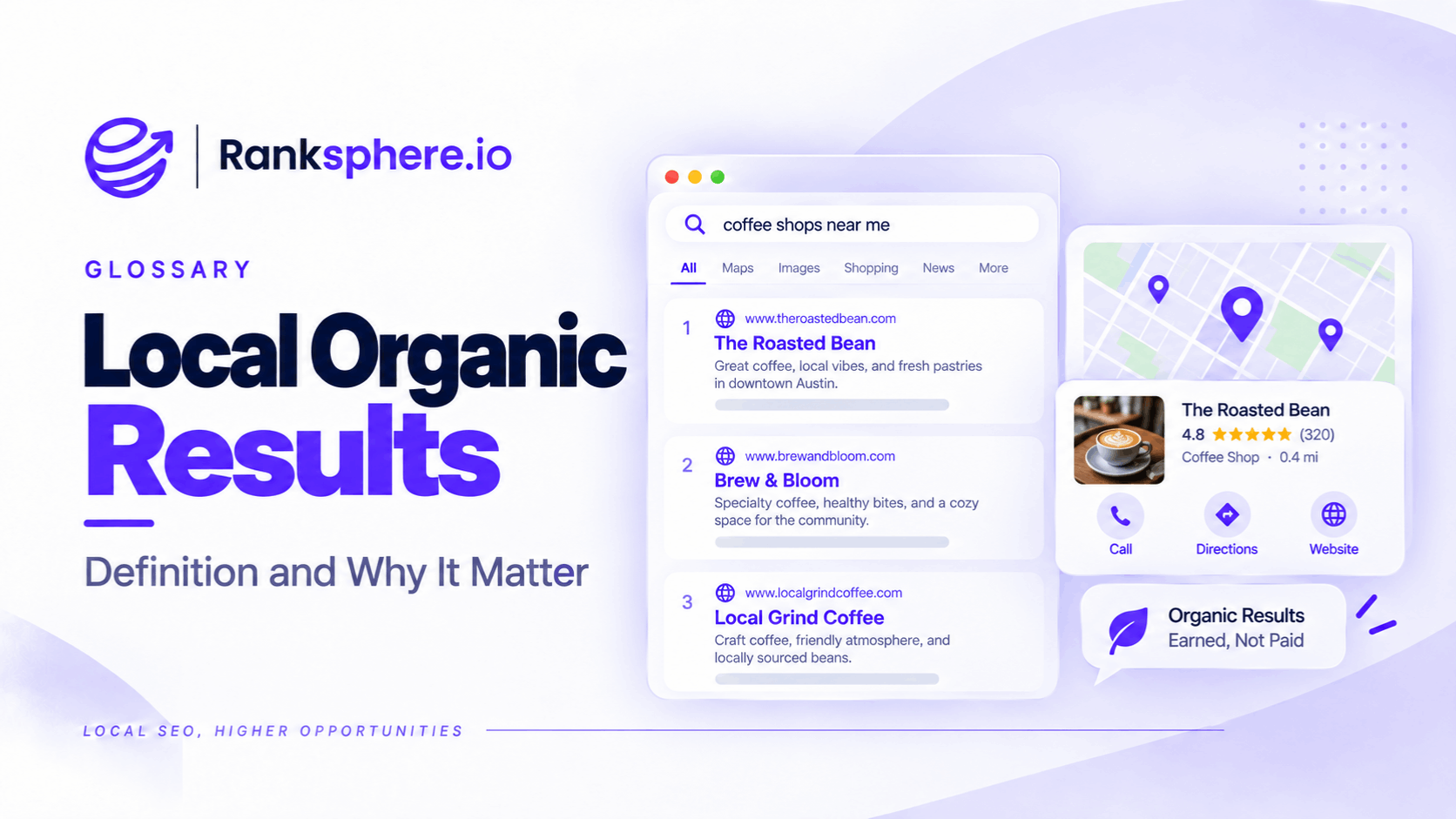
Local organic results are the unpaid website listings Google displays for searches with local intent. They appear in the standard search results, often below the local pack, and are ranked through Google's organic search systems.
For example, someone searching for "roof repair in Maidstone" might see a local pack featuring nearby roofing companies, followed by organic listings from contractors, business directories, and service websites.
These are two different types of search results.
The local pack primarily displays business profiles, while local organic results direct users to webpages.
A roofing company might appear in the local pack but have no website page ranking prominently for the same query. Another business might rank first organically but not appear among the local pack listings.
A single local search can therefore create two opportunities for visibility, each with different ranking considerations.
Understanding the difference helps businesses choose the right SEO activities and measure their performance more accurately.
Local Organic Results vs Local Pack
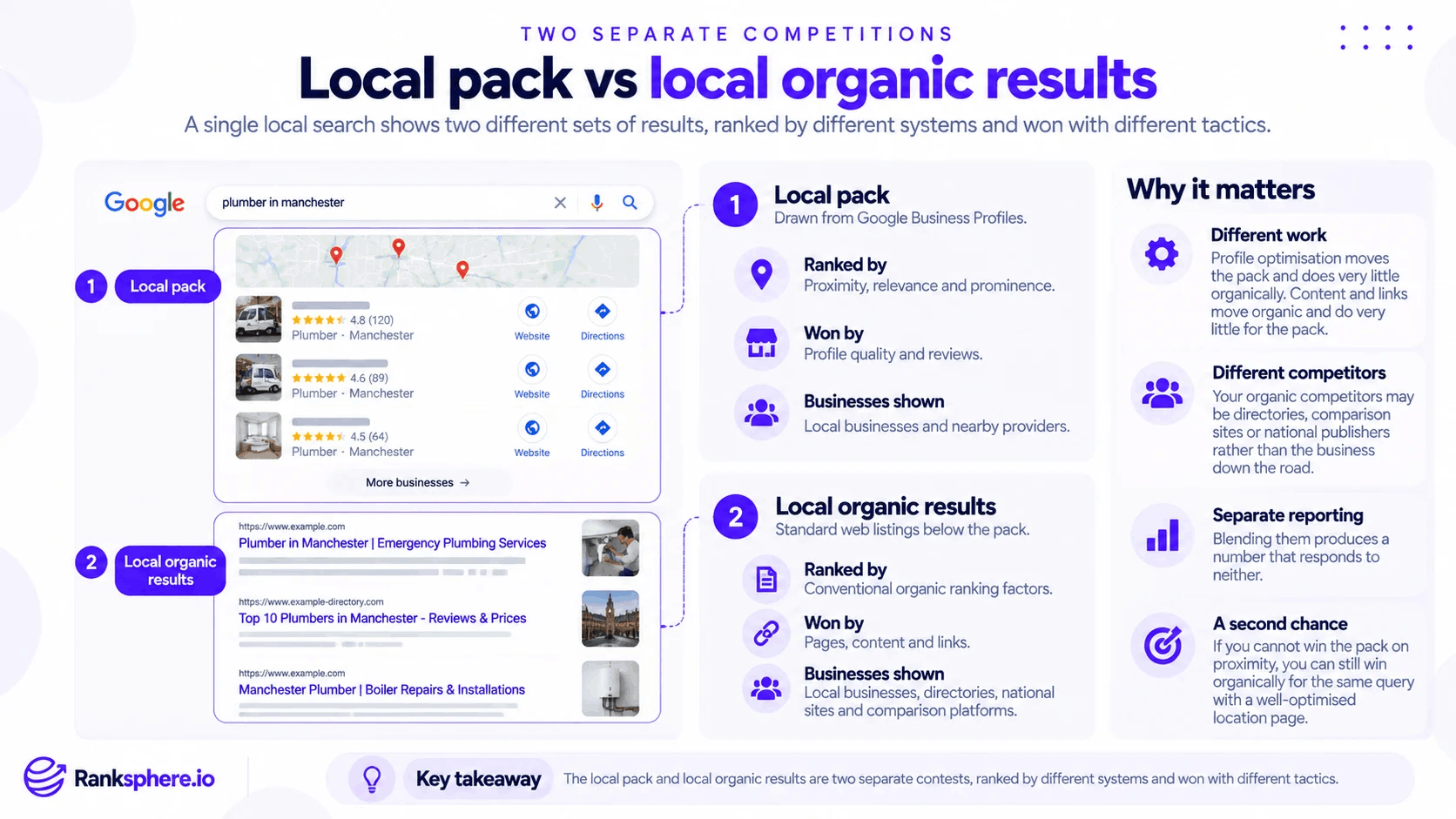
The local pack and local organic results can appear together on the same Google search engine results page.
However, they serve different purposes.
Google Local Pack
The local pack displays a selection of businesses that Google considers relevant to a location-based search.
These listings draw heavily on Google Business Profile information.
Google states that local rankings are primarily based on:
- Relevance — How closely a business matches the search.
- Distance — How far the business is from the location associated with the query.
- Prominence — How well-known or established the business is.
Accurate profile information, appropriate categories, genuine reviews, and other relevant signals can help Google understand a business.
However, no individual optimisation guarantees a particular local pack position.
Local Organic Results
Local organic results are conventional website listings that appear for geographically relevant searches.
For example, a search for "physiotherapist in Bristol" may return webpages from local clinics, healthcare directories, and other relevant websites.
Google evaluates these pages through its organic ranking systems.
Factors and considerations include relevance to the query, content quality, links, page experience, and technical accessibility.
The website's geographic relevance can also matter.
For example, a page clearly explaining physiotherapy services in Bristol may be relevant to someone searching for those services in that city.
Key Differences
| Feature | Local pack | Local organic results |
| Main result type | Business profiles | Website pages |
| Primary ranking systems | Local ranking systems | Organic search ranking systems |
| Distance | Explicit local ranking factor | Geographic relevance and search context may matter |
| Important assets | Google Business Profile and business information | Relevant webpages and website content |
| Typical competitors | Nearby eligible businesses | Businesses, directories, publishers, and other websites |
| Common customer actions | Calls, directions, website visits | Website visits and on-page actions |
These systems aren't completely independent.
For example, a business's website can help Google understand its services and relevance.
Likewise, business information across the web can contribute to Google's understanding of an organisation.
However, improving a website page doesn't guarantee a local pack improvement, and updating a Business Profile doesn't guarantee higher organic rankings.
Why Local Organic Results Matter for SEO
Local SEO discussions often focus heavily on Google Maps and the local pack.
That's understandable because these features can appear prominently when someone searches for a nearby service.
However, organic website results remain an important route for customers to discover businesses.
A Second Opportunity to Appear in Search
A business may not appear in the local pack for every search location.
For example, a roofing contractor based outside Maidstone town centre may have limited local pack visibility for searches performed in the centre.
However, its website may still be relevant to someone searching for roofing services in Maidstone.
A useful, geographically relevant service page could compete in organic results.
That doesn't guarantee a ranking, but it provides another opportunity for search visibility.
Different Search Competitors
Your local pack competitors aren't necessarily the same as your organic competitors.
For example, an electrician may compete against nearby electrical contractors in the local pack.
In organic results, the competition might include:
- Local electrical contractors
- Business directories
- Comparison websites
- National service platforms
- Informational publishers
This matters because keyword research should identify the websites actually ranking for a query, not only the businesses appearing on Google Maps.
More Opportunities for Informational Searches
Not every locally relevant query displays a local pack.
For example, someone searching for "how much does roof replacement cost in Kent?" may be researching prices rather than looking for a contractor immediately.
Google may show pricing guides, articles, and other informational results.
A roofing business with genuine pricing information and practical experience could create useful content for that query.
Organic SEO can therefore help businesses reach customers before they're ready to contact a provider.
Greater Control Over Website Content
Google Business Profiles have defined fields and supported features.
A business's own website offers more flexibility.
For example, a physiotherapy clinic can publish detailed service information, treatment explanations, practitioner qualifications, pricing, and appointment guidance.
These pages can address questions that would be difficult to answer fully within a business profile.
What Helps Local Organic Results Rank?
Local organic SEO follows many of the same principles as conventional SEO, with additional attention to location and customer intent.
Useful Service Pages
A service page should clearly explain what a business offers.
For example, an emergency plumbing page might include:
- Services available
- Common problems handled
- Areas covered
- Relevant availability information
- Pricing guidance where possible
- How to contact the business
The objective is to help people understand whether the business meets their needs.
Simply repeating "emergency plumber Maidstone" throughout the page doesn't make it more useful.
Genuine Location Pages
A location page can help a business explain its services in a particular geographic area.
For example, a landscaping company based in Maidstone may also serve Aylesford.
A useful Aylesford page might include:
- Services genuinely available there
- Relevant completed projects
- Photographs of actual work
- Location-specific customer information
- How customers can request a quote
However, creating nearly identical pages for every nearby town can produce low-value content.
Location pages should serve genuine customer needs rather than exist solely to capture geographic keyword variations.
Relevant Topic Coverage
A business can build a useful collection of pages around its main services.
For example, a roofing company might publish content about roof repairs, replacements, costs, materials, and common problems.
This relates to topical authority.
However, topical authority isn't a single published Google ranking score.
Covering a subject properly can help create useful content, but the pages still need to satisfy their intended search queries.
Relevant Backlinks
Backlinks can contribute to organic search visibility.
For example, a local business might receive a relevant link from a trade association, industry publication, or community organisation.
The value comes from the relevance and credibility of the linking source, not simply the number of links.
Avoid buying or exchanging links primarily to manipulate rankings.
Internal Linking
Internal linking helps users and search engines navigate related pages.
For example, a roofing company's main roof repair page may link to:
- Emergency roof repairs
- Flat roof repairs
- Roof replacement
- Repair costs
- Relevant service areas
These connections help visitors find additional information and support a logical website structure.
Technical SEO
A page needs to be accessible to search engines before it can compete effectively in organic results.
Important checks include:
- Crawlability
- Indexing eligibility
- Correct canonicalisation
- Mobile usability
- Internal links
- Page performance
- Appropriate redirects
Technical SEO doesn't guarantee rankings, but problems in these areas can prevent useful pages from being discovered or indexed correctly.
Geo-Modified Keywords and Local Organic Results
A geo-modifier is a geographic term added to a search query.
For example:
- Roofer Maidstone
- Physiotherapist Bristol
- Electrician in Canterbury
These searches identify a particular location.
A business doesn't always need to be physically based in the named town to compete in organic results.
For example, a roofing contractor may serve Canterbury while operating from a nearby town.
If the business genuinely provides services in Canterbury, a useful page explaining that service may be relevant to the query.
However, distance can still influence the wider search experience, and the page must compete against other relevant websites.
A location page is not a guaranteed way to overcome proximity limitations in the local pack.
The more useful distinction is that a business can pursue relevant organic visibility in its service area even when its local pack rankings are weaker at certain search locations.
How Much Traffic Do Local Organic Results Receive?
There isn't one reliable percentage of local search traffic that goes to organic results.
The proportion varies depending on the query and the search results displayed.
For example, a search for "plumber near me" may prominently feature a local pack and advertisements.
A search for "how much does boiler repair cost?" may show more informational content.
The position and number of organic listings visible before scrolling can differ substantially.
SERP Features Affect Visibility
An organic result may appear below:
- Paid advertisements
- A local pack
- An AI Overview
- Other search features
For example, AI Overviews may appear for certain informational queries.
Their presence can change the layout and how users interact with the results.
However, it would be misleading to claim that local organic results always receive less traffic or that AI features consistently reduce clicks by a fixed amount.
Actual performance depends on the query, search context, and user behaviour.
Ranking Position Isn't the Whole Story
A page ranking first organically may still appear below several other features.
Meanwhile, a page ranking third organically for another query may be more immediately visible.
That's why businesses should review ranking positions alongside search impressions, clicks, and relevant customer actions.
Organic position remains useful, but it needs context.
How to Track Local Organic Rankings
Local businesses should distinguish between organic website rankings and Google Business Profile rankings.
Combining the two into a single position can make reporting difficult to interpret.
Track Organic Rankings Separately
Choose the website pages and keywords that matter to the business.
For example, a roofing company may monitor:
- Roof repair Maidstone
- Flat roof replacement Maidstone
- Roofing contractor Maidstone
- Roof replacement cost
Check which website pages appear for those queries.
Monitor performance over time rather than relying on one search result.
Track Local Pack Visibility
For queries that trigger local results, also monitor the business's Google Business Profile visibility.
For example, a business may appear prominently in the local pack near its premises but less prominently several miles away.
Geo-grid ranking analysis can help identify these differences.
Ranksphere's Local Rank Tracker helps businesses measure local keyword visibility across geographic search points.
For complete reporting, local pack tracking should be complemented by organic search performance data, such as Google Search Console and appropriate organic rank monitoring.
Measure Customer Actions
Ranking improvements are useful only when they contribute to meaningful visibility or business outcomes.
Depending on the website and tracking setup, monitor:
- Organic search clicks
- Relevant landing page visits
- Enquiry submissions
- Tracked calls
- Appointment requests
- Other qualified leads
Some local pack interactions happen without a website visit, so Google Business Profile performance should also be reviewed.
See rank tracking for more information.
Common Local Organic SEO Mistakes
Several mistakes come from treating local pack and organic rankings as though they are the same.
Reporting One Ranking Position for Both
A business might rank first organically but fifth in local pack results.
Those are different outcomes.
Reports should identify which type of ranking is being measured.
Assuming Google Business Profile Optimisation Controls Organic Rankings
Accurate categories, services, and profile information matter for Google Business Profile relevance.
However, updating profile fields doesn't guarantee that a website's organic rankings will improve.
Organic performance also depends on the website itself and the queries it targets.
Ignoring Website SEO Because the Local Pack Is the Priority
A business may focus exclusively on Google Maps visibility and overlook its website.
That can mean missing searches involving pricing, comparisons, and detailed service information.
Both channels deserve attention when they're relevant to the business.
Creating Location Pages Without Useful Information
Publishing dozens of near-identical town pages doesn't automatically expand organic visibility.
Each page should have a reason to exist.
A genuine project example, location-specific service detail, or other relevant information can make the page more useful.
Identifying Competitors Only Through Google Maps
A local business may compete with directories and national websites in organic search.
Ignoring those results can lead to poor keyword targeting and unrealistic content plans.
Ignoring Search Intent
Not every query with a city name requires a location page.
For example, "roof replacement cost Maidstone" may be better served by a pricing guide than a generic service page.
Review the actual search results before deciding what to create.
Local Organic SEO Best Practices
To improve local organic visibility:
- Track local pack and organic rankings separately.
- Research the actual search results for important keywords.
- Identify organic competitors independently from local pack competitors.
- Create useful service pages based on customer needs.
- Build genuine location pages for relevant service areas.
- Address informational and comparison queries where appropriate.
- Include real project examples and accurate business information.
- Build relevant internal links.
- Earn legitimate backlinks from useful, credible sources.
- Keep important pages crawlable and indexable.
- Review mobile usability and website performance.
- Measure clicks and enquiries alongside ranking positions.
- Revisit keyword intent when search performance changes.
The objective isn't to choose between Google Business Profile optimisation and website SEO.
It's to understand how each contributes to visibility and customer acquisition.
Example of Local Organic Results for an Optician
Consider a hypothetical optician called Fernhill Opticians.
The practice reports that it ranks first for "optician Fernhill."
However, enquiries from Google haven't increased as expected.
The business assumes the ranking should be generating more calls and appointments.
What the Agency Discovers
The agency reviews the actual Google search results.
It finds that the practice ranks first organically for the query.
However, Google also displays a local pack above the organic results.
The local pack contains three competing opticians.
The practice doesn't appear among them at the search location being checked.
This explains why the organic ranking report doesn't describe the complete search experience.
What Needs Attention
The agency reviews the business's Google Business Profile.
It checks:
- Primary and secondary categories
- Services
- Opening hours
- Address accuracy
- Photographs
- Customer reviews
- Other relevant profile information
It also checks local visibility from multiple geographic points.
The objective is to establish where the business appears and whether its profile information accurately represents the practice.
How the Agency Changes Its Reporting
The agency begins reporting organic and local pack performance separately.
For example:
Organic visibility
Measures how the website performs for relevant search queries.
Local pack visibility
Measures where the business appears in local search results across selected locations.
Customer actions
Reviews available website enquiries, calls, direction requests, and appointment activity.
The business can now understand whether changes are affecting its website, its local business listing, or both.
Example Shows
“The original ranking report wasn't necessarily incorrect.
The practice did rank first organically.
However, the report omitted the local pack, which was a prominent part of the search results.
The agency needed to evaluate both opportunities rather than rely on a single ranking position.
Local organic results and the local pack are different ways to appear for the same search.
For local businesses, a strong strategy considers both: accurate Google Business Profile information for local discovery and useful website pages for relevant organic searches.”
See Also
- Local Pack — The local business results that may appear above organic website listings.
- SERP — The search engine results page containing organic listings and other features.
- Rank Tracking — Monitoring search visibility across different queries and result types.
- Location Page — Creating useful pages for specific service areas.
- Local Ranking Factors — Understanding relevance, distance, and prominence in Google's local results.
- Geo-Modifier — Geographic terms that help specify where someone wants search results.