A local visibility score is a metric calculated by an SEO tool to summarise how visible or well-optimised a business is in local search.
Depending on the software, the score may combine Google Maps rankings, Google Business Profile information, customer reviews, local citations, and other indicators.
For example, an SEO tool might give a dental practice a visibility score of 72 out of 100.
That number may be useful for tracking progress within the tool, but it doesn't mean the practice appears in 72% of relevant local searches or is outperforming 72% of competitors.
Google doesn't publish an official local visibility score. Each SEO platform defines and calculates its own version.
This makes the metric useful for certain reporting and diagnostic tasks, but unreliable as a standalone measure of business growth.
How Is a Local Visibility Score Calculated?
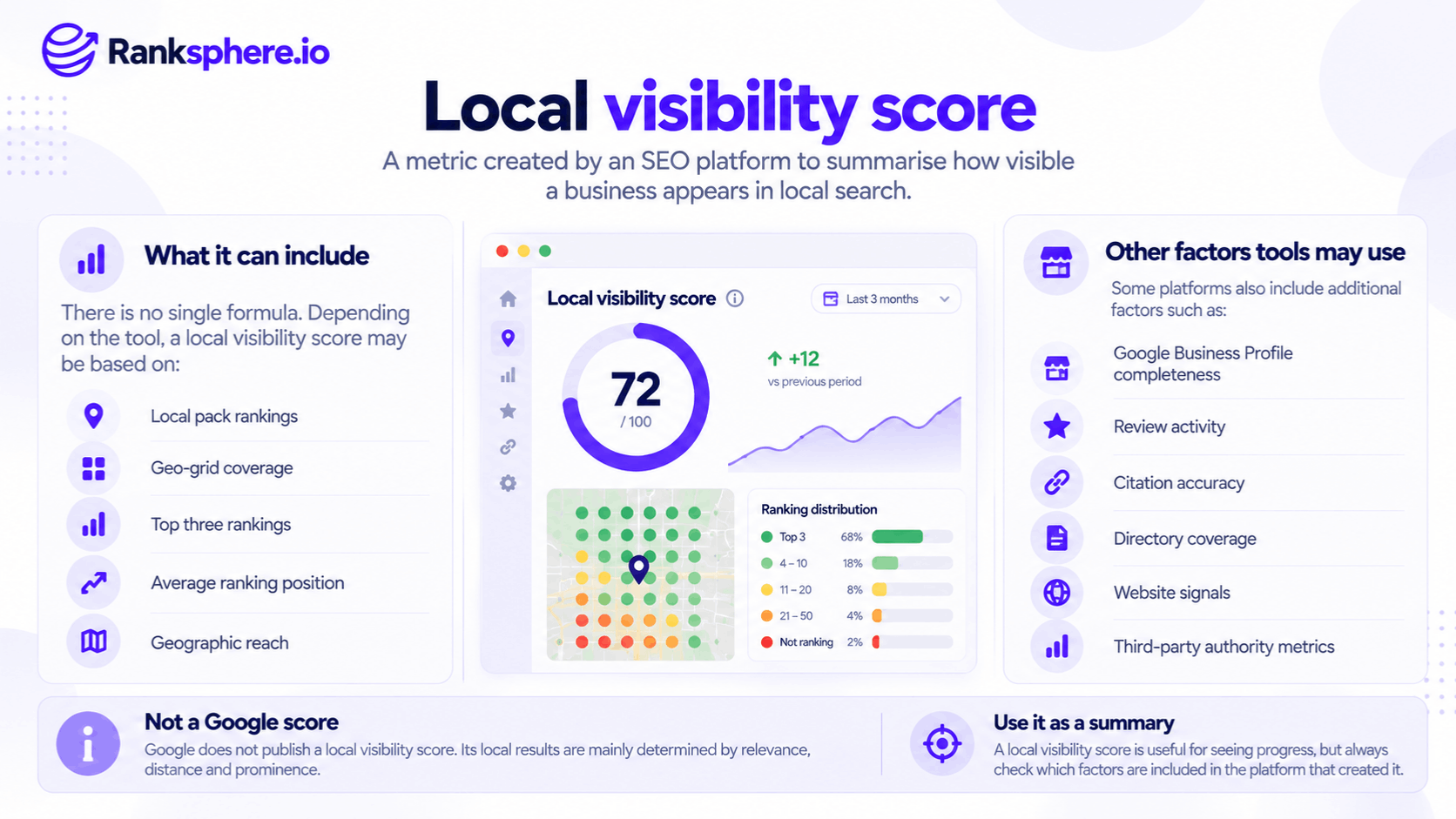
There is no standard formula.
One SEO platform may calculate local visibility almost entirely from tracked keyword rankings. Another may combine rankings with several optimisation indicators.
Common inputs include:
| Component | What it measures |
|---|---|
| Local search rankings | Positions for selected keywords and locations |
| Geo-grid coverage | How frequently a business appears within selected ranking positions across a geographic grid |
| Google Business Profile information | Whether important profile fields are complete or accurate |
| Customer reviews | Review count, ratings, or other review-related indicators |
| Local citations | Accuracy or consistency of business information across directories |
| Website metrics | Selected on-page or technical indicators |
| Domain Authority | A third-party estimate of website authority, where a tool chooses to include it |
The weighting depends on the provider.
For example, one platform may assign most of its score to local rankings, while another gives considerable weight to business listing completeness.
The same business could receive different scores from the two tools without either calculation being internally incorrect.
They simply measure different things.
Is Local Visibility Score a Google Ranking Factor?
No.
Google does not identify third-party local visibility scores as ranking factors.
According to Google's official guidance, local search rankings are mainly determined by three factors:
- Relevance: How closely a business matches what someone is searching for.
- Distance: How far the business is from the location associated with the search.
- Prominence: How well-known or established the business is, including relevant information such as reviews and links.
Google also recommends keeping business information complete and accurate.
However, that does not mean filling in a profile field increases a third-party visibility score and automatically improves local rankings.
A tool's score is its interpretation of selected data, not Google's assessment of the business.
Why Local Visibility Scores Can Be Misleading
The biggest limitation is that a composite score can improve without any corresponding improvement in customer enquiries.
1. The Score Can Be Influenced by What You Track
Consider a roofing business tracking ten competitive keywords.
Its rankings are relatively weak.
The agency then adds several easier, more specific terms to the tracking set.
Depending on how the tool calculates visibility, the overall score may increase.
However, the business hasn't necessarily improved its rankings for the original keywords.
The measurement has changed.
2. The Weighting May Not Be Clear
A visibility score can rise from 60 to 75 without explaining what contributed to the increase.
Did the business improve its rankings?
Did it receive more reviews?
Did someone complete missing profile information?
Without the underlying data, the client cannot tell.
3. Scores Can Hide Declines
A business might gain reviews and improve citation accuracy while losing rankings for an important service keyword.
The composite score could remain stable or even increase.
That makes the overall number reassuring while an important commercial metric is getting worse.
4. Different Improvements Have Different Value
Correcting an inaccurate telephone number can have immediate practical value.
Adding several low-relevance directory listings may have little.
Yet a tool could award points for both activities.
A composite score doesn't necessarily reflect the importance of each change to customers.
5. Scores Aren't Comparable Across Platforms
A score of 80 in one tool doesn't mean the same thing as 80 in another.
Even comparisons within the same platform can become less reliable if the provider changes its scoring formula or the agency changes its tracked keywords and locations.
This is why scoring methodology should be documented when the metric is used for reporting.
When Is a Local Visibility Score Useful?
A composite score isn't necessarily worthless.
It can be helpful when used for the right purpose.
Identifying Businesses That Need Attention
An agency managing dozens of locations may use scores to identify accounts worth reviewing.
For example, locations with consistently low visibility scores could be added to an investigation queue.
The score provides a starting point, not a diagnosis.
The agency still needs to inspect the underlying metrics.
Prospecting and Initial Audits
A local visibility score may help summarise findings during a prospecting audit.
For example, a tool might highlight a business with weak local rankings and incomplete directory information.
That could suggest opportunities for improvement.
However, the agency should explain the actual findings rather than simply telling a prospect their score is poor.
Monitoring Trends Within One Tool
A score can provide useful historical context when the calculation and tracked dataset remain consistent.
For example, an increase over several months may suggest that some measured indicators have improved.
But the agency should still show which components changed.
What Should Local SEO Agencies Report Instead?
A strong local SEO report should focus on measurable visibility and business outcomes.
Rather than using one composite number as the headline, consider a small set of clearly defined metrics.
1. Top-Three Geo-Grid Coverage
Geo-grid tracking measures ranking positions at selected points across a geographic area.
For example, a plumbing company might appear in the top three Google Maps results at 18 of 49 grid points for a particular keyword.
That gives a top-three coverage rate for the selected grid.
Unlike a broad composite score, the result can be traced to the keyword, location, grid size, and scan date.
However, grid coverage is still a sample of selected locations and searches, not the percentage of all customers who see the business.
2. Google Business Profile Actions
Google Business Profile performance provides information about supported customer interactions, including call clicks and direction requests.
These metrics can help show whether people are taking action after discovering a business.
However, a call click isn't necessarily a completed call or an enquiry.
Google's performance data also has its own measurement rules and limitations.
3. Review Performance
Monitor review count, average rating, and review velocity.
For example, a dental practice might receive more recent reviews while maintaining its overall rating.
That provides useful reputation context.
Google confirms that more reviews and positive ratings can help local rankings, but there is no published formula linking a particular review increase to a guaranteed ranking improvement.
4. Enquiries and Bookings
Where reliable tracking is available, monitor actual business outcomes.
Examples include qualified enquiries, booked consultations, and completed appointments.
These measures help establish whether improved visibility contributes to the business's goals.
5. Share of Local Voice
Share of local voice can help compare a business's local ranking visibility with selected competitors.
However, the metric depends on the provider's calculation and the keywords and locations being measured.
It shouldn't be presented as an official Google market-share figure.
Ranksphere's Local Rank Tracker helps businesses and agencies examine geo-grid rankings, coverage, and competitor visibility.
These measurements provide more detail about where a business appears than a single unexplained visibility score.
Local Visibility Score vs Other SEO Scores
Local visibility scores share an important limitation with other third-party SEO metrics.
For example:
- Domain Authority estimates aspects of a website's link-related strength.
- Listing Accuracy Score summarises business listing accuracy according to a provider's methodology.
- Local visibility scores summarise selected local SEO indicators.
All three can be useful for analysis.
The problem arises when they are presented as official Google measurements or direct evidence of business growth.
A local visibility score should explain what it combines, while the underlying measurements show what actually changed.
Common Local Visibility Score Mistakes
- Using the score as the main KPI. A composite doesn't necessarily reflect business outcomes.
- Comparing scores from different SEO tools. Each may use a different formula.
- Treating the score as an official Google metric. Google doesn't publish one.
- Changing the keyword set without noting it. This can make historical comparisons misleading.
- Improving the score instead of local visibility. More points don't automatically mean more customers.
- Ignoring individual components. A high score can hide poor rankings or declining enquiries.
- Setting contractual score targets. The vendor controls the formula, not the agency.
- Reporting percentages without defining them. A score of 80 doesn't necessarily represent 80% visibility.
Local Visibility Score Best Practices
Use composite scores as supporting indicators rather than the main measure of SEO success.
When reporting them, explain what the score represents and which components contributed to any change.
Keep keyword sets, geographic grids, and other measurement settings consistent wherever possible.
Lead client reports with relevant local ranking coverage, Google Business Profile interactions, review performance, and enquiries.
Choose each KPI according to what the business is trying to achieve.
A useful metric should help someone understand performance and decide what to do next.
Example of a Misleading Local Visibility Score
Consider a hypothetical SEO agency managing a dental practice.
The agency reports that the practice's local visibility score increased from 54 to 82 over six months.
At first glance, the improvement appears substantial.
However, the practice manager asks what actually changed.
What the Agency Finds
The agency reviews the score's underlying components.
During the reporting period, the team had added easier keywords to the tracking set, completed several profile fields, and submitted the practice to additional business directories.
Those activities contributed to the higher score.
However, its geo-grid rankings for the original priority keywords had changed only slightly.
Google Business Profile call interactions were broadly stable.
What the Agency Changes
The agency rebuilds the monthly report around four measurements:
- Top-three geo-grid coverage for a fixed set of priority keywords
- Google Business Profile call interactions
- Customer review performance
- Qualified appointment enquiries
The original visibility score remains available as a supporting internal measure.
The agency also documents the tracked keywords, geographic area, and scan settings so future comparisons are more consistent.
Example
“The original score wasn't necessarily calculated incorrectly.
The problem was that it summarised changes without showing whether those changes mattered to the business.
The revised report made it easier to identify actual improvements and areas requiring attention.
A local visibility score can be a useful starting point, but it should never replace the metrics that explain where a business appears and whether customers are taking action.
For local SEO reporting, clarity matters more than producing a single impressive number.”
See Also
- KPI — Choosing meaningful measurements for local SEO reporting.
- Domain Authority — A third-party metric sometimes mistaken for a Google ranking factor.
- Listing Accuracy Score — A composite measure of local business listing accuracy.
- Geo-Grid Rank Tracking — Measuring local rankings across selected geographic points.
- White-Label Reporting — Presenting local SEO results under an agency's branding.
- Share of Local Voice — Comparing local ranking visibility against selected competitors.