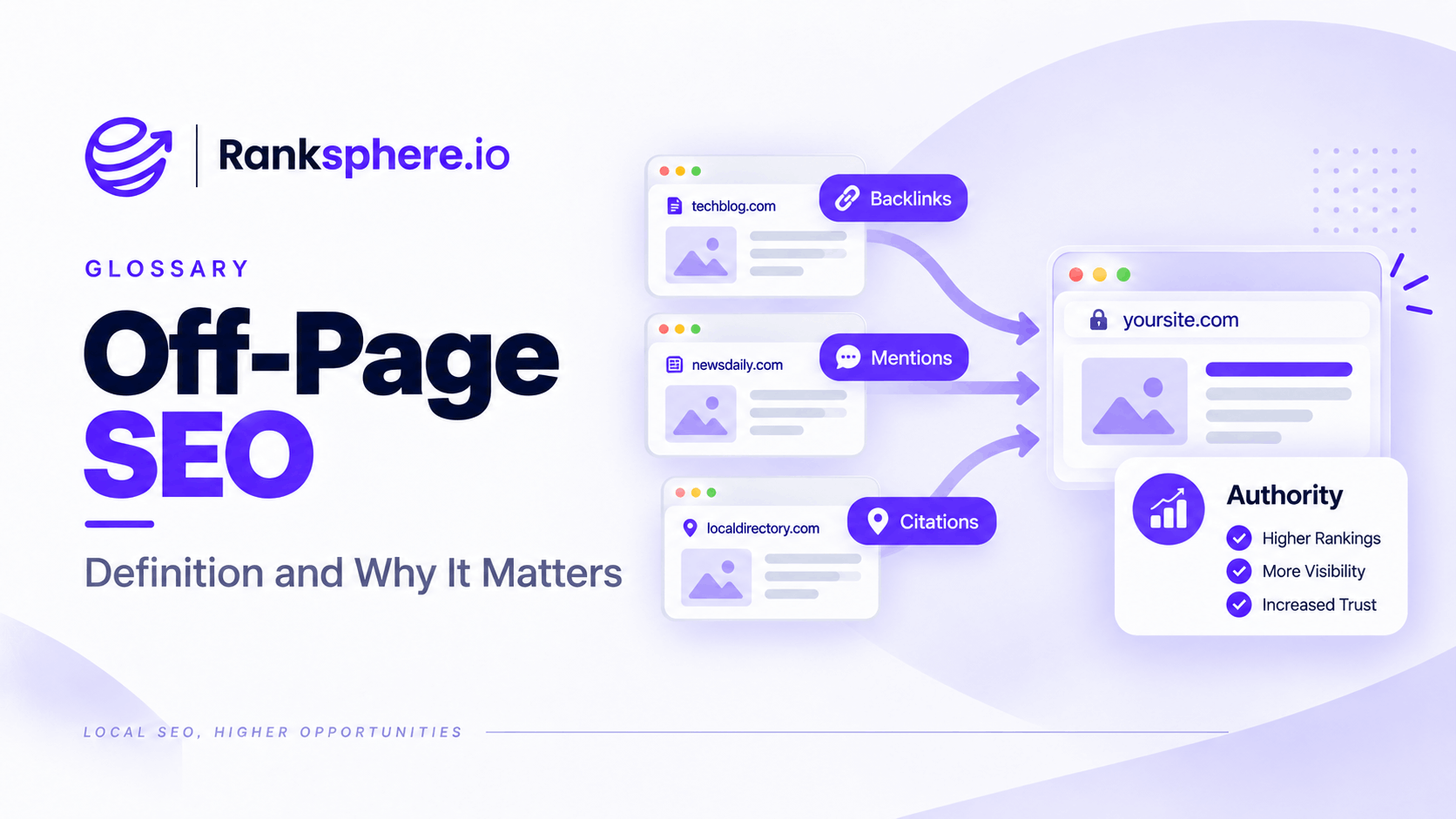
Off-page SEO is the process of improving a website's search visibility through activities and signals outside the website itself.
It includes earning backlinks, managing business listings, building a positive reputation, and gaining relevant mentions across the web.
For local businesses, it also includes managing a Google Business Profile, which helps customers discover businesses through Google Search and Maps.
Off-page SEO is often described as link building, but that definition is too narrow.
A roofing company could have several good backlinks and still lose potential customers because its Business Profile displays an incorrect telephone number or outdated opening hours.
For local businesses, off-page SEO isn't just about earning links. It's about making sure people can find, recognise and trust the business wherever it appears online.
What Does Off-Page SEO Include?
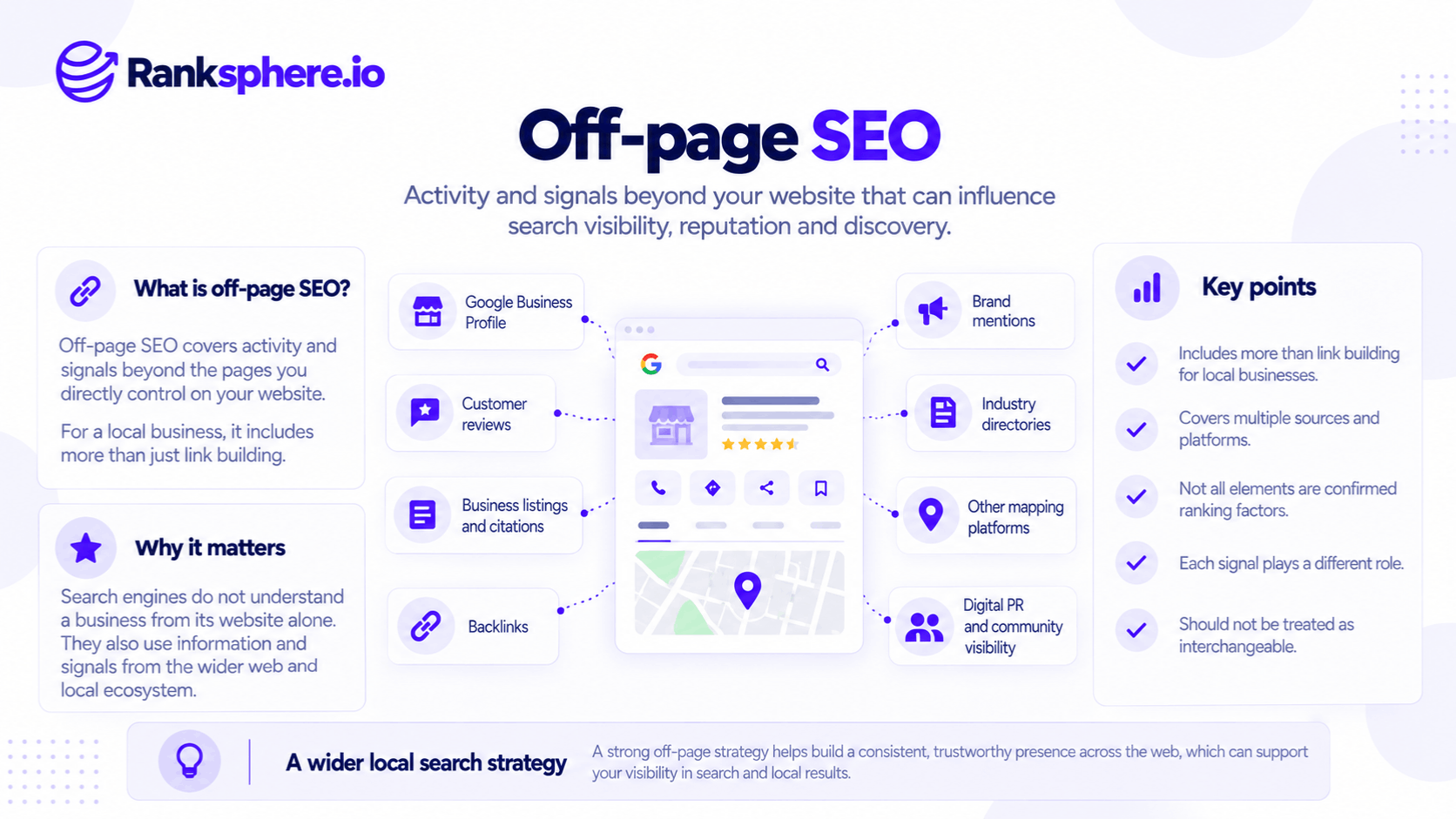
Off-page SEO covers several activities, each serving a different purpose.
1. Google Business Profile Management
A Google Business Profile allows eligible businesses to manage how important information appears on Google Search and Maps.
That includes:
- Business categories and services
- Opening hours
- Addresses or service areas
- Business attributes
- Photographs and videos
Google recommends providing complete and accurate business information because it helps Google understand the business and match it to relevant searches.
For example, a dental practice should choose accurate categories and list the services it genuinely provides.
Profile information is particularly important for the local pack, but completing every field doesn't guarantee a higher ranking.
2. Customer Reviews
Online reviews help prospective customers evaluate a business.
They also have a role in local search rankings.
Google confirms that more reviews and positive ratings can help a business's local ranking.
However, it doesn't publish a formula showing how much ranking improvement a particular number of reviews produces.
Businesses should encourage genuine feedback and respond professionally.
Avoid fake reviews, incentives for positive ratings, or selectively requesting feedback only from satisfied customers.
3. Local Citations
A citation is a mention of a business's identifying information on another website or platform.
For example, a local directory might display a company's name, address and telephone number.
Accurate citations help customers find reliable information.
They can also contribute to Google's understanding of a business across the web.
However, creating hundreds of directory listings doesn't automatically improve rankings.
Start by correcting inaccurate information on relevant platforms rather than submitting the business to every available directory.
Ranksphere's Local Citation Management Tool helps businesses review listings across more than 500 directories and identify records that need attention.
4. Brand Mentions
Brand mentions occur when another website references a business, with or without a link.
For example, a local newspaper might mention a veterinary practice that supported an animal rescue event.
These mentions can introduce the business to new audiences and provide context about the business as an entity.
However, Google hasn't confirmed that every unlinked mention directly improves rankings.
The value depends on the relevance and credibility of the source, as well as whether the mention helps people discover the business.
5. Backlinks
A backlink is a link from another website to yours.
For example, a local trade association may link to a roofing company listed among its members.
Google uses links as part of its ranking systems, including when assessing local prominence.
Backlinks therefore remain relevant to local SEO.
The mistake is assuming that more links always mean better rankings.
A relevant editorial link from a respected local organisation may be more useful than dozens of low-quality directory links.
6. Other Business Listings and Social Platforms
Local businesses may also benefit from maintaining accurate listings on platforms such as Apple Business Connect and Bing Places.
These platforms provide additional ways for customers to discover business information.
Social platforms can also contribute through recommendations, content distribution and customer engagement.
However, likes and follower counts aren't established direct Google ranking factors.
See social signals.
Why Off-Page SEO Is Different for Local Businesses
Traditional off-page SEO often focuses heavily on backlinks.
That makes sense for websites competing in national organic search results, where links may be an important part of the competitive picture.
Local SEO introduces additional considerations.
Google says local rankings are mainly determined by relevance, distance and prominence.
That means a business's location, relevance to the query, reputation and information across the web can all matter.
For example, a nearby dental practice with accurate information and strong customer reviews may be a better match for a particular search than a more distant competitor with more backlinks.
However, no single metric determines the outcome.
Google doesn't confirm that reviews always outweigh backlinks, or that citations matter more than website quality.
The right priority depends on what is currently limiting the business's visibility.
Off-Page SEO vs On-Page and Technical SEO
The difference comes down to where the work happens and how much control the business has.
| SEO type | Main focus | Example |
|---|---|---|
| On-page SEO | Content and elements on your website | Improving service pages and internal links |
| Technical SEO | Crawling, indexing and website functionality | Fixing blocked pages or redirect errors |
| Off-page SEO | External visibility, links and reputation | Managing reviews, citations and backlinks |
Businesses usually have direct control over their website content and technical settings.
Off-page SEO is different.
You can manage your Business Profile, but you cannot control which customers leave reviews, which publishers link to you, or every change that external platforms make to their listings.
That makes monitoring and ongoing maintenance important.
How to Prioritise Off-Page SEO for a Local Business
There isn't one priority order that works for every business.
However, the following approach is practical when reviewing a typical local SEO campaign.
Start with Google Business Profile. Check eligibility, verification, categories, hours, services and contact information. Correct anything inaccurate or misleading.
Review customer feedback. Assess recent reviews, unanswered reviews and whether the business has a compliant process for requesting genuine feedback.
Audit important citations. Correct old addresses, disconnected telephone numbers and duplicate listings where appropriate.
Check other relevant platforms. Keep important business listings accurate, particularly on platforms customers in your area use.
Investigate existing brand mentions. Where a publisher has already mentioned the business, consider whether a relevant link would help readers.
Build genuine local relationships. Earn local links through useful resources, industry participation, partnerships and editorial coverage.
This order can change.
For example, if a business already has an accurate profile and strong reviews but very few relevant links, link building may deserve earlier attention.
The objective is to address the most important weaknesses rather than follow a fixed sequence.
Common Off-Page SEO Mistakes
- Treating off-page SEO as link building alone. Local business information and reputation also matter.
- Buying links to manipulate rankings. This can violate Google's spam policies.
- Ignoring Google Business Profile accuracy. Incorrect information can affect customers and discoverability.
- Building citations before checking existing listings. Old records may need correcting first.
- Treating review quantity as the only goal. Genuine feedback, recency and customer experience also deserve attention.
- Assuming every brand mention improves rankings. The benefit isn't automatically measurable.
- Using the same strategy for every business. Local competition and existing weaknesses differ.
- Reporting link counts instead of business outcomes. More backlinks don't necessarily mean more enquiries.
Off-Page SEO Best Practices
Keep important business profiles complete and accurate.
Request genuine reviews consistently and respond to customer feedback.
Check citations before creating new listings.
Prioritise relevant links and mentions over artificial volume.
Monitor local rankings, Google Business Profile interactions and qualified enquiries.
Most importantly, use Google's documented ranking guidance rather than assuming any single off-page activity guarantees results.
Example of Off-Page SEO for a Roofing Company
Consider a hypothetical roofing company that hires an agency to improve its local rankings.
The agency initially proposes a campaign focused almost entirely on acquiring backlinks.
However, the initial audit reveals more immediate problems.
What the Audit Finds
The company's Google Business Profile has incomplete service information.
Several important directory listings show an address the company stopped using years ago.
The business receives genuine customer reviews, but it has no consistent process for requesting feedback after completed jobs.
Its website is functioning correctly, and it already has some relevant backlinks.
What the Agency Changes
Instead of beginning with a large link acquisition campaign, the agency prioritises the existing problems.
It corrects Business Profile information, investigates outdated citations and introduces a compliant review request process.
The company also pursues a small number of relevant local link opportunities, including industry associations and legitimate local publications.
How Results Are Measured
The agency monitors local rankings across a consistent geographic grid.
It also tracks Google Business Profile interactions, review performance and qualified roofing enquiries.
Over time, these measurements help show which areas are improving.
However, the agency doesn't assume that every ranking change was caused by a particular citation correction or new review.
Example
“Both link acquisition and business profile optimisation belong within off-page SEO.
The difference is prioritisation.
The company needed accurate business information and a stronger approach to customer feedback before spending heavily on additional links.
That won't be the right order for every roofing company, but it was justified by the weaknesses identified in this example.
Effective off-page SEO is not about doing more activities outside your website. It's about improving the external information, reputation and connections that help customers find and choose your business.”
See Also
- Google Business Profile — Managing business information in Google Search and Maps.
- Online Review — Customer feedback and its role in local visibility.
- Citation — Business information on external directories and platforms.
- Backlink — Links from other websites to yours.
- Local Ranking Factors — Understanding relevance, distance and prominence.
- On-Page SEO — Optimising content and elements within your website.