An FAQ page (Frequently Asked Questions page) is a section of a website that answers common questions about a business, its services or its products.
It helps visitors find information without needing to contact the business.
For SEO, however, not every question needs to live on one dedicated FAQ page.
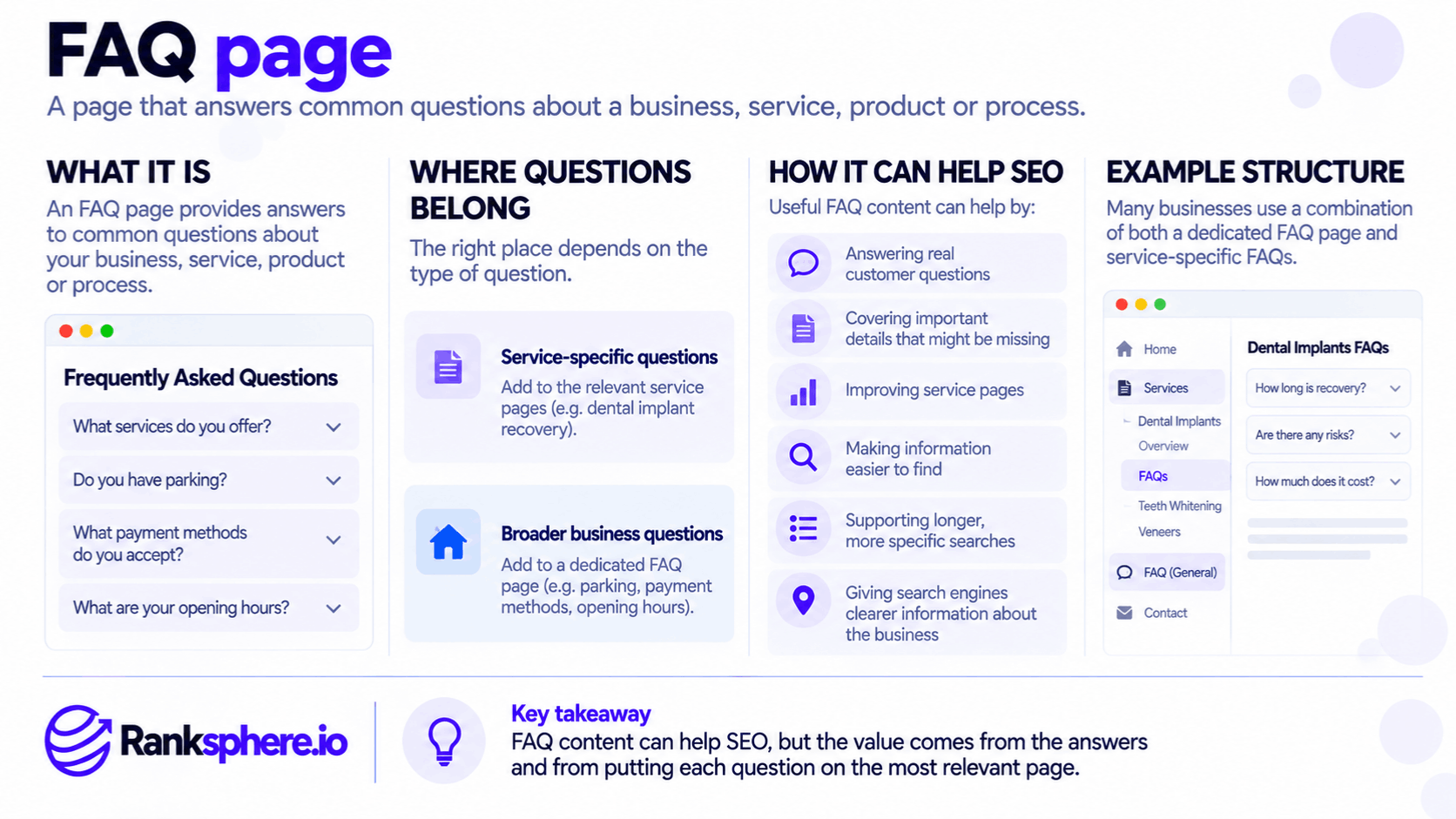
A dental practice, for example, might answer questions about implant recovery directly on its dental implants page, while keeping general questions about parking, payment methods and opening hours on a separate FAQ page.
The goal isn't to collect as many questions as possible. It's to put useful answers where customers are most likely to need them.
Should FAQs Be on a Separate Page?
A dedicated FAQ page can be useful, but it isn't always the best place for every question.
If a business places thirty unrelated questions on one page, visitors may have to search through information about several different services to find an answer.
A better approach is often to divide the questions according to their subject.
For example, questions about dental implant costs, suitability and recovery can sit on the implant service page.
Questions about parking, accepted payment methods and booking arrangements may belong on a general FAQ page.
This makes the information easier to navigate and keeps service-specific answers alongside relevant content.
However, Google doesn't prescribe one arrangement over the other. The best structure depends on the website and what visitors need.
Why Service-Specific FAQs Can Help SEO
Putting relevant questions on service pages has several practical advantages.
Stronger Topical Relevance
A question about implant recovery makes sense on a page explaining dental implants.
The answer benefits from the surrounding treatment information, and visitors don't need to navigate elsewhere.
Better Customer Experience
Someone considering a service often has practical questions before making an enquiry.
Answering those questions directly on the service page reduces unnecessary steps.
For example, a roofing customer may want to know how long a repair takes or whether the business provides written quotations.
Opportunities for Search Visibility
Clear answers can help search engines understand a page's content.
Google may select relevant webpage passages for featured snippets, while AI-powered search experiences may also use helpful information from webpages.
However, writing questions as headings doesn't guarantee either result.
Less Unnecessary Content Overlap
Keeping related answers together can reduce duplication between service pages and a general FAQ page.
This may also help avoid unnecessary keyword cannibalisation.
However, having similar questions on two pages doesn't automatically create a ranking problem.
The concern is whether the pages serve distinct purposes or unnecessarily compete for the same search intent.
When Does a Dedicated FAQ Page Make Sense?
A standalone FAQ page works well for questions that apply to the business as a whole.
For example:
- Where can customers park?
- Which payment methods do you accept?
- How can someone cancel an appointment?
- Do you offer payment plans?
- What should customers bring to their first visit?
These questions may not belong naturally on an individual service page.
A dedicated page can also be useful for existing customers who want quick answers.
For most local business websites, a combination works well: general questions on an FAQ page and service-related questions on relevant service pages.
How to Write SEO-Friendly FAQ Content
Good FAQ answers are direct, accurate and genuinely useful.
Use the customer's wording. Questions should reflect how people actually ask them, rather than forcing keywords into every heading.
Answer immediately. Provide the essential information in the first sentence or two.
Add detail where necessary. Explain pricing conditions, exceptions or next steps when the subject requires them.
Use clear headings. Descriptive heading tags help organise the page for readers.
Answer difficult questions. Pricing, waiting times, eligibility and possible complications often matter more than generic questions about the business.
For example, consider this question:
How much does a dental implant cost?
An unhelpful answer would say that prices vary and customers should contact the clinic.
A better answer would provide the practice's actual starting price or typical range, explain what affects the cost and clarify whether consultation fees are included.
Where a precise figure cannot be given, explain why.
That is more useful to customers than a long answer written mainly to include keywords.
Does FAQ Schema Help SEO?
FAQPage schema is structured data used to describe a page containing questions and their answers.
Historically, Google supported FAQ rich results that could display those questions directly beneath a search listing.
However, Google discontinued FAQ rich results in May 2026.
Adding FAQPage schema no longer makes a page eligible for that Google Search feature.
This is different from Google's general support for other structured data and rich results.
FAQPage markup can still describe question-and-answer content for systems that support Schema.org vocabulary, but its broader benefits shouldn't be assumed.
For a typical local business, implementing FAQPage schema solely to improve Google rankings or obtain FAQ rich results isn't a worthwhile priority.
If the website already contains accurate FAQPage markup, there's generally no need to remove it solely because Google retired the display feature.
As with other structured data, any claims in the markup should accurately represent the page's content.
Ranksphere's Schema Generator can help businesses prepare structured data for supported use cases. Choose markup based on the page's content and current search engine support, rather than assuming every schema type produces a visible search feature.
Where Should FAQ Questions Come From?
The most useful questions are often those customers already ask.
Start with the questions reception staff, sales teams and customer support regularly receive.
You can also review review sentiment to understand what customers found confusing or helpful.
Search features such as People Also Ask, Google Autocomplete and related searches can suggest further topics.
If the website has internal site search, review the phrases visitors search for, particularly queries that return no useful results.
These sources help identify questions worth answering. They don't mean every question requires a new page.
FAQs and AI-Powered Search
FAQs may help make business information clearer to people and search systems.
For example, a veterinary practice can state whether it offers weekend appointments, emergency care or treatment for particular animals.
That information may be relevant to AI-powered discovery experiences, including Ask Maps.
However, AI systems don't require a dedicated FAQ page to find information, and publishing one doesn't guarantee an accurate AI-generated answer.
Keep important facts consistent across the website and relevant business profiles.
For questions affecting customer decisions, accuracy matters more than formatting.
Common FAQ Page Mistakes
- Putting every question on one page. Service-specific answers may be more useful on the relevant service pages.
- Writing questions nobody asks. Use genuine customer feedback and research.
- Burying the answer. Address the question before adding background detail.
- Avoiding pricing questions. Explain actual costs or the factors affecting them where possible.
- Repeating identical answers across multiple pages unnecessarily.
- Expecting FAQ rich results. Google discontinued the feature in 2026.
- Adding schema purely for rankings. FAQPage markup isn't a direct ranking factor.
FAQ Page Best Practices
Put service-specific questions alongside the services they concern.
Use a separate FAQ page for broader business questions where it improves navigation.
Write clear answers using customers' natural wording.
Review questions regularly as services, prices and policies change.
Treat FAQs as useful content, not a shortcut to featured snippets or AI citations.
Example of Improving a Dental Practice FAQ Page
Consider a hypothetical dental practice called Merrow Dental.
Its website has one FAQ page containing 34 questions about implants, whitening, hygiene appointments, emergency care, payment methods and parking.
Some questions are useful, but the page is difficult to navigate.
What the Practice Changes
The practice moves treatment-specific answers onto the appropriate service pages.
For example, its dental implants page now answers questions about recovery, suitability and treatment costs.
General questions about parking, payment plans and appointments remain on the main FAQ page.
The team also reviews the answers with the relevant clinicians to make sure medical information is accurate.
Example
“Visitors can now find answers alongside the services they're considering.
The dedicated FAQ page remains useful for general information.
The practice may also gain additional search visibility if the improved pages satisfy relevant queries, but no featured snippet or ranking improvement is guaranteed.
The improvement comes from organising information around customers' needs, not from increasing the number of FAQs or adding schema markup.”
See Also
- Featured Snippet — How Google selects answers to display prominently.
- Schema Markup — Structured data used to describe webpage information.
- Service Page — Where service-specific customer questions often belong.
- Ask Maps — AI-powered questions and discovery in Google Maps.
- Content Gap — Identifying important questions a website doesn't answer.
- Internal Site Search — Discovering what visitors are trying to find.