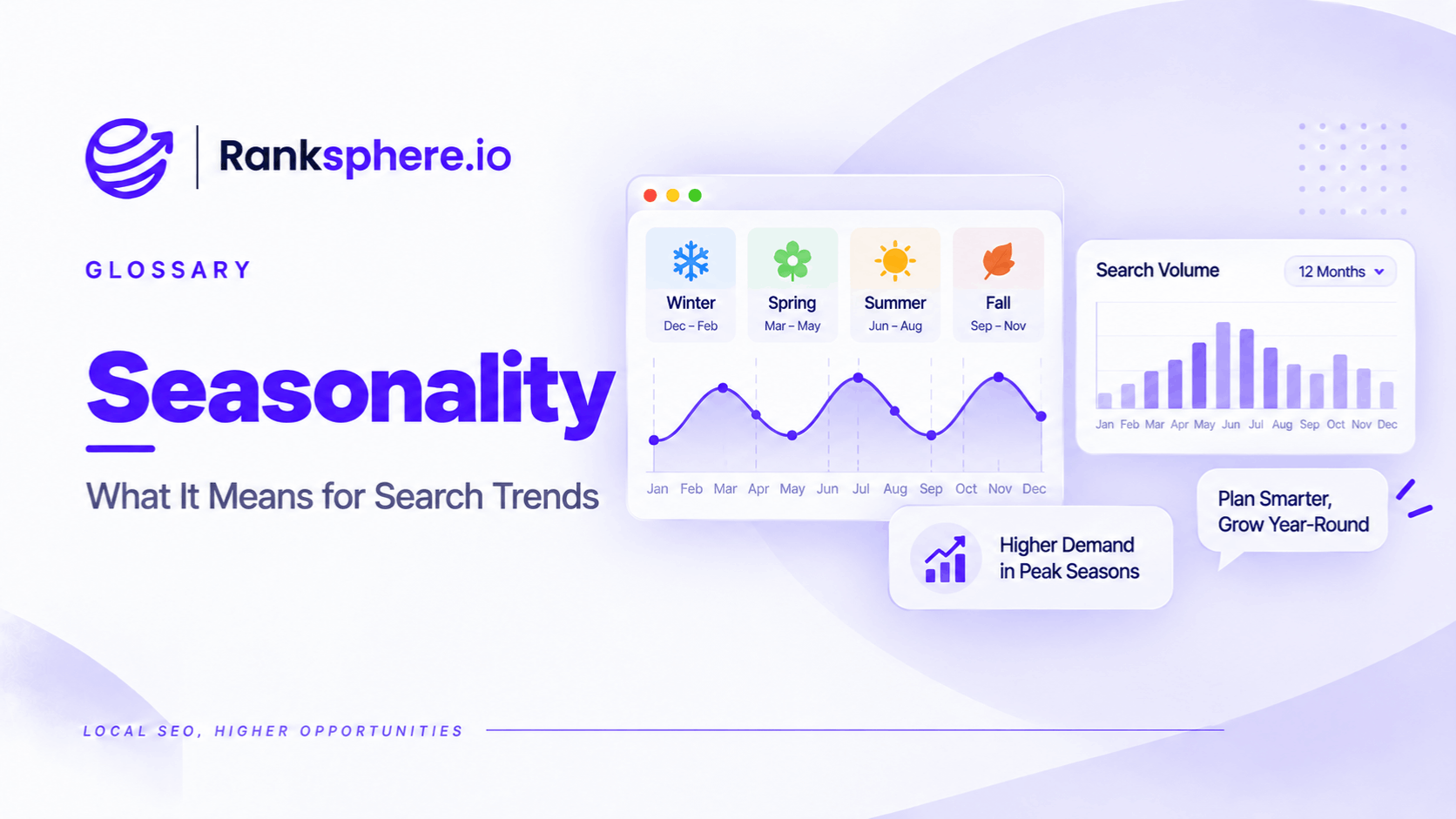
Seasonality in SEO refers to recurring changes in search demand throughout the year. These changes are often influenced by weather, holidays, school terms, financial deadlines, and other predictable events.
For example, searches for air conditioning services may increase during warmer months, while heating repair searches may rise as temperatures fall.
A garden centre might receive significantly more organic traffic in spring and summer than in late autumn.
That doesn't necessarily mean its SEO performance has declined. It may simply reflect fewer people searching for its products during the quieter season.
This is why seasonality matters when evaluating local SEO performance.
A decline in traffic isn't always a decline in search visibility. Sometimes demand has fallen even though the business is ranking just as well.
Understanding the difference helps agencies report more accurately, plan content ahead of demand, and avoid treating normal seasonal changes as SEO problems.
How Does Seasonality Affect SEO?
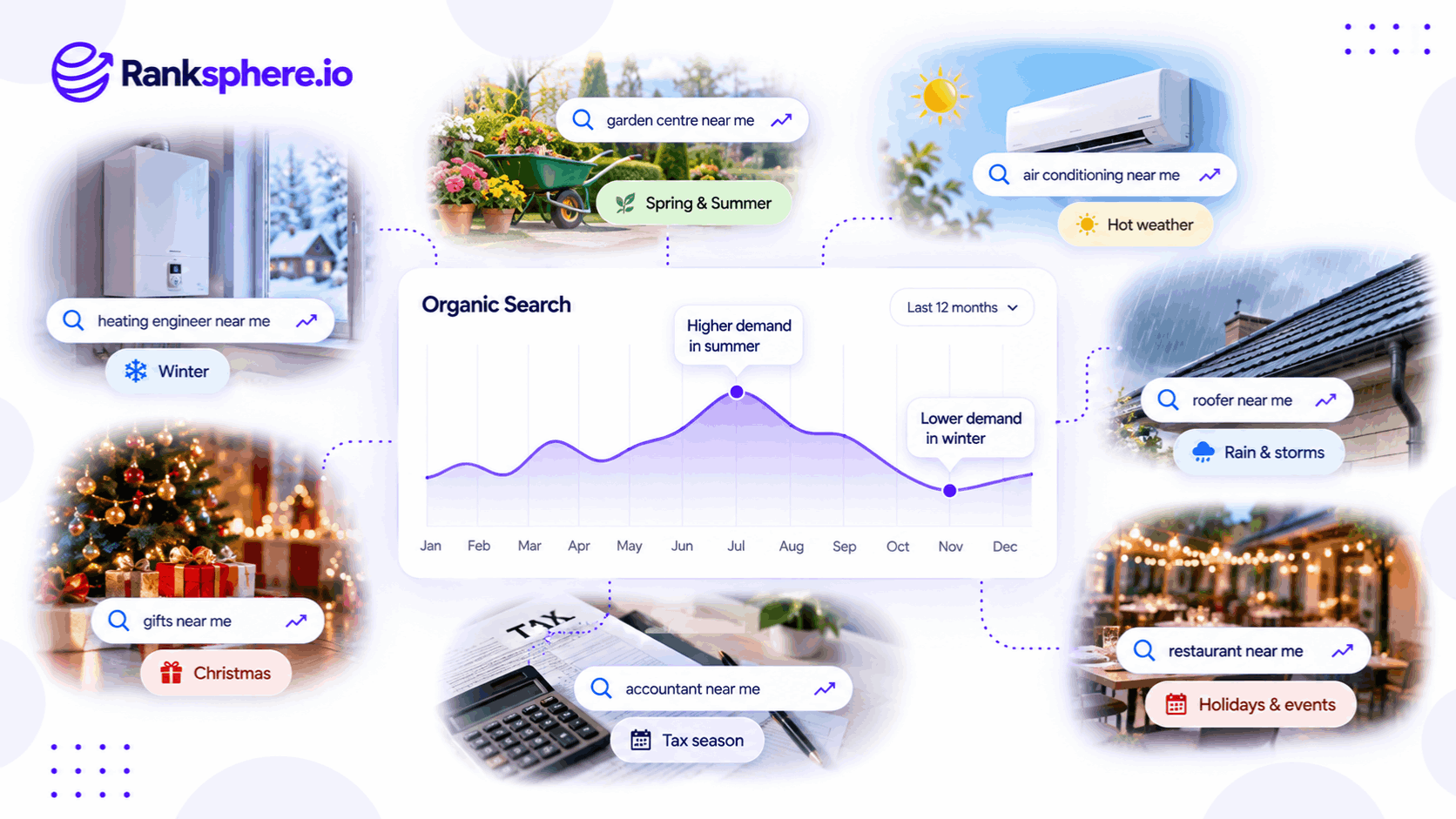
Search demand isn't constant throughout the year.
Some industries experience clear annual patterns, while others respond to weather events, school calendars, holidays, or economic conditions.
These changes can affect:
- Search impressions
- Organic website traffic
- Google Business Profile interactions
- Enquiries and bookings
- Conversion rates
- Advertising costs
- Revenue
For example, a landscaping company may receive fewer enquiries during winter because homeowners are less likely to plan garden projects.
Even if the company's rankings remain stable, its organic traffic may decline.
That is different from a situation where both demand and rankings remain steady but the website loses visibility to competitors.
The first may be ordinary seasonality.
The second needs further investigation.
Common Types of Seasonality in Local SEO
Seasonal patterns vary between industries.
Weather-Driven Seasonality
Some services are closely connected to weather conditions.
Examples include:
- Roofing repairs during periods of storm damage
- Drainage services during heavy rainfall
- Heating repairs during colder months
- Air conditioning services during hot weather
- Landscaping and gardening during spring
- Gutter cleaning during autumn
These patterns can be predictable at a broad level.
However, individual weather events may produce sudden changes that are difficult to forecast.
For example, a severe storm may create a short-term increase in emergency roofing searches outside the usual seasonal pattern.
Holiday-Driven Seasonality
Public holidays and seasonal celebrations can affect customer demand.
For example:
- Restaurants may experience increased demand around certain holidays.
- Retailers may receive more searches before Christmas.
- Hair salons may see changes in appointment demand before major celebrations.
- Hotels may experience peaks during holiday periods.
The timing and strength of these patterns can differ by location and audience.
A business operating in a tourist area may have a different seasonal cycle from a similar business serving mostly local residents.
Calendar-Driven Seasonality
Some industries experience predictable demand linked to the calendar rather than the weather.
Examples include:
- Accountants around tax filing deadlines
- Gyms during January
- Tutors before examinations
- School-related services before a new term
- Financial services around relevant reporting periods
These patterns may repeat each year, although changes in regulations or customer behaviour can affect them.
Event-Driven Demand
Some searches increase around particular events.
For example, veterinary practices may receive more questions about pets and fireworks during local celebrations.
Locksmiths and emergency trades may experience demand changes during holiday periods.
However, not every event-driven spike repeats at the same time or to the same extent.
Counter-Seasonal Businesses
Not every industry becomes busier during summer or December.
Some businesses experience their strongest demand when others are quiet.
For example, heating engineers may be busiest during winter, while landscaping businesses may experience higher demand in spring.
Understanding these differences is useful when planning staff capacity and marketing activity.
Why Month-on-Month SEO Comparisons Can Be Misleading
Month-on-month reporting compares performance with the previous month.
For example, an agency might compare November organic traffic with October.
This can be useful for identifying recent changes.
However, it can be misleading for businesses with strong seasonal demand.
Consider a garden centre.
Organic visits may increase substantially during spring and summer.
By November, traffic may naturally fall because fewer people are searching for gardening products.
Reporting that decline without seasonal context may suggest an SEO problem that doesn't exist.
Why Year-on-Year Comparisons Are Often Better
Year-on-year reporting compares the same period across different years.
For example:
November 2026 vs November 2025
This can provide a more meaningful comparison for businesses with recurring seasonal patterns.
However, year-on-year reporting isn't automatically reliable.
Changes in weather, public holiday dates, competitors, search behaviour, and website performance can still affect the results.
The most useful approach is to review multiple metrics and investigate the reasons behind the changes.
How to Identify Seasonal Search Trends
Before describing a traffic decline as an SEO problem, establish whether the business has a recurring demand pattern.
1. Review Historical Search Console Data
Google Search Console can help identify changes in organic search visibility.
Review:
- Search impressions
- Organic clicks
- Click-through rate
- Average position
- Important queries
- Landing pages
Look for repeated increases and decreases during similar periods.
For example, an air conditioning company may see impressions rise during warmer months across several years.
That pattern suggests demand is contributing to the traffic changes.
However, Search Console alone doesn't measure total market demand.
It reports how the website performs in Google Search.
2. Compare the Same Months Across Years
Review comparable periods.
For example:
- January 2026 vs January 2025
- April 2026 vs April 2025
- November 2026 vs November 2025
This helps identify whether a decline resembles the previous year's pattern.
Where possible, compare more than one year.
A single unusual season can distort the baseline.
3. Check Google Trends
Google Trends can help identify changes in relative search interest over time.
For example, a business can compare interest in searches related to air conditioning repair across different months.
However, Google Trends doesn't provide exact monthly search volumes.
Its data is normalised, and low-volume local queries may not have enough information to display reliable patterns.
Use it alongside Search Console and business data.
4. Review Google Business Profile Performance
For local businesses, Google Business Profile data can provide additional context.
For example, a roofing contractor may see fewer calls during a quiet period.
However, the decline may reflect lower seasonal demand rather than a ranking problem.
Compare available profile performance metrics with historical activity where possible.
5. Compare Search Visibility With Demand
This is an important distinction.
A business may experience lower traffic while its rankings remain relatively stable.
For example:
- Search impressions decline.
- Organic clicks decline.
- Tracked local rankings remain similar.
This pattern may suggest lower search demand.
However, it isn't conclusive.
SERP features, competitors, query changes, and other factors can also affect visibility.
A useful investigation considers all of them.
How to Report SEO Performance Around Seasonality
Seasonality should be part of regular reporting, particularly for industries with predictable demand changes.
Use Year-on-Year Comparisons Where Appropriate
For strongly seasonal businesses, year-on-year comparisons often provide better context than month-on-month figures alone.
For example, compare November traffic with the previous November rather than relying exclusively on October.
However, include month-on-month changes when they help explain recent developments.
Both views can be useful.
Establish a Baseline During Client Onboarding
Seasonality should be discussed during client onboarding.
Before beginning an SEO campaign, review historical traffic and enquiry data.
For example, a landscaping business may experience its quietest months during winter.
If the agency understands that pattern at the start, it can explain seasonal changes before they become a concern.
This also helps set realistic expectations about when demand may increase.
Use Rolling Reporting Periods
A trailing twelve-month view can help businesses evaluate longer-term performance.
This may be particularly useful for metrics such as cost per lead.
For example, a seasonal business may experience a temporary increase in cost per lead during quieter months.
A longer reporting period can help show whether the overall acquisition cost remains commercially reasonable.
However, annual figures shouldn't replace shorter-term monitoring.
Recent problems can be hidden inside a twelve-month average.
Track Geographic Visibility Separately
For local businesses, geo-grid ranking data can help show how visibility changes across the service area.
For example, a business may maintain similar rankings in Google Maps while search impressions decline during a quieter season.
Ranksphere's Local Rank Tracker supports recurring geo-grid scans and historical comparisons, helping businesses review geographic ranking changes over time.
This can provide useful context alongside traffic and enquiry data.
However, rankings and geo-grid coverage aren't immune to seasonal changes.
Competition, relevance, user behaviour, and search result changes can still affect rankings.
They should be monitored rather than assumed to remain stable.
How to Plan SEO Around Seasonal Demand
Understanding seasonality isn't only useful for reporting.
It also helps businesses decide when to publish content, update business information, and prepare for changes in demand.
Publish Seasonal Content Before Demand Peaks
Seasonal content should generally be prepared before the period when customers are most likely to search.
For example, a heating company may benefit from reviewing its boiler maintenance content before autumn.
A landscaping business may want its spring garden preparation guides ready before spring begins.
Publishing early gives search engines time to discover and process the content.
However, there is no guaranteed period required for a new page to rank.
Some pages may gain visibility quickly, while others take longer.
The practical approach is to avoid waiting until demand has already peaked before creating the information customers need.
Review Existing Seasonal Pages
Businesses don't always need new content every year.
For example, a roofing company may already have a useful winter roof maintenance guide.
Instead of creating another similar article, it can review the existing page.
Check whether:
- Information remains accurate
- Relevant services have changed
- Pricing needs updating
- Internal links still work
- Important customer questions are answered
A useful existing page can often be improved rather than replaced.
Update Special Business Hours
Holiday periods can affect when businesses operate.
Google Business Profile business hours should reflect accurate regular and special hours.
For example, a veterinary practice may operate different hours during a bank holiday.
Keeping those details current helps customers understand when services are available.
Prepare Seasonal Google Posts
Businesses can use Google Posts to share relevant updates.
For example, a garden centre might announce seasonal products or changes in opening hours.
A roofing business might share information about winter maintenance services.
However, Google Posts aren't guaranteed to improve local rankings.
Their main purpose is communicating useful business information.
Use Quiet Periods for Foundational Work
Quieter months can be useful for projects that don't require immediate customer demand.
Examples include:
- Technical SEO improvements
- Citation audits
- Updating service pages
- Reviewing website structure
- Content refreshes
- Improving internal links
- Reviewing reporting and conversion tracking
This can help businesses prepare before their busiest periods.
Prepare Seasonal Digital PR
Some industries have recurring seasonal stories that may interest local publications.
For example:
- Winter pipe protection advice from a plumbing company
- Storm preparation tips from a roofing contractor
- Summer pet safety guidance from a veterinary practice
- Garden maintenance advice from a landscaping business
These can create opportunities for digital PR.
However, pitches should contain genuine expertise, useful information, or relevant data.
Seasonal timing alone doesn't make a story newsworthy.
Weather Events and Sudden Search Demand
Some local businesses experience demand spikes caused by specific weather events.
For example:
- Roof repairs after storms
- Drainage services following heavy rainfall
- Heating repairs during sudden cold weather
- Air conditioning repairs during heatwaves
These events can cause sharp increases in search activity.
However, their exact timing and severity may be unpredictable.
Prepare Useful Pages in Advance
An emergency roofing contractor should have an accurate, useful page explaining its emergency repair services before a storm occurs.
That page should cover:
- Services available
- Areas served
- How customers can request help
- Availability and response expectations
- Important safety information
Publishing a new page during an emergency may be too late to benefit from the immediate increase in demand.
However, existing pages still need to accurately reflect what the business can provide.
Use Real Experience in Seasonal Content
A contractor may have useful experience from previous weather-related projects.
For example, a roofing company could explain common storm damage it has repaired, supported by genuine project photographs.
This information can help homeowners understand what to look out for.
It may also provide a basis for relevant local media coverage.
Communicate Timely Business Updates
A business may use its Google Business Profile or website to communicate changes during severe weather.
For example, it might explain temporary opening hours or changes to service availability.
The information should be accurate and updated when circumstances change.
Common Seasonality SEO Mistakes
- Comparing only month on month. A seasonal decline may be normal for the industry.
- Assuming every traffic drop is an algorithm problem. Search demand may have changed.
- Publishing seasonal content too late. Important information should be prepared before demand peaks.
- Ignoring historical performance during onboarding. This can create unrealistic expectations.
- Judging a new SEO campaign only by its first quiet season. A short period may not represent the longer-term trend.
- Assuming rankings never change seasonally. Competition and search behaviour can also affect visibility.
- Removing seasonal pages because recent traffic is low. Useful content may become relevant again.
- Using year-on-year comparisons without context. Weather, holidays, and market changes can still distort results.
- Confusing lower demand with lower visibility. The two require different responses.
During a content audit, seasonal pages should be evaluated using an appropriate timeframe rather than recent traffic alone.
Seasonality SEO Best Practices
To manage seasonal search demand effectively:
- Review historical organic search performance.
- Identify recurring peaks and quieter periods.
- Compare year-on-year results where appropriate.
- Use Google Trends to understand broader search interest.
- Establish seasonal expectations during client onboarding.
- Track local rankings alongside traffic and enquiries.
- Prepare important seasonal content before demand increases.
- Review existing seasonal pages instead of creating duplicates.
- Keep special opening hours accurate.
- Use quieter periods for technical and content improvements.
- Investigate unusual declines rather than assuming they're seasonal.
- Evaluate longer-term performance without ignoring recent problems.
The objective is to distinguish ordinary demand changes from genuine SEO performance issues.
Example of Seasonality in Local SEO Reporting
Consider a hypothetical garden centre that begins working with an SEO agency in August.
The agency starts improving the website, reviewing product pages, and tracking local search visibility.
By November, organic traffic has declined substantially.
The client becomes concerned that the SEO campaign isn't working.
What the Initial Report Shows
The agency's monthly report focuses on traffic changes since August.
Organic sessions are down.
Enquiries have also declined.
Without context, the results appear disappointing.
However, the agency hasn't reviewed the garden centre's historical seasonal demand.
What the Agency Discovers
When the team examines previous years, it notices a recurring pattern.
The business regularly receives more search traffic during spring and summer, followed by a decline during autumn and winter.
The agency also reviews the keywords and pages responsible for the change.
Many of the declining queries relate to seasonal gardening products.
This suggests that lower search demand may explain part of the traffic reduction.
Meanwhile, some local ranking measurements have improved.
The business may therefore be more visible for selected queries even while fewer people are searching.
How the Agency Changes Its Reporting
The team introduces:
- Year-on-year traffic comparisons
- Historical seasonal benchmarks
- Organic search impression trends
- Local ranking comparisons
- Google Business Profile performance
- Relevant enquiry data
It also explains the garden centre's seasonal cycle in regular client reports.
The focus shifts from whether November traffic is lower than August to whether the business is performing better than comparable periods in previous years.
How the Agency Plans Ahead
During winter, the team reviews pages likely to matter during the next spring and summer season.
It updates product information, improves relevant service pages, and prepares useful seasonal content.
The agency also establishes a benchmark report to support future comparisons.
Example Shows
“The traffic decline wasn't automatically evidence that the SEO campaign had failed.
It needed to be evaluated against the business's normal seasonal pattern.
By reviewing historical demand alongside current search visibility, the agency could provide a more accurate explanation of performance.
Seasonality changes how many people are searching. SEO performance determines how effectively a business competes for those searches.
or local businesses, understanding both makes reporting more useful and helps marketing activity align with the times customers are most likely to need their services.”
See Also
- Benchmark Report — Establishing a baseline for evaluating SEO performance.
- Client Onboarding — Setting expectations and collecting historical performance data.
- SERP Volatility — Understanding changes in search rankings and results.
- Cost Per Lead — Measuring acquisition costs over relevant reporting periods.
- Content Strategy — Planning content around customer needs and seasonal demand.
- Geo-Grid Rank Tracking — Measuring local search visibility across geographic areas.