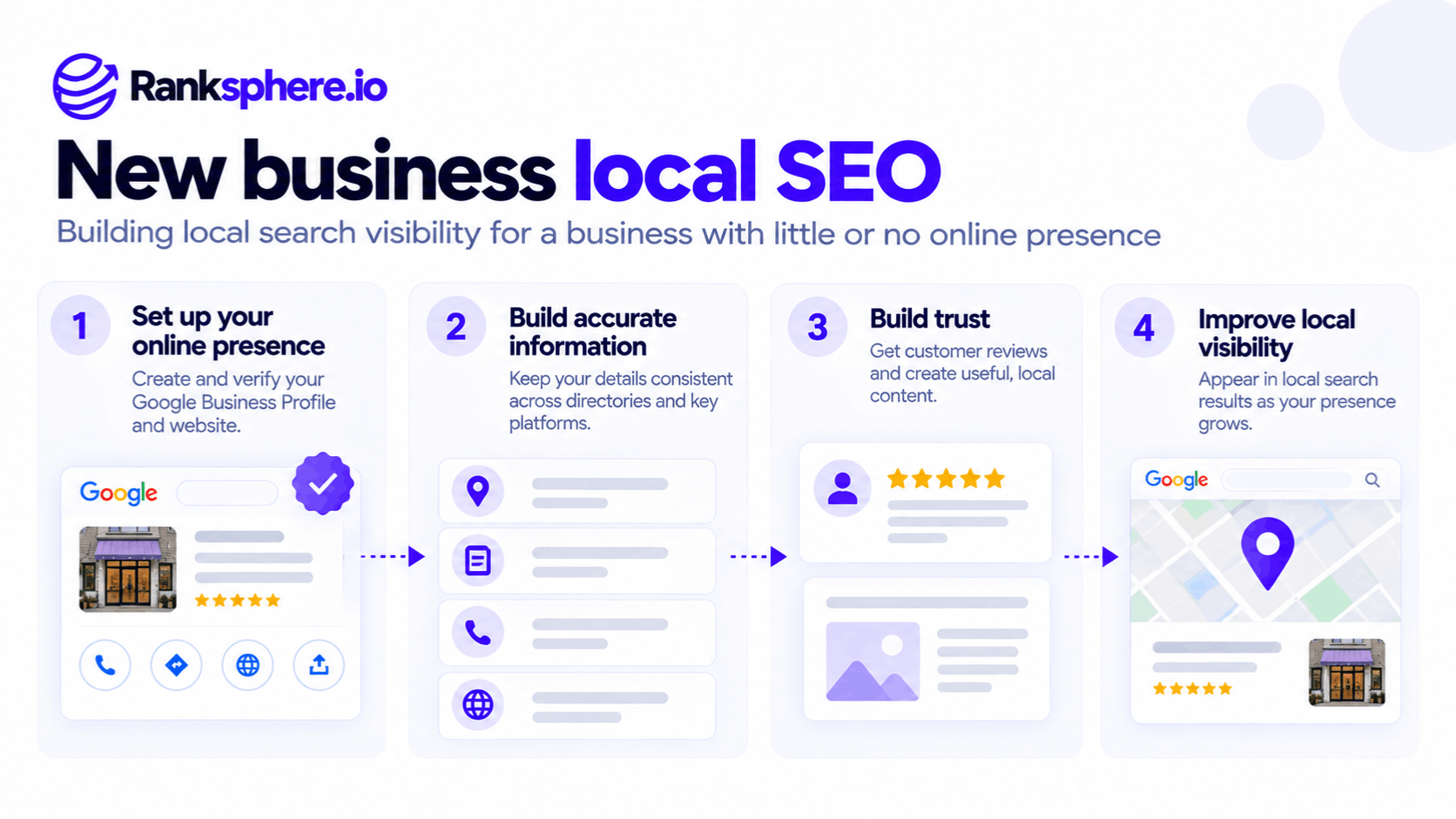
New business local SEO is the process of building local search visibility for a business that has recently opened and has little or no established online history.
Unlike an established business, a new company may have no Google Business Profile, customer reviews, directory listings or search performance data.
That creates a different starting point.
There may be nothing to optimise yet. The business first needs accurate information, a website customers can use and a legitimate presence on the platforms where people search.
For a new business, local SEO begins with establishing the fundamentals, not trying to outrank established competitors immediately.
Why Is Local SEO Different for New Businesses?
Google says local rankings mainly depend on relevance, distance and prominence.
A new business may be relevant to a search and close to the customer, but it often lacks the reviews, links and other information associated with an established competitor.
That can make competitive local rankings difficult initially.
Several challenges are common.
Limited prominence. Established competitors may already have years of genuine reviews, links and local recognition.
Little supporting information. Other websites may not yet mention the business, making its online entity information less established.
Verification requirements. Google may require video verification or another available method to confirm that the business is eligible and managed by an authorised representative.
No performance history. The business has little data for comparing rankings, enquiries or customer interactions.
These challenges don't mean Google imposes a fixed waiting period on new businesses.
They mean some aspects of local visibility take time to develop.
The First Month: Establish the Essentials
A new business should prioritise getting its information correct and making itself accessible to customers.
1. Create and Verify Google Business Profile
For eligible businesses, a Google Business Profile is an important starting point.
Make sure the business meets Google's eligibility requirements before creating one.
Online-only businesses generally aren't eligible. Service-area businesses may qualify when they meet customers in person, but they must follow Google's rules on addresses and service areas.
Google Business Profile verification confirms that the person managing the profile is authorised to represent the business.
Google determines which verification methods are available.
If video verification is required, prepare before recording.
For a storefront business, Google may expect evidence of the location, permanent signage and the ability to manage the premises.
Service-area businesses have different evidence requirements.
A failed verification attempt doesn't necessarily mean the business is ineligible. Google provides instructions for correcting unsuccessful submissions.
2. Use the Real Business Name
The profile name should match the business's genuine real-world name.
Don't add services or locations simply to influence rankings.
For example, a company called "Northfield Plumbing" shouldn't change its profile name to "Northfield Plumbing Best Emergency Plumbers Manchester" unless that genuinely reflects its established business name.
Misleading information can create policy risks, including Google Business Profile suspension.
3. Choose Accurate Business Categories
Select the most specific accurate primary category available.
Then add relevant secondary categories where appropriate.
Google uses business information to understand how well a profile matches a search, so Google Business Profile categories deserve attention.
Don't add categories for services the business doesn't genuinely provide.
4. Complete Important Profile Information
Add accurate opening hours, services, contact details, descriptions, attributes and photographs where supported.
You don't need to fill every optional field simply because it exists.
The priority is to give customers and Google reliable information about what the business actually offers.
5. Publish a Useful Website
A new business should also have a functional website with clear service information.
At minimum, customers should understand what the company offers, where it operates and how to contact it.
Keep the business's name, address and telephone information—commonly called NAP—accurate.
Where appropriate, add LocalBusiness schema using verified information.
Structured data can help describe the business, but it doesn't guarantee rankings or a particular search appearance.
Months Two to Six: Build Local Recognition
Once the basic setup is working, focus on strengthening the business's reputation and making its information available across relevant platforms.
Start Requesting Genuine Reviews
A new business doesn't need to wait months before asking for reviews.
Once customers have had a genuine experience, invite them to leave honest feedback.
Google permits businesses to share review links or QR codes, but prohibits incentives, fake engagement and selectively soliciting positive reviews.
Avoid fake reviews or pressure to achieve a particular rating.
Google confirms that more reviews and positive ratings can help local rankings, but there is no official threshold at which a new business becomes competitive.
Twenty reviews aren't a guaranteed milestone.
Build Relevant Local Citations
After confirming the correct business information, establish listings on platforms customers are likely to use.
These may include Apple Business Connect, Bing Places, relevant local directories and professional registers.
A citation should accurately represent the business.
For some industries, an industry directory or professional register may be more useful than dozens of generic listing websites.
There's no need to submit the business to hundreds of directories simply to increase the citation count.
Develop Genuine Local Relationships
New businesses can earn useful mentions and links through legitimate relationships.
Examples include trade associations, suppliers, community organisations and relevant local publications.
These activities can help customers discover the company and develop its reputation.
They shouldn't be treated as a shortcut to manipulate rankings through black hat SEO.
Improve Service Content
Create or improve pages that answer real customer questions.
For example, a new physiotherapy clinic may need clear pages explaining its treatments, prices, appointment process and practitioner qualifications.
Content shouldn't automatically be postponed until every review and citation task is complete.
A useful website supports customer decisions from the day the business opens.
Ranksphere's Smart Tasks helps turn local SEO findings into prioritised actions, which can be useful when deciding what a new business should address next.
How Long Does Local SEO Take for a New Business?
There is no guaranteed timetable.
Some eligible businesses may become visible for branded searches relatively soon after their profiles are verified and processed.
Competitive non-branded searches can take longer.
The outcome depends on the market, location, relevance, website quality, customer reputation and competing businesses.
Review growth also depends on the number of genuine customer interactions.
A new restaurant serving hundreds of customers each week has different opportunities from a specialist clinic seeing a small number of patients.
Don't assume that reaching a particular review count or star rating automatically unlocks better rankings.
For a business that depends on immediate enquiries, local SEO should be part of a broader customer acquisition plan rather than its only source of demand.
How Should a New Business Measure Progress?
Because there is little historical data, start recording performance as soon as reliable measurements become available.
Track relevant local rankings, website visibility, Business Profile interactions and qualified customer enquiries.
Use consistent keywords and geographic settings when comparing ranking scans.
Early progress may involve successful verification, accurate business information, indexed service pages and genuine customer feedback.
Over time, reporting should shift towards the outcomes that matter to the business.
Common New Business Local SEO Mistakes
- Creating a profile before checking eligibility. Not every business qualifies.
- Adding keywords to the business name. This can violate Google's policies.
- Using an ineligible virtual office or mailbox.
- Buying reviews to look established. Fake engagement can lead to restrictions.
- Building citations before finalising contact details. Incorrect data spreads quickly.
- Creating multiple profiles for different services at one location.
- Waiting too long to publish useful website content.
- Promising rankings within a fixed timeframe. No agency can guarantee them.
New Business Local SEO Best Practices
Establish accurate business information from the beginning.
Verify an eligible Google Business Profile using Google's available process.
Publish useful service pages and make contact details easy to find.
Request genuine customer reviews consistently and develop relevant local listings.
Build relationships that create legitimate opportunities for mentions and links.
Measure visibility and enquiries over time, and adjust priorities according to what the data shows.
Example of Local SEO for a New Physiotherapy Clinic
Consider a hypothetical physiotherapy clinic opening in a competitive city.
The owner expects the practice to appear in Google's top three local results within three months.
However, the clinic has no existing reviews, business listings or search history.
What the Agency Prioritises
The agency first confirms the clinic's eligibility for a Google Business Profile.
When Google requests video verification, the team prepares an unedited recording showing the location, signage and appropriate evidence of management.
The website goes live with accurate treatment information, practitioner details and appointment instructions.
The clinic also begins requesting honest reviews from patients who have received care.
What Happens Next?
Over the following months, the practice establishes relevant directory listings, develops its website content and builds a history of genuine customer feedback.
The agency monitors rankings across the service area.
Some nearby searches may begin showing the clinic more prominently, while competitive searches farther away may remain difficult.
There is no guaranteed point at which the practice reaches the top three.
Example
“The clinic cannot create years of reputation overnight.
But it can establish accurate information, a useful website and a legitimate process for earning customer feedback.
New business local SEO is about building a reliable foundation first, then improving visibility as the business develops.
That approach is slower than promising instant rankings, but it avoids the policy risks and unrealistic expectations that often undermine new business campaigns.”
See Also
- Google Business Profile Verification — Confirming eligibility and management access.
- Review Velocity — Monitoring the pace of genuine customer reviews.
- Citation Building — Establishing accurate business information on relevant platforms.
- Local Ranking Factors — Understanding relevance, distance and prominence.
- Google Business Profile Suspension — Avoiding policy violations and profile restrictions.
- Local SEO — Improving visibility in geographically relevant searches.