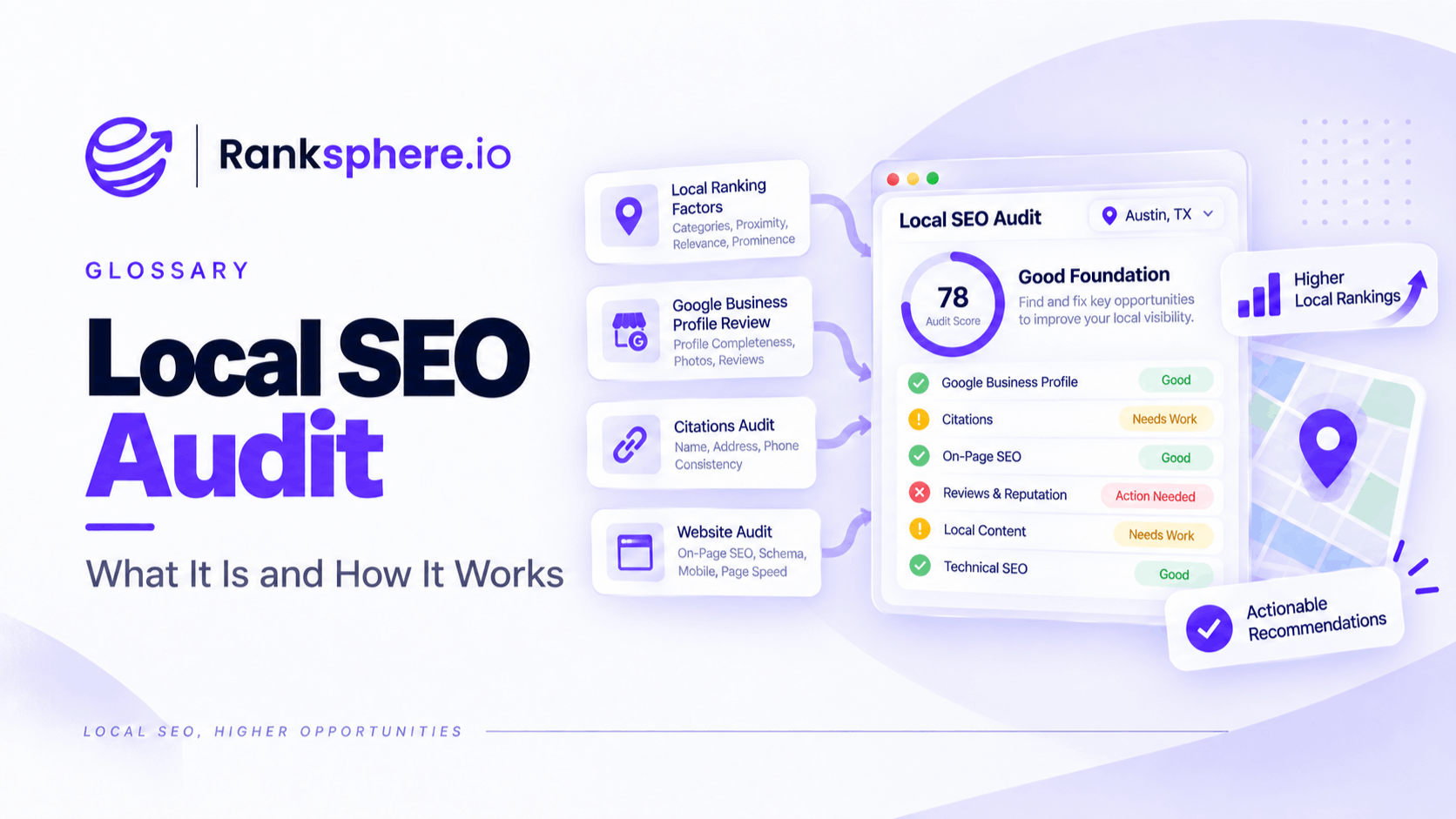
A local SEO audit is a structured review of the factors affecting a business's visibility in local search.
It typically examines areas such as:
- Google Business Profile
- Local rankings
- Reviews
- Citations
- Website performance
- Local landing pages
- Competitors
- Conversion tracking
The purpose is not to produce the longest possible list of problems.
It is to identify which issues are most likely to matter, which should be addressed first and how progress will be measured afterwards.
A useful local SEO audit should leave the business with a clear action plan.
Not a 100-page document full of warnings nobody knows how to prioritise.
What is a local SEO audit?
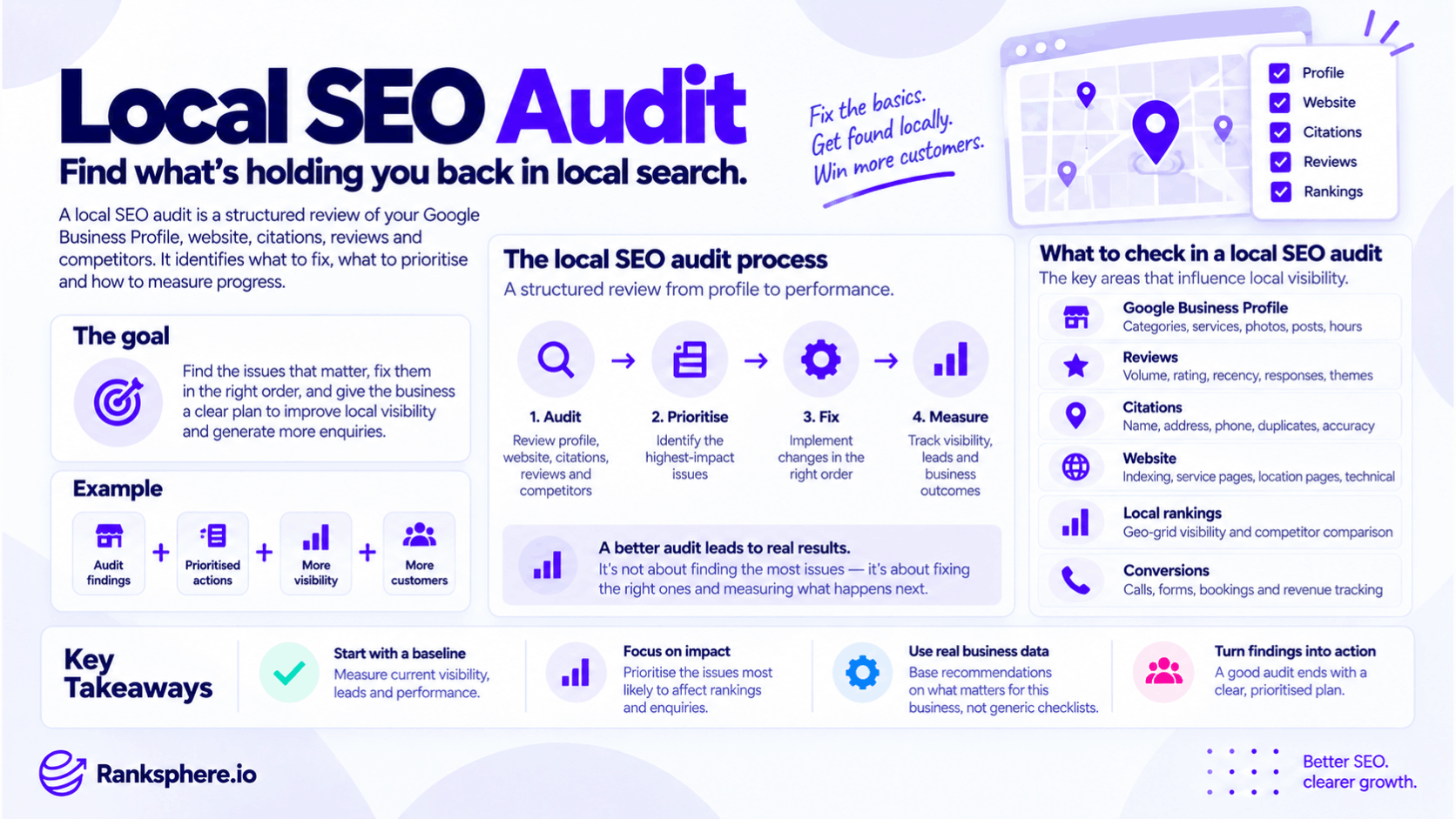
A local SEO audit evaluates how well a business is set up to compete in Google's local and organic search results.
For a local business, that usually means looking at both:
Google's local ecosystem
and:
the website itself.
The audit may examine:
- Google Business Profile
- Local pack visibility
- Website indexing
- Service and location pages
- Reviews
- Citations
- Competitor visibility
- Technical SEO
- Conversion measurement
The exact scope should depend on the business.
A single-location dentist does not need the same audit as a 70-location retailer.
Start with a baseline
Before changing anything, record where the business currently stands.
Without a baseline, it becomes difficult to answer:
Did the work actually improve anything?
This should usually happen during or immediately after client onboarding.
Useful baseline data can include:
- Geo-grid rank tracking for priority local searches
- Google Business Profile performance
- Review count and rating
- Organic clicks and impressions
- Qualified leads or bookings where measurable
- Important page rankings
- Conversion data
- Current citation accuracy
Use enough historical data to understand the business.
Twelve months can be useful where seasonality matters, but it should not be treated as a requirement.
A new business may not have twelve months of data.
Baseline local visibility
A local SEO audit should not rely on one ranking checked from one location.
Local results vary geographically.
A grid scan can reveal:
- Where the business appears strongly
- Where visibility falls away
- Which competitors dominate particular neighbourhoods
- Whether proximity appears to be influencing results
This gives the audit geographic context.
For example:
“Rank 3 for dentist”
is much less informative than:
“Top-three visibility across 17 of 49 tracked points, with the strongest coverage close to the practice.”
Baseline business outcomes
Rankings are not enough.
Where possible, also record:
- Calls
- Enquiries
- Bookings
- Qualified leads
- Revenue
That gives the audit a commercial baseline.
A business can improve rankings without increasing enquiries.
Likewise, it can generate more business even when one ranking metric barely changes.
Local SEO should ultimately connect visibility with customer behaviour.
Google Business Profile audit
For many local businesses, the Google Business Profile deserves close attention because it supplies important information used across Google Search and Maps.
Review whether the profile accurately represents the real business.
Primary category
Check the primary Google Business Profile category.
Ask:
Does this accurately describe the core business?
The primary category can be highly relevant to which local searches the profile is considered for.
But do not change it simply because a competitor uses something different.
The correct category is the most accurate category for the business itself.
Secondary categories
Check whether appropriate secondary categories are missing.
Secondary categories can describe additional genuine aspects of the business.
Do not add every remotely relevant option.
More categories do not automatically mean more visibility.
Use only categories that accurately represent what the business does.
Business name
The Google Business Profile name should reflect the business's real-world name.
Do not add:
- Services
- Cities
- Keywords
- Promotional language
unless they genuinely form part of the name the business uses in the real world.
For example:
Smith Plumbing
should not become:
Smith Plumbing Emergency Plumber Boiler Repair Manchester
simply for SEO.
That kind of manipulation can breach Google's profile guidelines and may create enforcement risk.
Services
Check whether the services listed accurately reflect what the business provides.
Missing services may make the profile less complete for both:
- Customers
But do not list services the business does not actually offer.
Profile completeness should never come at the expense of accuracy.
Products
Products may be relevant for certain business types.
If they genuinely apply, check that:
- Information is current
- Descriptions are useful
- Links still work
Do not populate product sections simply because the field exists.
Opening hours
Review:
- Standard hours
- Holiday hours
- Temporary changes
Incorrect hours can create immediate customer problems.
This is particularly important for:
- Clinics
- Restaurants
- Shops
- Emergency services
A local SEO audit should check accuracy, not just whether the fields are filled.
Attributes
Attributes can give customers useful information about the business.
Depending on category, these may relate to:
- Accessibility
- Service options
- Amenities
- Payment methods
Only use attributes that genuinely apply.
Business description
The description should accurately explain:
- What the business does
- Who it serves
- Important services
It should not be treated as an excuse for keyword stuffing.
Write for customers first.
Photos
Check whether the profile has useful, recent photography.
That may include:
- Exterior
- Interior
- Team
- Completed work
- Products
- Logo
Photo count alone is not a useful optimisation target.
A competitor having 500 photos does not mean you need 501.
Look at:
- Relevance
- Quality
- Recency
- Authenticity
Google Posts
Google Posts can be reviewed as part of the profile.
They may be useful for:
- Offers
- Events
- Updates
- Announcements
But posting frequency should not be treated as a direct ranking formula.
If the business has something useful to communicate, use Posts.
Do not publish filler purely because an audit checklist says one post per week.
Storefront vs service-area business
Check whether the business is correctly represented as:
- Storefront
- Service-area business
- Hybrid business where eligible
A service-area business that does not receive customers at its address should not display that address simply to create a stronger-looking local presence.
The setup should reflect how the business genuinely operates.
Review audit
Reviews affect both customer decisions and Google's understanding of local prominence.
An audit should look beyond the headline rating.
Check:
- Total review count
- Average rating
- Recent review activity
- Response patterns
- Recurring themes
- Review-request process
Review velocity can be useful for understanding how consistently new feedback arrives.
But do not interpret it as:
“You need exactly X reviews per month to rank.”
Google publishes no such threshold.
Compare review performance with competitors
Competitive context can be useful.
Suppose:
Your business: 72 reviews
Competitor A: 85 reviews
Competitor B: 620 reviews
The useful conclusion is not automatically:
Get 548 more reviews.
Instead ask:
- How consistently are customers reviewing each business?
- What do reviews mention?
- Are competitors strongly associated with particular services?
- Does your business have a working review-request process?
The goal is a sustainable stream of genuine feedback.
Check for review gating
Review-generation processes should comply with platform rules.
See review gating.
Be cautious with systems that:
- Ask customers privately whether they had a good experience.
- Send only satisfied customers to Google.
- Divert unhappy customers elsewhere.
A compliant review programme should not selectively encourage only positive reviewers.
Read the reviews
Do not only count them.
Review text can reveal how customers describe the business.
For example, customers may repeatedly mention:
- Emergency appointments
- Dental implants
- Same-day repairs
- Friendly staff
- Rabbit care
Those patterns can reveal:
- Customer priorities
- Service associations
- Problems
- Content opportunities
Reviews are useful customer research as well as reputation data.
Citation audit
Citations are third-party references to a business's core information.
A citation audit should focus on important sources rather than trying to make every directory on the internet identical.
Review:
- Business name
- Address
- Phone number
- Website
- Status
The underlying information should be accurate.
Minor formatting differences are usually less important than genuine contradictions.
Search old business information
Do not search only for the current:
- Name
- Phone number
- Address
Also check historical information.
For example:
- Previous addresses
- Old phone numbers
- Former business names
These searches can uncover legacy listings that would otherwise be missed.
This is particularly important after:
- Relocation
- Rebranding
- Acquisition
- Phone-number changes
Duplicate listings
Duplicate listings deserve investigation.
But not every apparent duplicate is equally serious.
Ask:
- Is it actually the same business?
- Is the old listing still live?
- Does it contain incorrect information?
- Does it represent a former location?
- Is Google treating both as separate entities?
A duplicate creating real confusion may deserve urgent attention.
A harmless listing on an obscure directory may not.
Priority depends on impact.
NAP accuracy
A local SEO audit should check important NAP information.
But do not spend hours changing:
Road
to:
Rd
if both clearly refer to the same real address.
Focus on meaningful contradictions such as:
- Wrong phone numbers
- Old addresses
- Incorrect business names
Accuracy matters more than character-for-character formatting.
Website indexing
One of the first website questions should be:
Can Google index the pages that matter?
Check important pages for problems involving:
- noindex
- Canonicalisation
- Robots directives
- Redirects
- Crawlability
See indexing.
An accidental noindex on a major service page can be far more important than dozens of minor Google Business Profile improvements.
This is why audit priorities should be based on impact rather than a fixed checklist order.
Search Console
Review Search Console for issues such as:
- Important pages losing clicks
- Relevant queries gaining or losing visibility
- Unexpected indexing problems
- Pages competing for similar intent
Exporting historical data can be useful where deeper analysis is required.
But the audit should interpret the data rather than simply attaching a spreadsheet.
Service pages
Review important service pages.
Ask:
- Is the service explained clearly?
- Does the page satisfy the search intent?
- Is there enough useful detail?
- Does it show genuine experience?
- Is there a clear next action?
Do not judge pages by word count alone.
A 700-word page can be excellent.
A 3,000-word page can still be poor.
Location pages
Review location pages carefully.
For real branches, check whether each page contains accurate branch-specific information.
For service-area pages, look for genuine local value rather than templates that simply replace:
Manchester
with:
Liverpool
across dozens of pages.
Useful local details might include:
- Projects
- Service information
- Coverage details
- Genuine local examples
Avoid inventing local offices or addresses.
LocalBusiness schema
Check whether LocalBusiness schema is:
- Valid
- Accurate
- Appropriate
Structured data can help describe the business.
It does not create local rankings by itself.
Check that important information such as:
- Business name
- Address
- Telephone
- URL
accurately reflects the real business.
Title tags
Review important title tags.
Look for:
- Missing titles
- Duplicates
- Unclear topics
- Keyword stuffing
- Titles that no longer match page intent
A local service title should usually tell the searcher:
- What the page is about
- Where relevant, which location it serves
without becoming a string of keywords.
Internal linking
Internal links help users and search engines understand the relationship between pages.
Check whether important:
- Service pages
- Location pages
- Guides
are properly connected.
Watch for orphan pages that have few or no meaningful internal links.
Do not add links simply to increase link count.
Use them where they help someone navigate logically.
Mobile usability
Local search happens heavily on mobile, so test important pages on real mobile layouts.
Look for problems such as:
- Contact buttons hidden
- Phone numbers difficult to tap
- Forms hard to complete
- Intrusive overlays
- Poor navigation
Mobile problems can reduce leads even when rankings are strong.
Core Web Vitals
Core Web Vitals can form part of the technical review.
But avoid treating every failed Lighthouse score as a top local SEO emergency.
Use real-user field data where available and prioritise performance problems that genuinely affect:
- User experience
- Important pages
Technical perfection is not the objective.
Conversion tracking
A good local SEO audit should also examine measurement.
Check whether the business can actually track:
- Forms
- Calls
- Bookings
- Important Google Business Profile interactions
Otherwise, the agency may improve visibility without being able to show whether it helped the business.
This is especially important before agreeing KPIs.
Competitor analysis
A competitor analysis should be based on businesses actually appearing in search.
Do not rely only on the client's commercial competitor list.
Grid data may reveal completely different businesses competing across the target area.
Review competitors by:
- Keyword
- Geography
- Search surface
Local pack competitors can differ from organic competitors.
Compare what competitors do differently
Useful areas to compare include:
- Categories
- Reviews
- Service coverage
- Location pages
- Website quality
- Links
- Citations
But do not assume every difference explains the ranking.
A competitor may also have a geographic advantage because it is physically closer to the searcher.
Competitor analysis identifies plausible opportunities.
It does not reveal Google's ranking formula.
Prioritising local SEO audit findings
A good audit usually discovers more issues than the business can address immediately.
Prioritisation is therefore part of the deliverable.
Score findings using factors such as:
Impact
How much could fixing this matter?
Urgency
Is it actively harming customers or search visibility?
Confidence
How confident are we that this is genuinely a problem?
Effort
How difficult or expensive is it to fix?
This produces a much more useful roadmap than:
Critical: 37
Warning: 94
Notice: 152
High-impact urgent issues
Examples may include:
- Important page accidentally set to noindex
- Incorrect Google Business Profile category
- Wrong phone number
- Business incorrectly marked closed
- Broken location page
- Major duplicate profile causing confusion
These often deserve immediate attention.
The exact priority depends on the business.
High-impact strategic work
Other improvements take longer.
Examples might include:
- Weak service pages
- Poor location-page strategy
- Review-generation process
- Citation cleanup
- Important technical restructuring
- Relevant link acquisition
These belong on a roadmap rather than a same-day checklist.
Ongoing work
Some areas are processes rather than fixes.
Examples include:
- Review acquisition
- Content improvements
- Profile maintenance
- Link building
- Competitor monitoring
- Reporting
An audit should make that distinction clear.
Otherwise, the client may expect something like:
“Reviews fixed”
to be completed once and disappear from the plan.
Low-priority findings
Technical audit tools can produce dozens or hundreds of warnings.
Some may matter.
Others may have almost no practical impact.
For example, a tiny local site may not need immediate attention on every:
- Minor HTML warning
- Low-impact redirect chain
- Cosmetic schema recommendation
Do not ignore technical findings.
Prioritise them according to real impact.
Smart Tasks and audit prioritisation
Ranksphere's smart tasks turn audit findings into a prioritised list by impact, helping turn audit data into a practical sequence of work rather than an overwhelming collection of warnings.
That distinction matters.
An audit only creates value when someone knows what to do next.
The audit should produce actions
Every important finding should answer:
What is wrong?
Why does it matter?
What should we do?
How much effort will it take?
How will we know whether it helped?
For example:
Finding
Dental implant page has noindex.
Impact
High.
Action
Remove unintended indexing restriction and request recrawl.
Effort
Low.
Measurement
Confirm indexing, then monitor impressions, clicks and relevant rankings.
That is much more actionable than:
Indexability warning detected.
Prioritise the top five
A useful audit can still contain detailed appendices.
But the executive summary should normally make the highest-priority actions obvious.
For example:
1. Fix accidental noindex on implant service page
2. Correct Google Business Profile primary category
3. Resolve duplicate legacy profile
4. Improve review-request process
5. Strengthen implant service content and internal links
The client should not need to read 50 pages to understand what happens first.
Local SEO audit tools vs human analysis
Tools are useful for collecting:
- Ranking data
- Technical errors
- Indexing information
- Citation information
But an automated tool cannot always determine:
- Which service is most profitable
- Whether a category accurately reflects the business
- Whether a page answers customer questions well
- Whether a competitor's approach should be copied
The tool identifies evidence.
The auditor still has to interpret it.
Common local SEO audit mistakes
- Treating Google Business Profile as automatically more important than every website issue.
- Starting changes before establishing a baseline.
- Checking rankings from only one location.
- Changing the primary category simply because a competitor uses another one.
- Treating review velocity as a fixed Google ranking formula.
- Obsessing over harmless NAP formatting differences.
- Treating every duplicate citation as an emergency.
- Ignoring old addresses, names and phone numbers.
- Reviewing service pages only by word count.
- Publishing templated location pages with little genuine local value.
- Treating schema as a local ranking shortcut.
- Prioritising every technical warning equally.
- Auditing without competitor context.
- Producing an exhaustive problem list without telling the client what to fix first.
- Ignoring conversion tracking.
- Making changes without recording the original state.
Local SEO audit best practices
- Establish the baseline before making changes.
- Track local rankings geographically rather than from one point only.
- Include leads and business outcomes where possible.
- Check both Google Business Profile and website fundamentals.
- Prioritise according to impact rather than following a fixed audit order.
- Use the most accurate Google Business Profile categories.
- Review the quality and sustainability of the review process.
- Search for historical NAP information as well as current details.
- Confirm important pages are crawlable and indexable.
- Review service and location pages against real search intent.
- Use competitor data for context without copying competitors blindly.
- Separate urgent fixes from long-term work.
- Show impact, effort and next action for important findings.
- Keep the executive action list short enough to use.
- Re-audit after major migrations, relocations, rebrands or substantial site changes.
- Review established local SEO foundations periodically rather than assuming they remain correct forever.
Example
“Bracken Hill Dental receives a local SEO audit containing 46 pages.
The report includes:
- Image compression warnings
- Heading recommendations
- Schema notices
- Hundreds of technical checks
Almost everything is technically documented.
Almost nothing is prioritised.
The practice does not know where to start.
The audit is rebuilt around the business's actual local-search problems.
A baseline is established using:
- Geo-grid visibility
- Google Business Profile data
- Search Console
- Review performance
- Lead tracking
Five important issues emerge.
The Google Business Profile category setup does not accurately reflect the practice's current positioning.
Several important services are poorly represented.
An old profile from a previous location is still active and needs investigation.
The practice has no consistent process for requesting reviews.
Most importantly, the dental implant page contains an accidental noindex directive and cannot appear normally in Google's index.
The work is prioritised.
The indexing problem is addressed immediately.
The profile is corrected where the existing setup is genuinely inaccurate.
The legacy listing is resolved through the appropriate process.
The review workflow becomes ongoing work rather than a one-time fix.
The service page is then improved once it can actually be indexed.
Future grid scans use the same settings as the original baseline so visibility changes can be compared properly.
The difference between the two audits is not that the second one found more problems.
It found fewer problems that mattered more.
That is what a local SEO audit should do:
establish where the business stands, identify the issues most likely to hold it back and turn those findings into a prioritised plan that can actually be implemented and measured.”
See also
- Client onboarding — establishing access, expectations and the starting baseline
- Google Business Profile — a major part of local-search visibility
- Citation audit — reviewing important third-party business information
- Competitor analysis — understanding who actually competes in local search
- Local ranking factors — the broader context behind local visibility
- Geo-grid rank tracking — measuring geographic local-search performance