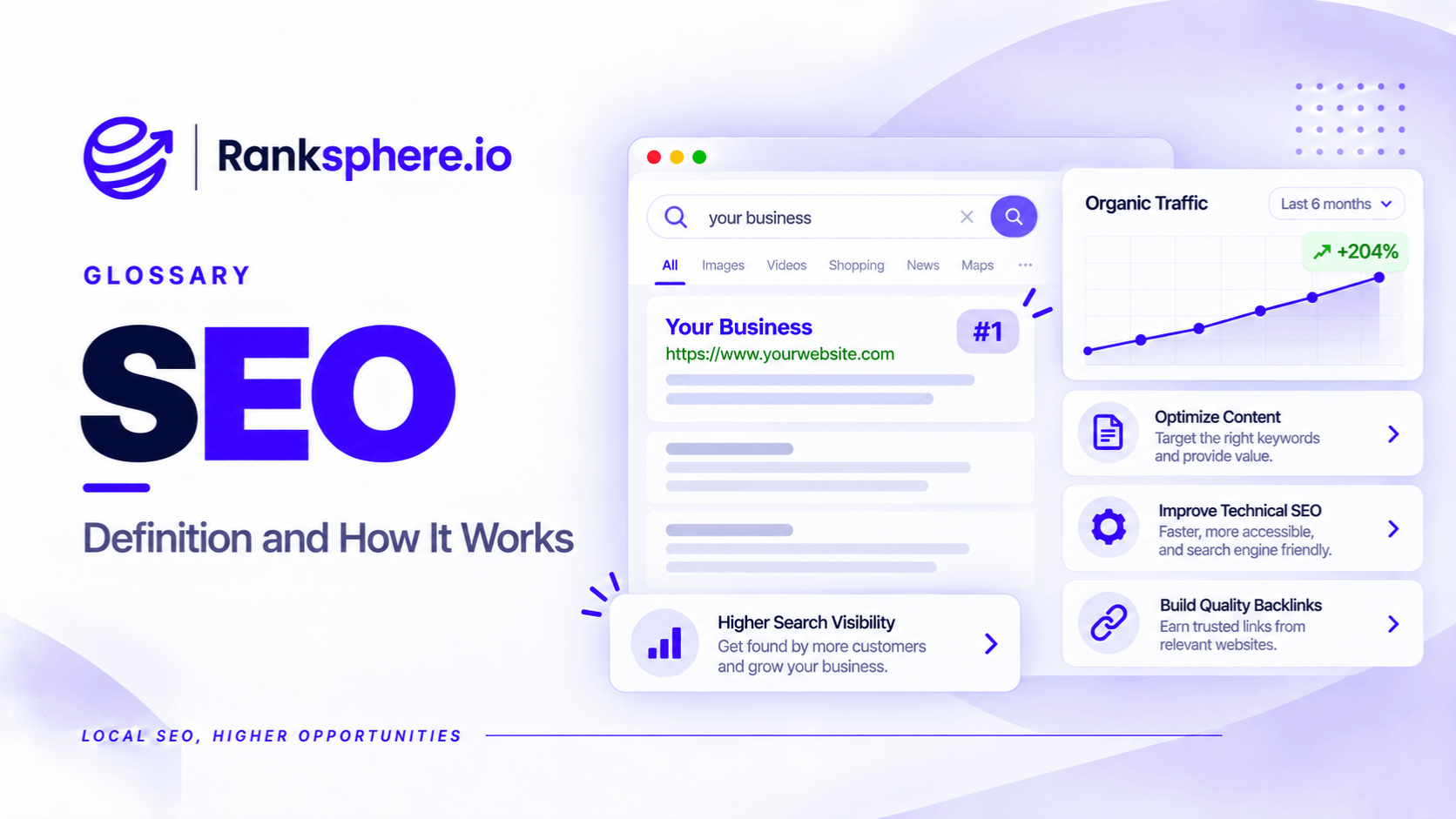
SEO (search engine optimisation) is the process of improving a website's visibility in unpaid search engine results.
It helps search engines discover and understand your content while making it easier for potential customers to find your business.
For example, a roofing company may use SEO to improve its visibility when someone searches for "roof repairs in Bristol."
SEO traditionally covers three main areas: on-page SEO, technical SEO and off-page SEO. For businesses serving specific geographic areas, local SEO adds another important set of activities.
For a local business, SEO isn't just about getting more website visitors. It's about being found by the right people and turning that visibility into enquiries, bookings and customers.
A business may receive calls directly through Google Maps without anyone visiting its website. Those interactions matter, even when they don't appear in organic website traffic reports.
What Are the Main Types of SEO?
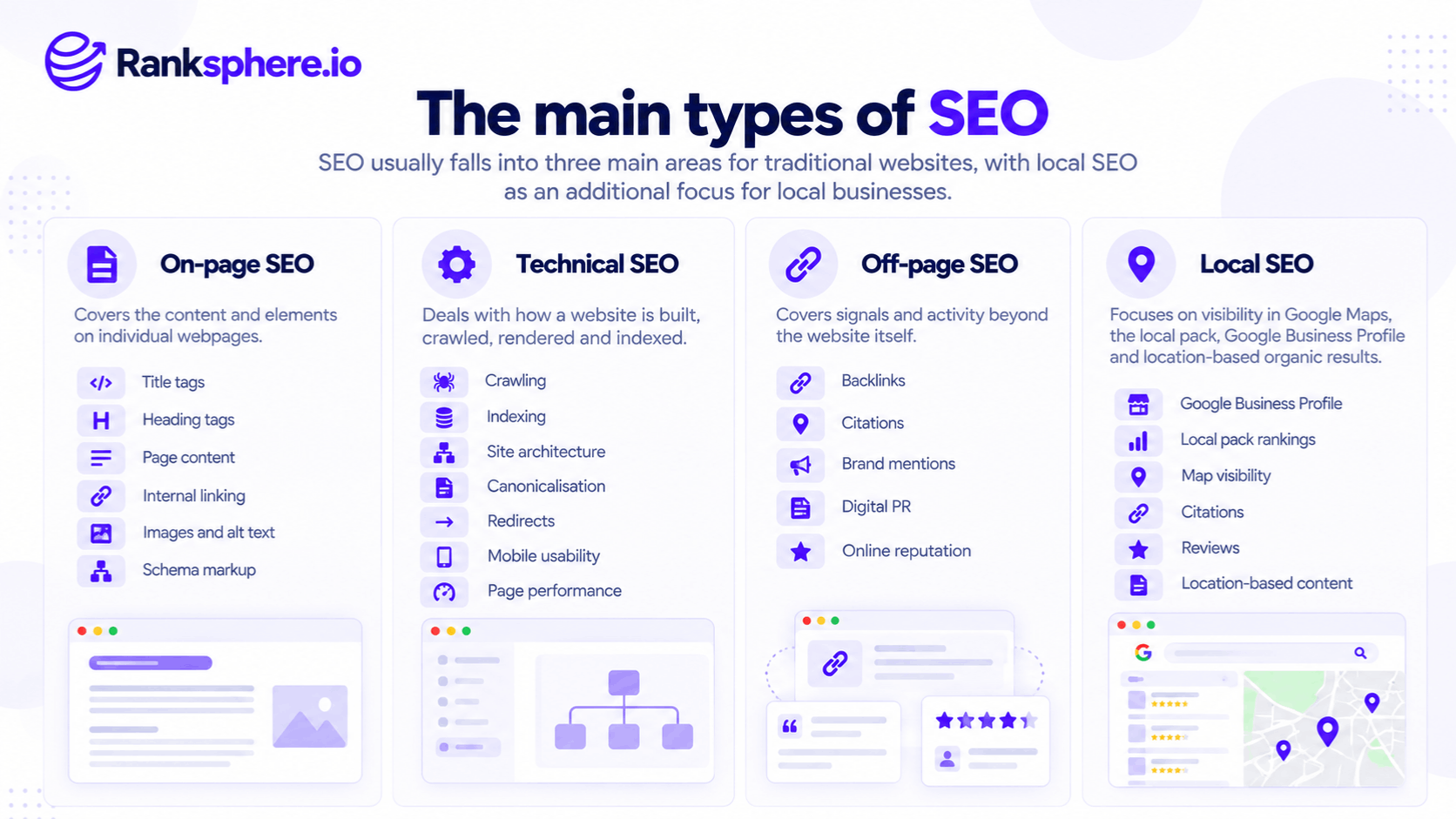
SEO is commonly divided into three areas, with local SEO often treated as a fourth specialism.
1. On-Page SEO
On-page SEO focuses on improving the content and elements of individual webpages.
It includes writing useful content, organising information clearly and helping search engines understand what each page covers.
Common elements include title tags, heading tags, internal linking and schema markup.
For example, a dental implant service page should explain the treatment, who it may be suitable for, what patients can expect and how to arrange a consultation.
Simply repeating "dental implants" throughout the page isn't a substitute for useful information.
2. Technical SEO
Technical SEO focuses on whether search engines can access, process and understand a website.
It covers areas such as:
- Crawling and indexing
- Website performance and mobile usability
- Redirects and canonical URLs
- Internal website structure
- Structured data
For example, a plumbing company's emergency service page might contain excellent information but accidentally have a noindex directive.
Until that issue is corrected, Google won't index the page while the directive applies.
Technical SEO helps resolve problems that prevent useful content from being discovered or displayed correctly.
3. Off-Page SEO
Off-page SEO involves activities outside your own website that can affect its visibility and reputation.
These may include earning relevant backlinks, maintaining business citations, and gaining legitimate brand mentions.
For example, a veterinary practice might be mentioned and linked to by a local animal rescue organisation.
That link can help people discover the practice and may contribute to how search systems evaluate the page.
However, buying links or creating artificial mentions solely to manipulate rankings can violate Google's spam policies.
4. Local SEO
Local SEO focuses on improving a business's visibility for searches connected to a particular location.
It includes traditional website SEO, but also involves managing information and reputation across Google Search, Maps and relevant local platforms.
For example, a dental practice may want to appear when someone searches for "dentist near me."
Its website matters, but so does its Google Business Profile, along with its relevance, location and reputation.
Local SEO is particularly important for shops, restaurants, clinics, tradespeople and other businesses serving defined geographic areas.
How Does Local SEO Work?
Google says local search rankings are mainly based on three factors.
Relevance is how closely a business matches someone's search.
Distance considers how far the business is from the searcher or the location associated with their query.
Prominence concerns how well-known or established the business is, including information Google finds across the web.
These factors help determine which businesses appear in Google Maps and the local pack.
This is why a business may rank well near its premises but appear lower in results several miles away.
Google also confirms that more reviews and positive ratings can help local rankings.
However, it doesn't publish a formula that guarantees a particular ranking improvement from reviews, profile changes or backlinks.
A complete Business Profile can help Google understand a business, but completing every field doesn't guarantee a top-three position.
What Does SEO Involve for a Local Business?
The right priorities depend on the business's existing problems.
A practical starting point is to check the fundamentals before investing in more content or link building.
Review Google Business Profile
Check whether the profile is verified, accurate and eligible.
Review the business name, opening hours, services, attributes, photographs and business categories.
Incorrect categories or missing information may make it harder for Google and customers to understand the business.
Manage Customer Reviews
Encourage genuine customer feedback and respond appropriately.
Reviews can help people evaluate a business, while Google confirms that review count and ratings can influence local rankings.
Avoid incentives, fake reviews and selectively requesting positive feedback.
Check Local Citations
Make sure important directories display accurate business information.
For example, an old telephone number or address may confuse customers.
Not every minor citation inconsistency requires urgent action. Prioritise inaccurate information on relevant, widely used platforms.
Improve Service and Location Pages
Create clear pages explaining what the business offers and where it operates.
A roofer serving several towns might need useful service-area information, but shouldn't create dozens of near-identical pages simply to target location keywords.
Fix Technical Problems
Check whether important webpages are accessible and eligible for indexing.
If a page is blocked, broken or redirected incorrectly, address the technical issue before expanding its content.
Expand Content and Earn Relevant Links
Once the fundamentals are in place, identify useful content opportunities and relevant websites that might legitimately reference the business.
The order isn't universal.
A business with a suspended profile needs a different plan from one with excellent profile information but a website Google cannot index.
Ranksphere's Smart Tasks helps turn local SEO findings into actionable improvements, making it easier to identify what needs attention.
How Has SEO Changed?
The purpose of SEO remains helping people find useful information, but search results and the way people discover businesses have evolved.
Search Engines Understand More Than Keywords
Modern semantic search systems evaluate meaning and context rather than relying only on exact keyword matches.
Keywords still matter, but repeating them excessively doesn't make content more useful.
Search Results Include More Features
A modern SERP may contain paid advertisements, local results, videos and AI Overviews.
As a result, traditional organic webpage listings aren't the only way a business can become visible.
Visibility Doesn't Always Produce a Website Click
In a zero-click search, someone finds enough information in the search results without opening a webpage.
For example, they might check a restaurant's opening hours or call a business from its profile.
These interactions may have business value even though they don't generate website sessions.
Businesses Are Represented Across Multiple Sources
Search engines and AI systems can use information about identifiable entities, including organisations and places.
This makes accurate, consistent business information important.
However, it doesn't mean traditional webpages have become irrelevant or that entity mentions guarantee inclusion in AI-generated answers.
What SEO Is Not
SEO is often misunderstood.
It isn't a one-time task that permanently secures rankings. Competitors, customer behaviour and search systems can change.
It also isn't about manipulating search engines through deceptive techniques. Practices associated with black hat SEO can violate search engine spam policies.
SEO results aren't guaranteed, and no agency can promise a particular Google ranking.
Nor is SEO the same as paid advertising.
For example, Local Services Ads are paid placements, not organic rankings.
Finally, SEO doesn't always take a fixed number of months. Some corrections may affect visibility relatively quickly, while competitive improvements can take considerably longer.
How Should Businesses Measure SEO Success?
Rankings and traffic are useful, but they don't tell the whole story.
For a local business, reporting should also consider qualified enquiries, bookings and other meaningful outcomes.
Depending on the business, useful measures may include organic search clicks, Google Business Profile interactions, local ranking coverage and actual customer enquiries.
A phone call interaction isn't necessarily a completed enquiry, and better rankings don't automatically mean more customers.
The most useful reporting connects search visibility with business outcomes wherever reliable measurement is available.
Common SEO Mistakes
- Focusing only on website traffic. Local customers may contact a business directly through Google Maps.
- Ignoring Business Profile accuracy. Incorrect information can affect discoverability and customer decisions.
- Publishing content before fixing critical indexing issues. Useful pages need to be accessible.
- Expecting guaranteed rankings. No supplier controls Google's ranking systems.
- Buying low-quality links or using manipulative tactics. These can violate Google's policies.
- Measuring rankings without enquiries. Visibility should support business objectives.
- Stopping SEO once performance improves. Websites and business information still require maintenance.
SEO Best Practices
Start by understanding how customers search for the business and what information they need.
Check website accessibility, Google Business Profile accuracy and existing search performance.
Prioritise improvements according to their likely impact rather than following a fixed checklist.
Create helpful service content, maintain reliable business information, earn genuine reviews and develop relevant links.
Monitor performance regularly and adjust the strategy when customer needs, competitors or search results change.
Example of SEO for a Dental Practice
Consider a hypothetical dental practice that hires an agency to improve its visibility.
The practice expects the work to involve blog articles, new keywords and website speed improvements.
However, the initial audit finds that the website is technically accessible and already contains useful treatment information.
The bigger opportunities are elsewhere.
What the Agency Finds
The Google Business Profile has incomplete service information and an inaccurate category.
The practice also has an old duplicate listing associated with a previous address.
Several important treatment pages could be improved, but there are no urgent indexing problems.
What the Agency Prioritises
The team first corrects the eligible profile information and investigates the duplicate listing through Google's supported processes.
It also introduces a compliant customer review request process.
The agency monitors local rankings across selected locations and compares relevant profile interactions and enquiries.
Website content improvements are planned alongside this work rather than being treated as the only form of SEO.
Example
“The original request was for SEO, but the most immediate opportunities weren't limited to the website.
The agency's responsibility was to identify the issues most relevant to the practice's visibility and customers.
There is no guarantee that profile changes or review growth will produce a particular ranking improvement.
SEO works best when it connects useful content, accessible websites and accurate business information with what customers are actually searching for.
For local businesses, that means looking beyond rankings and website sessions to understand whether search visibility is helping people find, evaluate and contact the business.”
See Also
- Local SEO — Improving visibility in location-based searches.
- On-Page SEO — Optimising webpage content and elements.
- Technical SEO — Improving crawling, indexing and website accessibility.
- Off-Page SEO — Building relevance and reputation beyond your website.
- Google Business Profile — Managing business information in Google Search and Maps.
- Ranking Factors — Understanding the signals used to determine search results.